
Atomic structure
Lesson overview
This lesson introduces the core chemistry idea, the useful equipment and the calculation or data skills used on this page.
What you will learn
Core knowledge
Atomic structure and periodic table infographic
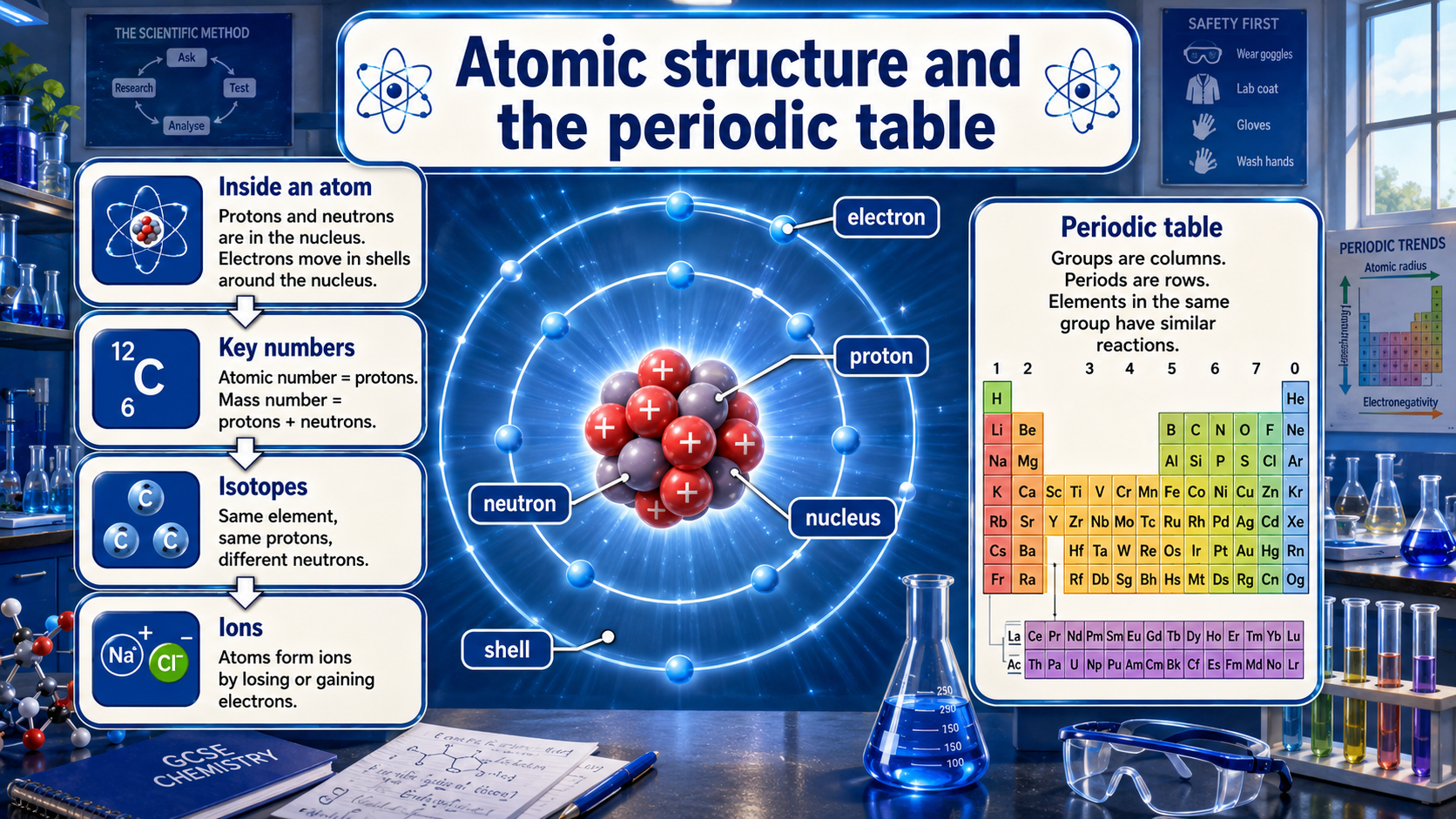
Atomic Structure practice set
Use the worked examples and practice questions on this page as a complete study task: learn the proton and neutron meanings, summarise the infographic in your own words, then answer the questions using the data, equations and observations given here. Check every answer for relative mass, atomic number, mass number and isotope abundance.
Clear explanation
Atomic structure is the language behind the periodic table, bonding and ions. GCSE questions often give an atomic number and mass number, then ask you to work out particle numbers.
The atomic number identifies the element because every element has its own proton number. If the proton number changes, the element changes.
Isotopes do not have different numbers of protons. They have different numbers of neutrons, which changes the mass number but not the chemical identity.
Worked examples
Core example: sodium-23
Atomic number = 11, so protons = 11.
A neutral atom has the same number of electrons as protons, so electrons = 11.
Neutrons = mass number - atomic number = 23 - 11 = 12.
Extension example: magnesium ion
Magnesium has electron arrangement 2,8,2.
It loses two outer-shell electrons to get a full outer shell.
Losing two negative electrons leaves a 2+ charge.
Quick checks
Choose an answer, then check your thinking.
1. An atom has atomic number 6 and mass number 14. How many neutrons does it have?
2. What is different between isotopes of the same element?
Practice questions
Question 1
Define atomic number.
Reveal answer and marking guidance
Answer: The number of protons in the nucleus of an atom.
Marking: Credit protons; credit nucleus/atom for a complete definition.
Question 2
Chlorine has atomic number 17 and mass number 35. Work out protons, electrons and neutrons.
Reveal answer and marking guidance
Answer: Protons = 17, electrons = 17, neutrons = 35 - 17 = 18.
Marking: Award marks for each correct particle number and working.
Question 3
Explain why carbon-12 and carbon-14 are both carbon atoms.
Reveal answer and marking guidance
Answer: They both have 6 protons, so they are carbon. They have different numbers of neutrons, so they are isotopes.
Marking: Credit same protons and different neutrons.
Question 4
A calcium atom forms Ca2+. Explain what happened.
Reveal answer and marking guidance
Answer: It lost two electrons, so it has two more protons than electrons and a 2+ charge.
Marking: Credit lost two electrons and positive charge.
Question 5
Stretch: Why is relative atomic mass often not a whole number?
Reveal answer and marking guidance
Answer: It is a weighted mean that accounts for the abundance of different isotopes.
Marking: Credit weighted mean and isotope abundance.
Practice ladder
Answers and marking guidance
The exact practice answers are hidden under each question so you can try first. Marks come from using the correct chemistry model, choosing the right equation where needed, keeping units with values, and explaining changes with precise words such as particles, ions, bonds, energy, rate, evidence and uncertainty.
Common mistakes
- Confusing mass number with relative atomic mass.
- Saying isotopes have different numbers of protons.
- Forgetting neutral atoms have equal protons and electrons.
- Writing that ions form by gaining or losing protons.
Extension challenge
Create a six-line revision card for atomic structure: two definitions, one infographic detail or equation line, one equation or data check, one common mistake, and one complete explanation sentence using proton, neutron, electron.
Reveal answer
Example answer: A complete response names the chemistry model, uses accurate units or observations, and explains why the evidence supports the conclusion.
Exam-board guidance
Short board notes only. Learn the core chemistry above first.
AQA GCSE Chemistry
Often links this topic to atomic structure through proton and neutron. Question wording and depth can vary by board.
OCR GCSE Chemistry
Often links this topic to atomic structure through proton and neutron. Question wording and depth can vary by board.
Pearson Edexcel GCSE Chemistry
Often links this topic to atomic structure through proton and neutron. Question wording and depth can vary by board.
Eduqas GCSE Chemistry
Often links this topic to atomic structure through proton and neutron. Question wording and depth can vary by board.
WJEC Wales
Often links this topic to atomic structure through proton and neutron. Question wording and depth can vary by board.
CCEA GCSE Chemistry
Often links this topic to atomic structure through proton and neutron. Question wording and depth can vary by board.
Next lesson
Next, continue with Periodic table patterns.