
Atmosphere
Lesson overview
This lesson introduces the core chemistry idea, the useful equipment and the calculation or data skills used on this page.
What you will learn
Core knowledge
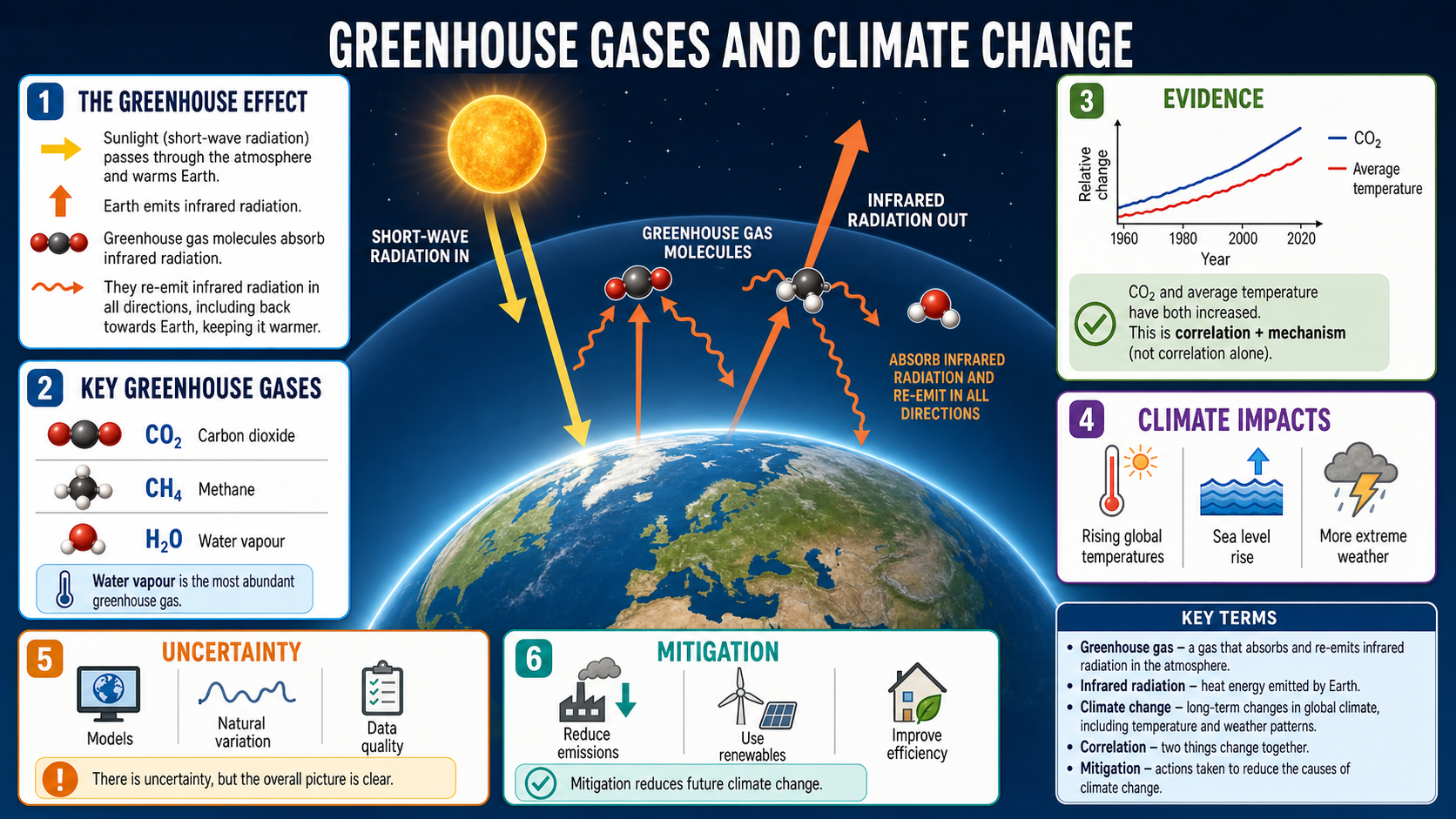
Greenhouse gases and climate change infographic
Climate practice set
Use the worked examples and practice questions on this page as a complete study task: learn the greenhouse gas and climate change meanings, summarise the infographic in your own words, then answer the questions using the data, equations and observations given here. Check every answer for graph interpretation and proportional change.
Clear explanation
The Sun sends mostly short-wave radiation through the atmosphere. The Earth's surface absorbs energy and emits infrared radiation back out.
Greenhouse gas molecules absorb some of this infrared radiation and re-emit it in different directions, so less energy escapes straight to space.
Human activities such as burning fossil fuels, agriculture and land-use change can increase greenhouse gas concentrations. A careful climate answer links the gas, the infrared absorption mechanism and the evidence trend.
Uncertainty does not mean no evidence. It means scientists judge the strength of data, model limits, natural variation and the range of likely outcomes.
Worked examples
Explaining the greenhouse effect
Carbon dioxide and methane absorb infrared radiation emitted by the Earth.
The absorbed energy is re-emitted in different directions.
This reduces the rate at which energy escapes to space.
Using climate evidence carefully
A graph shows carbon dioxide concentration and global mean temperature both increasing over many decades.
Correlation alone is not a full explanation.
Link the trend to the greenhouse-gas mechanism and mention that models include uncertainty.
Quick checks
Choose an answer, then check your thinking.
1. Which radiation is absorbed by greenhouse gases after the Earth's surface warms?
2. Why is correlation not enough by itself in a climate explanation?
Practice questions
Question 1
Name two greenhouse gases.
Reveal answer and marking guidance
Answer: Examples include carbon dioxide, methane and water vapour.
Marking: Credit any two valid greenhouse gases.
Question 2
Explain why increasing carbon dioxide concentration can increase average global temperature.
Reveal answer and marking guidance
Answer: More carbon dioxide absorbs and re-emits more infrared radiation from the Earth, so less energy escapes directly to space and average temperature can rise.
Marking: Credit carbon dioxide, infrared absorption/re-emission and reduced energy loss.
Question 3
A climate graph shows a rising trend with year-to-year variation. Explain why the variation does not automatically disprove the trend.
Reveal answer and marking guidance
Answer: Short-term variation can occur, but the long-term pattern can still show an increase. Scientists compare many years of data and use models to judge uncertainty.
Marking: Credit distinction between short-term variation and long-term trend.
Question 4
Give one way to reduce human greenhouse gas emissions and one limitation of that approach.
Reveal answer and marking guidance
Answer: Using renewable electricity can reduce carbon dioxide from fossil-fuel power generation, but storage, cost or infrastructure can limit how quickly it replaces existing systems.
Marking: Credit a valid reduction strategy plus a realistic limitation.
Practice ladder
Answers and marking guidance
The exact practice answers are hidden under each question so you can try first. Marks come from using the correct chemistry model, choosing the right equation where needed, keeping units with values, and explaining changes with precise words such as particles, ions, bonds, energy, rate, evidence and uncertainty.
Common mistakes
- Saying greenhouse gases reflect all sunlight away from Earth.
- Forgetting that the Earth emits infrared radiation after absorbing energy.
- Using one hot day as proof of long-term climate change.
- Writing that uncertainty means scientists have no evidence.
Extension challenge
Use a climate graph or data table to write a balanced paragraph: describe the trend, explain the infrared absorption mechanism, give one possible impact, and include one sentence about uncertainty.
Reveal answer
Example answer: A complete response names the chemistry model, uses accurate units or observations, and explains why the evidence supports the conclusion.
Exam-board guidance
Short board notes only. Learn the core chemistry above first.
AQA GCSE Chemistry
Often links this topic to atmosphere through greenhouse gas and climate change. Question wording and depth can vary by board.
OCR GCSE Chemistry
Often links this topic to atmosphere through greenhouse gas and climate change. Question wording and depth can vary by board.
Pearson Edexcel GCSE Chemistry
Often links this topic to atmosphere through greenhouse gas and climate change. Question wording and depth can vary by board.
Eduqas GCSE Chemistry
Often links this topic to atmosphere through greenhouse gas and climate change. Question wording and depth can vary by board.
WJEC Wales
Often links this topic to atmosphere through greenhouse gas and climate change. Question wording and depth can vary by board.
CCEA GCSE Chemistry
Often links this topic to atmosphere through greenhouse gas and climate change. Question wording and depth can vary by board.
Next lesson
Next, continue with Pollutants and air quality.