
Rates and equilibrium
Lesson overview
This lesson introduces the core chemistry idea, the useful equipment and the calculation or data skills used on this page.
What you will learn
Core knowledge
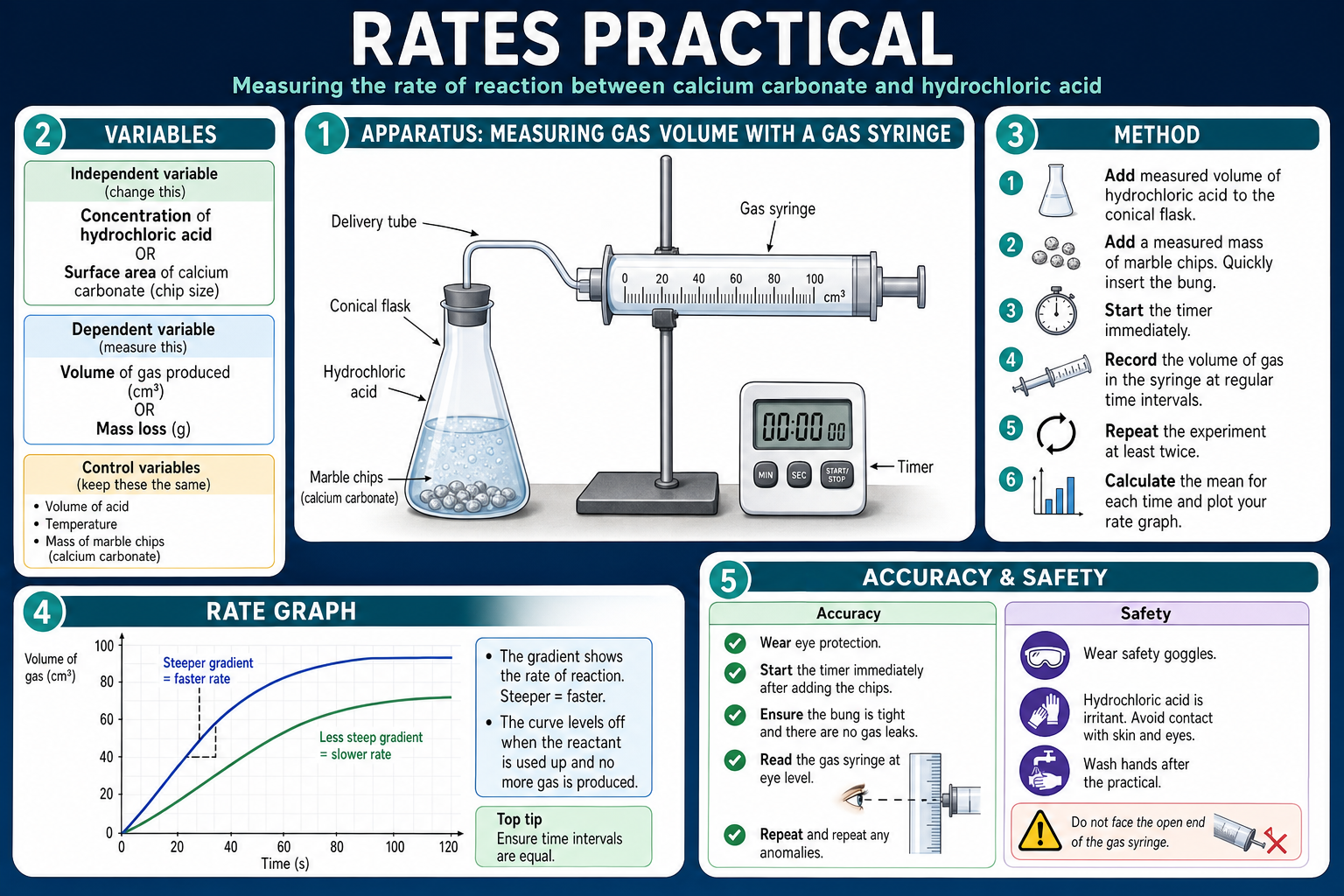
Rates practical and rate graphs infographic
Practical link
Rates Practical practice set
Use the worked examples and practice questions on this page as a complete study task: learn the rate graph and independent variable meanings, summarise the infographic in your own words, then answer the questions using the data, equations and observations given here. Check every answer for graph gradients, repeats and uncertainty.
Clear explanation
Rates graphs and practical graph method is built around rates graphs and practical method. Start by learning what rate graph and independent variable mean, then connect them to the sequence in the infographic.
The key GCSE skill is to move from evidence to explanation: name the observation, data trend, particle model, structure or reaction, then explain why it supports the conclusion.
For calculation or data work, show graph gradients, repeats and uncertainty. For written explanations, include the specific chemistry reason rather than a memorised topic sentence.
Worked examples
Core example: variables
Investigation: concentration and rate with marble chips.
Independent variable: acid concentration.
Dependent variable: gas volume in 60 s.
Controls: acid volume, chip mass, chip size and temperature.
Extension example: tangent rate
Draw a tangent at the time requested.
Choose two clear points on the tangent.
Calculate gradient = change in y / change in x.
Add units such as cm3/s.
Quick checks
Choose an answer, then check your thinking.
1. What is the independent variable in a concentration rates practical?
2. Why repeat a rates practical?
Practice questions
Question 1
Name one method for following a gas-producing reaction.
Reveal answer and marking guidance
Answer: Use a gas syringe for gas volume over time, or a balance for mass loss over time.
Marking: Credit valid gas collection or mass-loss method.
Question 2
Give two control variables for magnesium and hydrochloric acid.
Reveal answer and marking guidance
Answer: Examples: acid volume, acid concentration, magnesium length/mass, temperature.
Marking: Credit any two valid controls.
Question 3
Why is the disappearing cross endpoint less precise?
Reveal answer and marking guidance
Answer: It depends on human judgement of when the cross disappears.
Marking: Credit subjective judgement.
Question 4
Stretch: How do you calculate initial rate from a curve?
Reveal answer and marking guidance
Answer: Draw a tangent at time zero and calculate its gradient.
Marking: Credit tangent at start and gradient.
Practice ladder
Answers and marking guidance
The exact practice answers are hidden under each question so you can try first. Marks come from using the correct chemistry model, choosing the right equation where needed, keeping units with values, and explaining changes with precise words such as particles, ions, bonds, energy, rate, evidence and uncertainty.
Common mistakes
- Changing more than one variable.
- Comparing final volumes instead of gradients.
- Forgetting rate units.
- Using anomalous repeats in a mean without comment.
Extension challenge
Create a six-line revision card for rates graphs and practical graph method: two definitions, one infographic detail or equation line, one equation or data check, one common mistake, and one complete explanation sentence using rate graph, independent variable, dependent variable.
Reveal answer
Example answer: A complete response names the chemistry model, uses accurate units or observations, and explains why the evidence supports the conclusion.
Exam-board guidance
Short board notes only. Learn the core chemistry above first.
AQA GCSE Chemistry
Often links this topic to rates and equilibrium through rate graph and independent variable. Question wording and depth can vary by board.
OCR GCSE Chemistry
Often links this topic to rates and equilibrium through rate graph and independent variable. Question wording and depth can vary by board.
Pearson Edexcel GCSE Chemistry
Often links this topic to rates and equilibrium through rate graph and independent variable. Question wording and depth can vary by board.
Eduqas GCSE Chemistry
Often links this topic to rates and equilibrium through rate graph and independent variable. Question wording and depth can vary by board.
WJEC Wales
Often links this topic to rates and equilibrium through rate graph and independent variable. Question wording and depth can vary by board.
CCEA GCSE Chemistry
Often links this topic to rates and equilibrium through rate graph and independent variable. Question wording and depth can vary by board.
Next lesson
Next, continue with Reversible reactions and equilibrium.