
Quantitative chemistry
Lesson overview
This lesson introduces the core chemistry idea, the useful equipment and the calculation or data skills used on this page.
What you will learn
Core knowledge
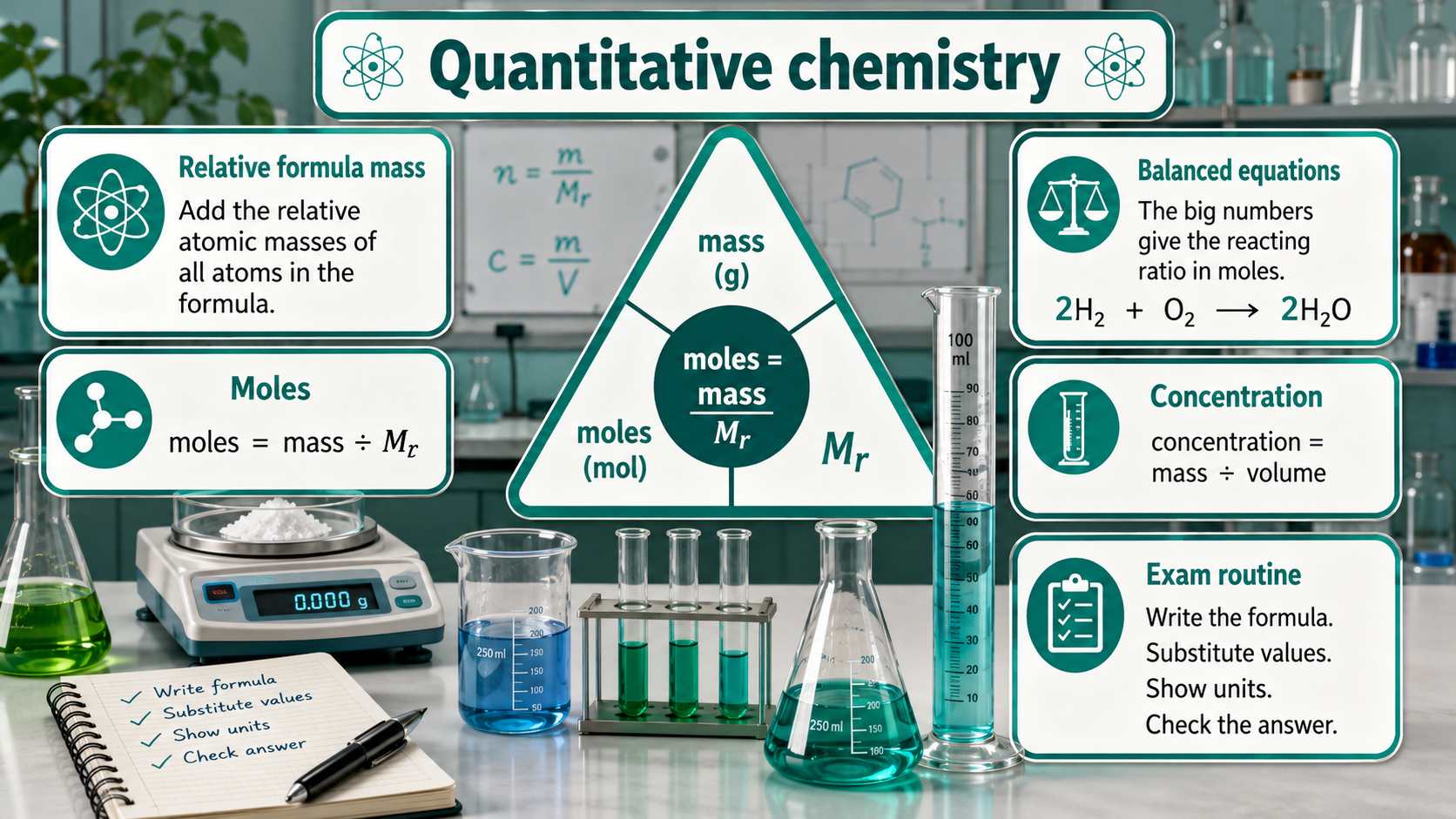
Quantitative chemistry infographic
Moles Basics practice set
Use the worked examples and practice questions on this page as a complete study task: learn the relative formula mass and mole meanings, summarise the infographic in your own words, then answer the questions using the data, equations and observations given here. Check every answer for Ar, Mr, moles and Avogadro-style proportional reasoning.
Clear explanation
Moles are a counting unit for chemicals. Because atoms and molecules are too small to count directly, GCSE calculations use mass and Mr to find amount in mol.
The most common error is using the wrong Mr because the formula has been read too quickly. Count atoms before substituting into the equation.
Good calculation answers show equation, substitution, answer and unit.
Worked examples
Core example: CO2
Ar: C = 12, O = 16.
Mr of CO2 = 12 + 16 + 16 = 44.
moles = mass / Mr = 4.4 / 44 = 0.10 mol.
Extension example: calcium carbonate
Mr of CaCO3 = 40 + 12 + (3 x 16) = 100.
mass = moles x Mr.
mass = 0.25 x 100 = 25 g.
Quick checks
Choose an answer, then check your thinking.
1. What is the Mr of H2O? Ar: H = 1, O = 16.
2. Which equation calculates moles from mass?
Practice questions
Question 1
Calculate the Mr of MgO. Ar: Mg = 24, O = 16.
Reveal answer and marking guidance
Answer: Mr = 24 + 16 = 40.
Marking: Credit correct addition.
Question 2
Calculate the amount in mol in 10 g of CaCO3. Mr = 100.
Reveal answer and marking guidance
Answer: moles = 10 / 100 = 0.10 mol.
Marking: Credit equation, substitution and unit.
Question 3
Calculate the mass of 0.50 mol of NaCl. Mr = 58.5.
Reveal answer and marking guidance
Answer: mass = 0.50 x 58.5 = 29.25 g.
Marking: Credit correct rearrangement and grams.
Question 4
Stretch: Why does 1 mol of CO2 have a greater mass than 1 mol of H2O?
Reveal answer and marking guidance
Answer: They contain the same number of molecules, but CO2 has a greater Mr.
Marking: Credit same amount of particles and higher Mr.
Practice ladder
Answers and marking guidance
The exact practice answers are hidden under each question so you can try first. Marks come from using the correct chemistry model, choosing the right equation where needed, keeping units with values, and explaining changes with precise words such as particles, ions, bonds, energy, rate, evidence and uncertainty.
Common mistakes
- Forgetting atoms after brackets.
- Writing moles without the unit mol.
- Using atomic number instead of relative atomic mass.
- Rounding too early.
Extension challenge
Create a six-line revision card for relative formula mass and moles: two definitions, one infographic detail or equation line, one equation or data check, one common mistake, and one complete explanation sentence using relative formula mass, mole, Avogadro.
Reveal answer
Example answer: A complete response names the chemistry model, uses accurate units or observations, and explains why the evidence supports the conclusion.
Exam-board guidance
Short board notes only. Learn the core chemistry above first.
AQA GCSE Chemistry
Often links this topic to quantitative chemistry through relative formula mass and mole. Question wording and depth can vary by board.
OCR GCSE Chemistry
Often links this topic to quantitative chemistry through relative formula mass and mole. Question wording and depth can vary by board.
Pearson Edexcel GCSE Chemistry
Often links this topic to quantitative chemistry through relative formula mass and mole. Question wording and depth can vary by board.
Eduqas GCSE Chemistry
Often links this topic to quantitative chemistry through relative formula mass and mole. Question wording and depth can vary by board.
WJEC Wales
Often links this topic to quantitative chemistry through relative formula mass and mole. Question wording and depth can vary by board.
CCEA GCSE Chemistry
Often links this topic to quantitative chemistry through relative formula mass and mole. Question wording and depth can vary by board.
Next lesson
Next, continue with Balanced equations and reacting masses.