
Lesson overview
Revise systems, networks, cybersecurity, databases and impacts with precise terms and scenario links.
Focus: Systems exam revision.
What you will learn
- Define the key GCSE Computer Science terms used in systems exam revision.
- Explain how systems vocabulary works in a practical scenario.
- Compare scenario application with an alternative or related method.
- Apply systems exam revision accurately in exam-style questions.
Before you start
- Computer systems.
- Networks and security.
- Databases and impacts.
Systems Revision scenarios
Use the mixed hardware, network, security, database and impact prompts below to practise concise theory answers.
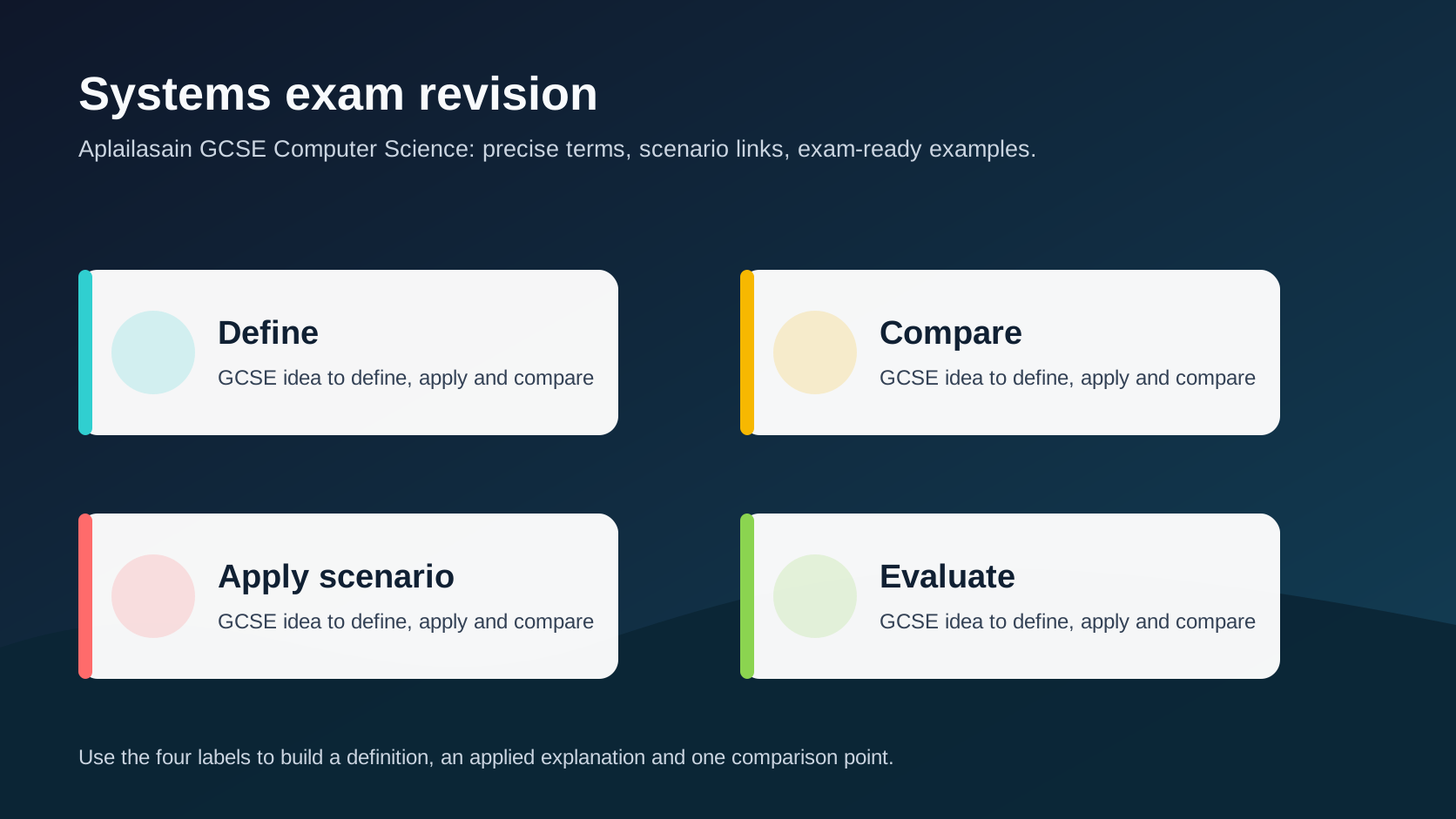
Systems exam revision infographic
Explanation
Theory questions often test whether you can define a term and apply it to a specific context. Generic answers lose marks when the scenario matters.
Comparison questions need at least two clear points, such as speed, cost, reliability, security, capacity or user impact.
Evaluation questions should give benefits, drawbacks and a justified conclusion where the command word asks for one.
Worked examples
Applying systems revision
A question asks whether a school should use cloud backup.
The pupil considers access, cost, internet dependence, security and recovery.
They make a recommendation linked to school needs.
Answer: A balanced answer applies benefits and risks to the school context before giving a justified conclusion.
Quick checks
1. What makes a theory answer scenario-linked?
- a. It applies the term to the details in the question
- b. It copies every keyword randomly
- c. It avoids all technical vocabulary
Reveal answer
Answer: a. Correct. Scenario detail turns a definition into an applied answer.
Not quite. Focus on systems vocabulary in the scenario.
2. Which idea is most closely linked to systems exam revision?
- a. A monitor brightness setting
- b. Balanced evaluation
- c. A random file extension
Reveal answer
Answer: b. Correct. Balanced evaluation is part of this topic.
Not quite. Choose the option that belongs to the Computer Science concept.
Practice
1. Give one way to improve a comparison answer.
Reveal answer
Answer: Use the same comparison factor for both options.
Marking: Credit paired comparison.
2. What should an evaluate answer include?
Reveal answer
Answer: Benefits, drawbacks and a justified judgement if required.
Marking: Credit balance and judgement.
3. Why define key terms first?
Reveal answer
Answer: It shows accurate knowledge before applying it.
Marking: Credit precise vocabulary.
4. Name one common theory comparison factor.
Reveal answer
Answer: Cost, speed, capacity, reliability, security, environmental impact or usability.
Marking: Credit valid factor.
Exam practice ladder
- Fluency: recall the key term and use it accurately.
- Application: apply the idea to the scenario rather than giving a generic definition.
- Algorithmic reasoning: show the steps, condition or variable change clearly.
- Evaluation: explain why one method, structure or control is suitable.
Answers and marking guidance
Exact answers and marking guidance are hidden under each question. For this lesson, earn marks by naming the correct Computer Science idea, applying it to the scenario and showing the logic or value change clearly.
Common mistakes
- Writing memorised paragraphs with no scenario link.
- Only giving advantages when asked to evaluate.
- Mixing up similar terms such as RAM and storage.
- Using vague words like better without a reason.
Extension
Build a final revision grid with one definition, one comparison and one scenario example for each major strand.
Course complete
This is the final lesson in the GCSE Computer Science sequence.
Exam-board guidance
Aplailasain is an independent learning resource and is not endorsed by any exam board.
AQA GCSE Computer Science
AQA GCSE Computer Science: this skill supports problem solving, clear algorithms and accurate programming explanations.
OCR GCSE Computer Science
OCR GCSE Computer Science: expect precise algorithm reasoning, trace work and careful use of programming vocabulary.
Pearson Edexcel GCSE Computer Science
Pearson Edexcel GCSE Computer Science: practise explaining the method as well as giving the final answer or code.
Eduqas GCSE Computer Science
Eduqas GCSE Computer Science: secure the transferable idea first, then check how your class applies it in tasks.
WJEC Wales
WJEC Wales: use accurate terminology and show enough working for the examiner to follow your logic.
CCEA
CCEA: connect the idea to your class route and use the same algorithm, programming or systems vocabulary your teacher uses.