
Lesson overview
This lesson tracks how the order, focus and ending of a text guide the reader.
Track how a text is organised from beginning to end. It supports GCSE English Language, GCSE English Literature or both, depending on your course.
What you will learn
Key habits before you start
Reading evidence route
- Explicit meaning: Start with what the text directly says before building an interpretation.
- Inference: Make a sensible conclusion that is supported by the words on the page.
- Evidence: Use short references that can be explained precisely.
- Explanation: Link the evidence back to the question, effect or writer's purpose.
Why this matters
Structure questions ask how the whole extract is shaped, not just which words are used.
Prior knowledge
You should already be comfortable with:
Practice source supplied on this page
Use the station source to practise structural movement: track the opening focus, the narrowed attention on Maya, and the final ticket-office click.
Original fiction source for practice
The station clock had stopped at 6:17, though the morning had moved on without it. Maya stood beneath the cracked glass roof and watched rain gather in bright beads along the iron beams. Every few minutes a train passed through without stopping, dragging warm air and newspaper scraps across the platform. She kept one hand around the envelope in her pocket. It was not heavy, but it seemed to pull her shoulder down. At the far end, the old ticket office opened with a click.
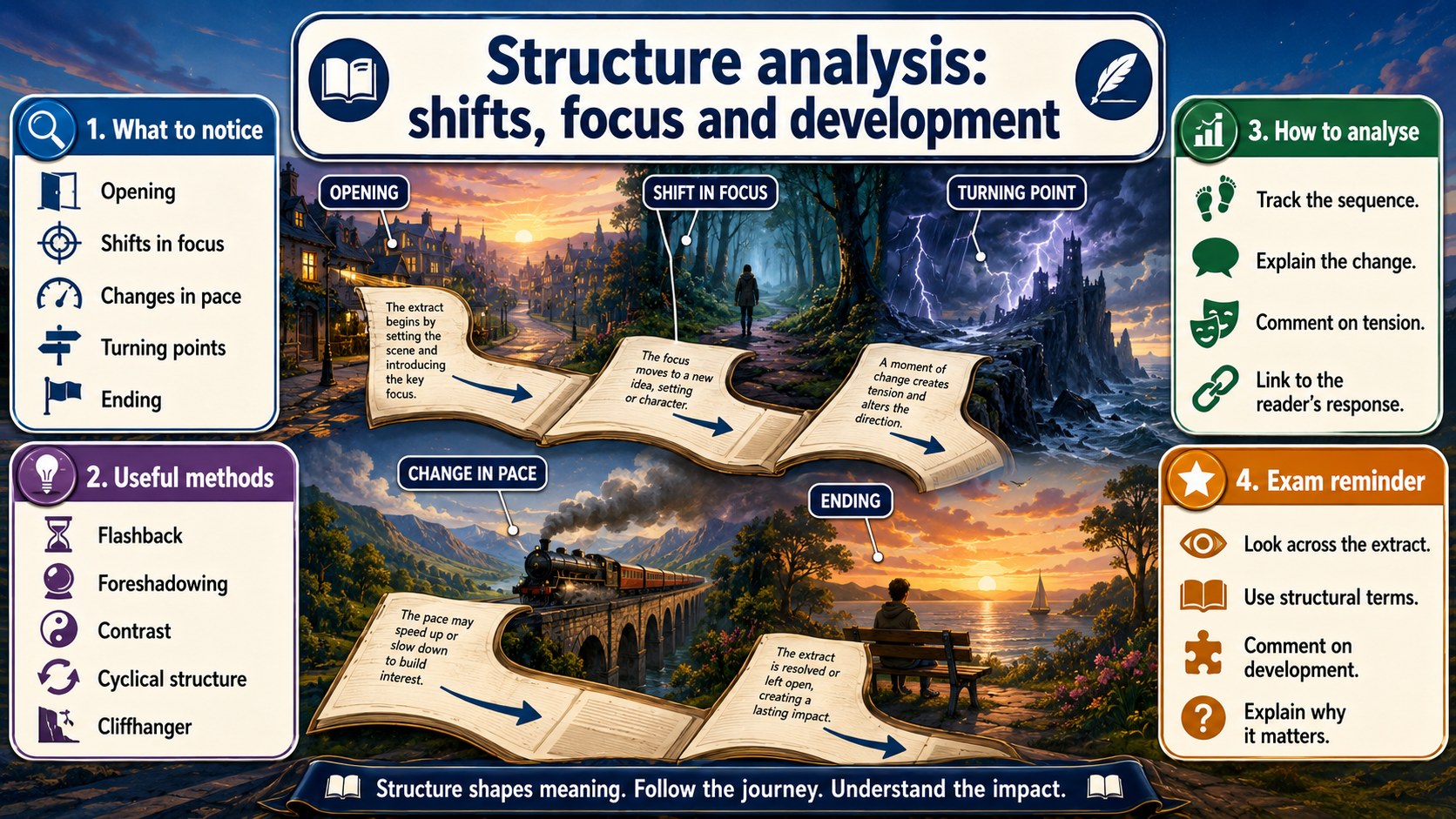
Structure analysis infographic
Before viewing
Before viewing, write the lesson title as a question: what should analysing structure help you do in an exam answer?
After viewing
After viewing, choose one label or route from the visual and use it to improve one sentence in your practice answer.
Clear explanation
Main idea
Look at where the text begins, what it focuses on next, and how it ends. Those choices guide the reader’s attention.
How to do it
Structural methods include shifts in focus, zooming in, contrast, repetition, dialogue, pace and cliff-hangers.
Answer habit
A good answer explains the journey of the reader through the extract.
Worked examples
Opening focus
The text begins with a wide description of the storm before moving to one frightened child.
Ending
The extract ends with an unanswered knock at the door.
Quick checks
Choose an answer, then check your thinking.
1. The source moves from a wide station view to one object in the narrator’s hand. What structural effect does that create?
2. Which structural comment is strongest?
Practice questions
Question 1
Describe the structural journey of the station source.
Reveal answer and marking guidance
Answer: It moves from the wider station, to Maya and the envelope, then to the final click of the ticket office.
Marking: Credit beginning-middle-ending awareness.
Question 2
Why does the final click matter structurally?
Reveal answer and marking guidance
Answer: It changes waiting into possible action and leaves the reader wanting to know what happens next.
Marking: Reward effect of ending.
Question 3
What is the difference between language and structure here?
Reveal answer and marking guidance
Answer: Language is the wording of details; structure is the order and focus of those details.
Marking: Credit clear distinction.
Question 4
Write a structural topic sentence for the extract.
Reveal answer and marking guidance
Answer: The writer gradually narrows the focus so the ordinary station becomes centred on Maya’s private problem.
Marking: Reward movement and reader effect.
Answers and marking guidance
The exact practice answers are hidden under each question so you can try first. For structure answers, look for comments on order, focus, shift, pace and ending: the wide station opening, Maya’s narrowed attention and the final ticket-office click should be explained as deliberate reader guidance, not retold as plot.
Common mistakes
- Retelling the source in order: explain why the order matters.
- Missing shifts: track movement from wide setting to narrow focus to ending.
- Calling everything suspense: name the exact structural choice creating it.
- Ignoring the ending: final details often reshape the reader’s understanding.
Extension challenge
Map the station source in three stages: opening focus, middle narrowing and final click. Add one effect for each stage.
Reveal answer
Example answer: A strong map shows how the writer guides attention from the wider station, to Maya and the envelope, then to the ticket-office click as a hook.
Exam-board guidance
Structure questions may ask about whole-text organisation, beginnings, endings or shifts. Use this lesson to practise tracking focus and sequence before selecting evidence.
AQA GCSE English
Check the mark value and assessment focus, then keep evidence and analysis tied to the exact question.
OCR GCSE English
Use precise references and organise the response around the command word rather than a memorised answer.
Pearson Edexcel GCSE English
Match the lesson skill to the relevant paper question, source, set text or writing form.
Eduqas GCSE English
Adapt the technique to the component your school is preparing for, especially timing and question wording.
WJEC Wales
Check whether your course uses current Wales-specific routes, then apply the same evidence and accuracy habits.
CCEA GCSE English
Use the unit focus to balance evidence, explanation, comparison, context and written accuracy.
Next lesson
Next, continue with Comparing Non-Fiction Texts.