
Lesson overview
Use this lesson when this text or poetry cluster is on your course.
Revise Animal Farm through power, propaganda, corruption, inequality and allegory. Set texts and anthology clusters vary by routes and school, so check your class list before revising this page in depth.
What you will learn
Key habits before you start
Literature argument route
- Thesis: Open with a clear argument about the writer's idea or message.
- Evidence range: Use short evidence from key moments across the text.
- Method: Explain how language, structure, characterisation or contrast shapes meaning.
- Whole text: Link moments together so the answer shows development, not isolated notes.
Why this matters
Animal Farm is short but dense. Pupils need to connect simple storytelling with political meaning and writer’s methods.
Prior knowledge
You should already be comfortable with:
Animal Farm revision material
Use named moments from your school edition to practise power, control and allegory without reproducing protected text. Build references around how the animals are persuaded, how rules are rewritten and how equality is corrupted.
Copyright-safe Animal Farm prompt bank
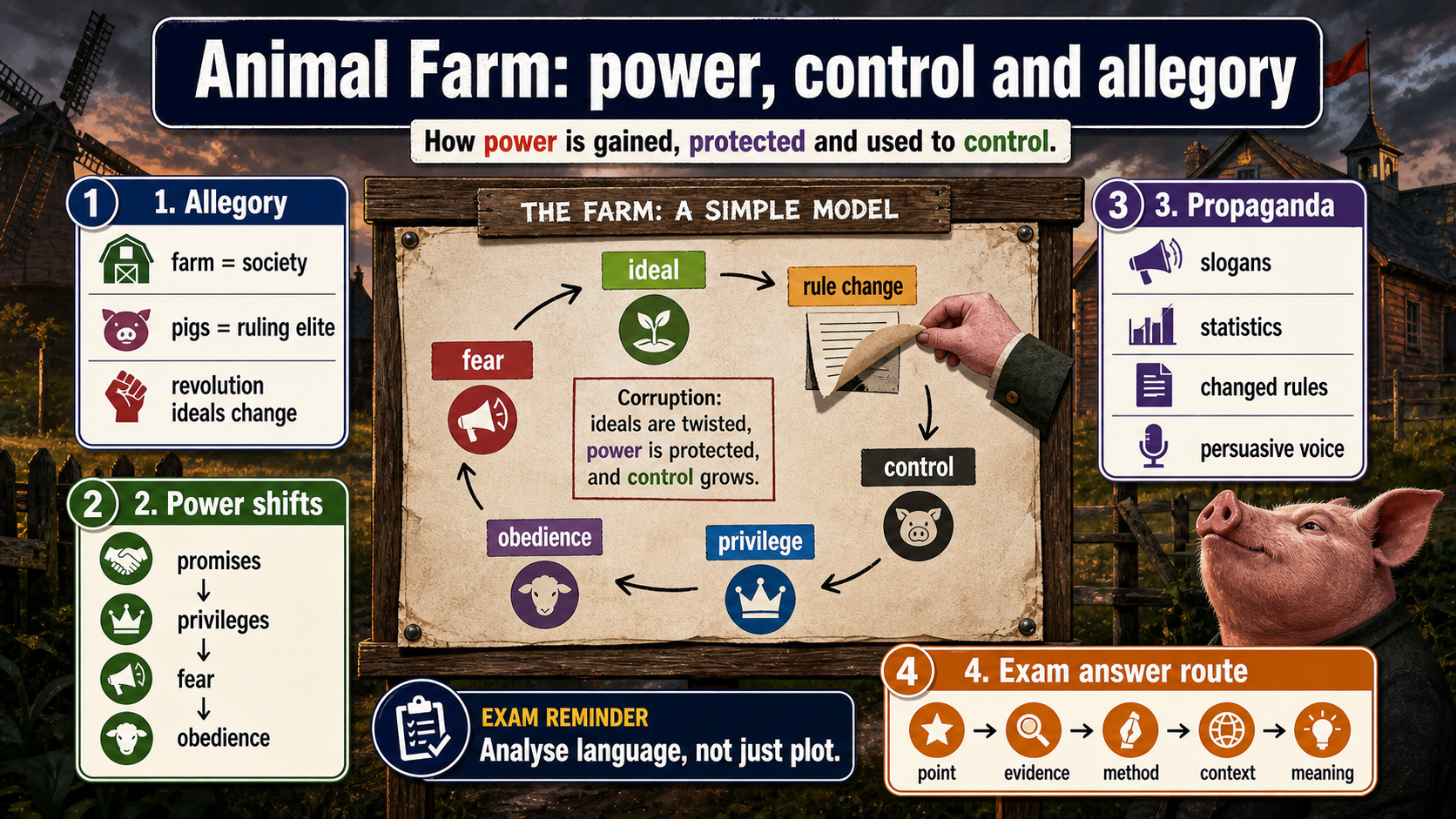
Animal Farm power and allegory infographic
Before viewing
Before viewing, choose one theme, character or turning point that the visual should help you connect to evidence.
After viewing
After viewing, write one thesis sentence and one evidence sentence using the route shown in the visual.
Clear explanation
Main idea
An allegory tells one story while pointing to another meaning. The farm story explores revolution, leadership and corruption.
Essay route
Power shifts through language, fear, education, violence and control of history.
Context and method
Historical context can help, but the essay still needs close attention to Orwell’s choices and the fable-like structure.
Worked examples
Theme route
A revolution promising equality gradually produces a new hierarchy.
Method route
Slogans simplify complex ideas.
Quick checks
Choose an answer, then check your thinking.
1. What does the changing commandment about "equal" reveal?
2. Which character route best tracks propaganda?
Practice questions
Question 1
Why do the commandments matter?
Reveal answer and marking guidance
Answer: Their alteration shows leaders changing truth to protect power.
Marking: Credit language and control.
Question 2
What is Squealer’s function?
Reveal answer and marking guidance
Answer: He turns lies into explanations and makes exploitation sound reasonable.
Marking: Reward propaganda focus.
Question 3
Write a thesis about Boxer.
Reveal answer and marking guidance
Answer: Orwell presents Boxer’s loyalty as admirable but tragic because power exploits his trust.
Marking: Credit character and message.
Question 4
How does allegory affect the answer?
Reveal answer and marking guidance
Answer: The farm story should be linked to wider political corruption without forgetting the animals and events.
Marking: Reward balanced allegorical reading.
Answers and marking guidance
The exact practice answers are hidden under each question so you can try first. For Animal Farm revision, reward secure references to power, propaganda, changing rules, Boxer, the pigs and allegory. Modern editions should supply exact quotations; this page should assess the argument, theme route and political meaning without reproducing protected text.
Common mistakes
- Treating the story as only farm events: connect characters to political allegory.
- Ignoring propaganda: Squealer’s language is central to control.
- Over-quoting protected editions: use short school-edition evidence.
- Missing corruption over time: track how equality is gradually rewritten.
Extension challenge
Plan three Animal Farm paragraphs: Napoleon’s control, Squealer’s propaganda and Boxer’s exploitation.
Reveal answer
Example answer: A strong plan turns plot moments into an argument about corrupted power and allegory, using exact references from the school edition.
Exam-board guidance
Animal Farm appears only on some routes. If it is your set text, match every point to the exact question and use your school edition for quotations.
AQA GCSE English
Check the mark value and assessment focus, then keep evidence and analysis tied to the exact question.
OCR GCSE English
Use precise references and organise the response around the command word rather than a memorised answer.
Pearson Edexcel GCSE English
Match the lesson skill to the relevant paper question, source, set text or writing form.
Eduqas GCSE English
Adapt the technique to the component your school is preparing for, especially timing and question wording.
WJEC Wales
Check whether your course uses current Wales-specific routes, then apply the same evidence and accuracy habits.
CCEA GCSE English
Use the unit focus to balance evidence, explanation, comparison, context and written accuracy.
Next lesson
Next, continue with Conflict Poetry: Power, Memory and Voice.