
Lesson overview
This lesson turns GCSE English into three concrete habits: read the question, choose evidence, explain the choice.
Start GCSE English by learning how reading marks, writing marks and literature marks are usually earned. It supports GCSE English Language, GCSE English Literature or both, depending on your course.
What you will learn
Key habits before you start
Reading evidence route
- Explicit meaning: Start with what the text directly says before building an interpretation.
- Inference: Make a sensible conclusion that is supported by the words on the page.
- Evidence: Use short references that can be explained precisely.
- Explanation: Link the evidence back to the question, effect or writer's purpose.
Why this matters
Many pupils think English is vague. It becomes more manageable when you know that marks come from evidence, explanation, writer choices, structure and accurate written control.
Prior knowledge
You should already be comfortable with:
Practice question material
Use these starter questions to practise the core GCSE English routine: read the task, choose evidence, explain the choice and check the answer still fits.
Exam-style question bank
Use these prompts with the studied text or edition set by your school. For copyrighted modern texts, this page teaches method without reproducing long extracts.
Evidence, choices and control infographic
Before viewing
Before viewing, write the lesson title as a question: what should gcse english is about evidence, choices and control help you do in an exam answer?
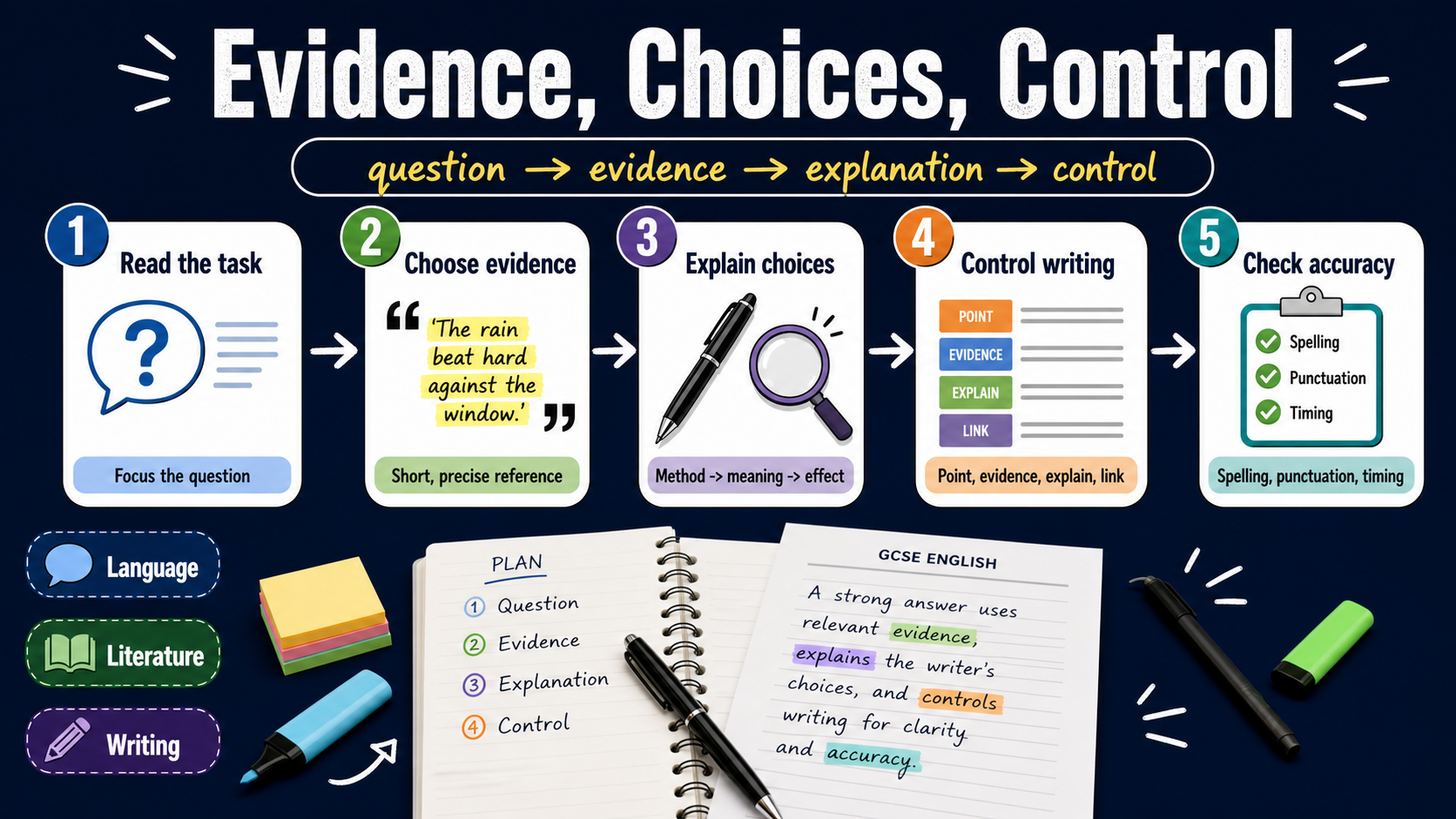
After viewing
After viewing, choose one label or route from the visual and use it to improve one sentence in your practice answer.
Clear explanation
Main idea
English Language focuses on unseen reading and your own writing. English Literature focuses on studied texts, poems and interpretations.
How to do it
Most analytical answers need a point, a short reference, a comment on method or meaning, and a link back to the question.
Answer habit
For writing tasks, plan the purpose, audience and tone before drafting. A controlled, accurate answer usually beats a rushed answer with lots of ideas.
Worked examples
Reading habit
Question: How does the writer make the setting seem dangerous?
Writing habit
Task: Write a speech to persuade pupils to volunteer.
Quick checks
Choose an answer, then check your thinking.
1. A pupil reads a GCSE English question and reaches for a prepared paragraph. What is the stronger first move?
2. Which answer opening is most likely to stay focused?
Practice questions
Question 1
Decode this task: “How does the writer make the setting seem threatening?” What two words should control your answer?
Reveal answer and marking guidance
Answer: “How” and “threatening”. The answer needs writer choices that create threat.
Marking: Credit command-word awareness and a focus on the named effect.
Question 2
Write a focused first sentence for that task using the station source.
Reveal answer and marking guidance
Answer: The writer makes the station feel threatening by presenting time as broken and the space as empty.
Marking: Reward a clear claim linked to the source, not a list of techniques.
Question 3
Choose one short detail from the source and say why it matters.
Reveal answer and marking guidance
Answer: The stopped clock suggests something is wrong before Maya understands the problem.
Marking: Credit concise evidence with a plausible interpretation.
Question 4
What final check should you make before moving on?
Reveal answer and marking guidance
Answer: Check that the paragraph answers the exact question, uses evidence and explains the writer’s effect.
Marking: Credit a practical check tied to marks.
Answers and marking guidance
The exact practice answers are hidden under each question so you can try first. For starter GCSE English answers, reward the basic habit this page teaches: read the command, make one focused claim, choose relevant evidence, explain it and check the response still answers the question. Prepared paragraphs should be reshaped or rejected.
Common mistakes
- Using a memorised paragraph: reshape every answer to the exact task.
- Choosing evidence before understanding the question: decode the command first.
- Explaining everything: select one relevant point and develop it.
- Skipping checking: reread the answer against the question.
Extension challenge
Take one starter question and write a claim, evidence choice and explanation in three separate lines.
Reveal answer
Example answer: A strong starter answer has a direct claim, a relevant reference and an explanation that clearly answers the command word.
Exam-board guidance
GCSE English routes differ, but the starting habits are stable: read the task, choose evidence, explain choices and control expression.
AQA GCSE English
Check the mark value and assessment focus, then keep evidence and analysis tied to the exact question.
OCR GCSE English
Use precise references and organise the response around the command word rather than a memorised answer.
Pearson Edexcel GCSE English
Match the lesson skill to the relevant paper question, source, set text or writing form.
Eduqas GCSE English
Adapt the technique to the component your school is preparing for, especially timing and question wording.
WJEC Wales
Check whether your course uses current Wales-specific routes, then apply the same evidence and accuracy habits.
CCEA GCSE English
Use the unit focus to balance evidence, explanation, comparison, context and written accuracy.
Next lesson
Next, continue with Reading Unseen Fiction.