
Lesson overview
Use this lesson when this text or poetry cluster is on your course.
Revise Jekyll and Hyde through duality, secrecy, reputation, science and Gothic fear. Set texts and anthology clusters vary by routes and school, so check your class list before revising this page in depth.
What you will learn
Key habits before you start
Literature argument route
- Thesis: Open with a clear argument about the writer's idea or message.
- Evidence range: Use short evidence from key moments across the text.
- Method: Explain how language, structure, characterisation or contrast shapes meaning.
- Whole text: Link moments together so the answer shows development, not isolated notes.
Why this matters
Jekyll and Hyde rewards pupils who understand structure. Stevenson withholds information to turn a moral problem into a mystery.
Prior knowledge
You should already be comfortable with:
Jekyll and Hyde practice material
Use Stevenson's novella to practise duality, reputation and fear. Choose short references that show secrecy, divided identity and the threat beneath respectable London.
prose reference bank
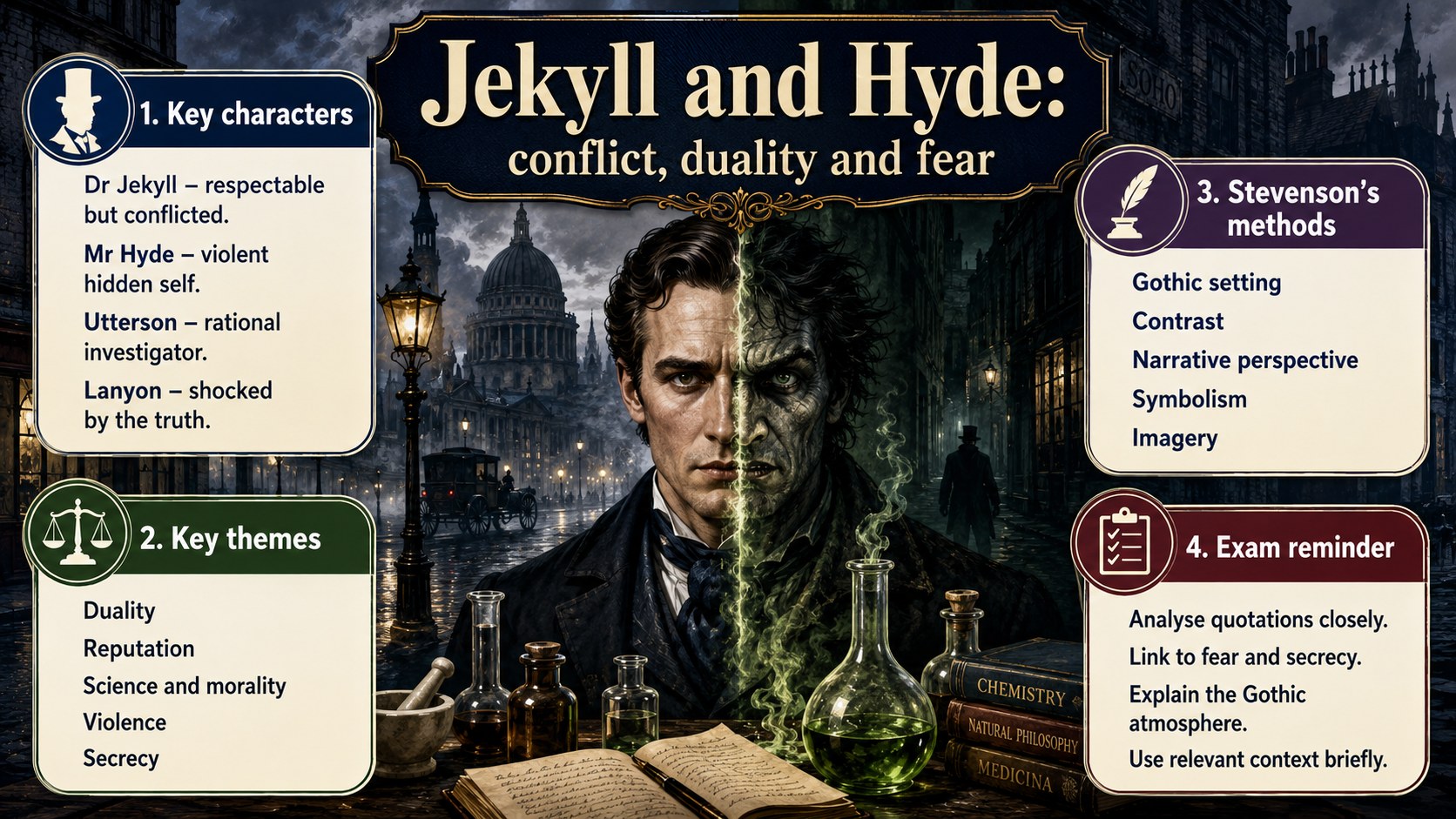
Jekyll and Hyde duality and fear infographic
Before viewing
Before viewing, choose one theme, character or turning point that the visual should help you connect to evidence.
After viewing
After viewing, write one thesis sentence and one evidence sentence using the route shown in the visual.
Clear explanation
Main idea
Duality means divided human nature: respectable public identity versus hidden desire or violence.
Essay route
The novella is structured as a mystery. Readers learn through documents, witnesses and delayed confession.
Context and method
Context about reputation, science, religion and Victorian respectability can deepen analysis when linked to Jekyll’s choices.
Worked examples
Theme route
Jekyll’s experiment exposes a split already present in society and the self.
Structure route
Delayed revelation makes Hyde frightening before he is explained.
Quick checks
Choose an answer, then check your thinking.
1. Why is reputation central to Jekyll’s conflict?
2. Which evidence route best shows duality?
Practice questions
Question 1
Why does reputation matter to Jekyll?
Reveal answer and marking guidance
Answer: He wants public respect while hiding desires that would ruin his name.
Marking: Credit duality.
Question 2
Which details build Gothic fear?
Reveal answer and marking guidance
Answer: Dark streets, locked doors, secrecy, violence and frightening transformations.
Marking: Reward genre method.
Question 3
Write a thesis about duality.
Reveal answer and marking guidance
Answer: Stevenson presents duality as dangerous because repression allows the hidden self to grow stronger.
Marking: Credit argument.
Question 4
How can structure support mystery?
Reveal answer and marking guidance
Answer: The delayed confession means the reader investigates Hyde before fully understanding Jekyll.
Marking: Reward narrative structure.
Answers and marking guidance
The exact practice answers are hidden under each question so you can try first. For Jekyll and Hyde, reward links between duality, reputation, secrecy, setting and narrative delay. short references can be brief, but the answer should explain how Stevenson turns respectable surfaces into fear and divided identity.
Common mistakes
- Writing only about good versus evil: reputation, secrecy and setting complicate duality.
- Ignoring narrative delay: mystery structure controls fear.
- Using context without evidence: Victorian respectability must link to a moment.
- Forgetting Utterson: his viewpoint shapes what readers learn.
Extension challenge
Plan three Jekyll and Hyde points: public reputation, hidden desire and the city’s fearful spaces.
Reveal answer
Example answer: A strong route shows how Stevenson turns respectable surfaces into anxiety through setting, narrative delay and divided identity.
Exam-board guidance
Jekyll and Hyde is widely studied but not universal across routes. Use exact extract practice for your board while keeping duality, reputation and fear connected.
AQA GCSE English
Check the mark value and assessment focus, then keep evidence and analysis tied to the exact question.
OCR GCSE English
Use precise references and organise the response around the command word rather than a memorised answer.
Pearson Edexcel GCSE English
Match the lesson skill to the relevant paper question, source, set text or writing form.
Eduqas GCSE English
Adapt the technique to the component your school is preparing for, especially timing and question wording.
WJEC Wales
Check whether your course uses current Wales-specific routes, then apply the same evidence and accuracy habits.
CCEA GCSE English
Use the unit focus to balance evidence, explanation, comparison, context and written accuracy.
Next lesson
Next, continue with An Inspector Calls: Responsibility, Class and Generational Conflict.