
Lesson overview
Use this lesson when this text or poetry cluster is on your course.
Build comparison routes for love and relationships poems through voice, memory, distance and power. Set texts and anthology clusters vary by routes and school, so check your class list before revising this page in depth.
What you will learn
Key habits before you start
Poetry evidence route
- Meaning first: Begin with what the poem says or suggests before naming techniques.
- Evidence: Use short quotations or precise references that reveal image, voice, tone or structure.
- Method and effect: Explain how a word, image, contrast, rhythm or ending shapes the reader's response.
- Comparison: Compare ideas and effects, not just matching technique labels.
Why this matters
Relationship poetry covers more than romance. Family, memory, distance, grief, dependency and power are often just as important.
Prior knowledge
You should already be comfortable with:
Love and relationships poetry material
Use these real poem extracts before applying the method to your anthology cluster.
Love's Philosophy - Percy Bysshe Shelley
The fountains mingle with the river
And the rivers with the ocean,
The winds of heaven mix for ever
With a sweet emotion;
Nothing in the world is single;
All things by a law divine
In one another's being mingle; -
Why not I with thine?
When We Two Parted - Lord Byron
When we two parted
In silence and tears,
Half broken-hearted
To sever for years,
Pale grew thy cheek and cold,
Colder thy kiss;
Truly that hour foretold
Sorrow to this.
Sonnet 29 - I think of thee! - Elizabeth Barrett Browning
I think of thee! - my thoughts do twine and bud
About thee, as wild vines, about a tree,
Put out broad leaves, and soon there's nought to see
Except the straggling green which hides the wood.
Comparison prompts
Love and relationships poetry comparison routes infographic
Before viewing
Before viewing, predict which details you should track first: meaning, speaker, image, tone, structure or comparison.
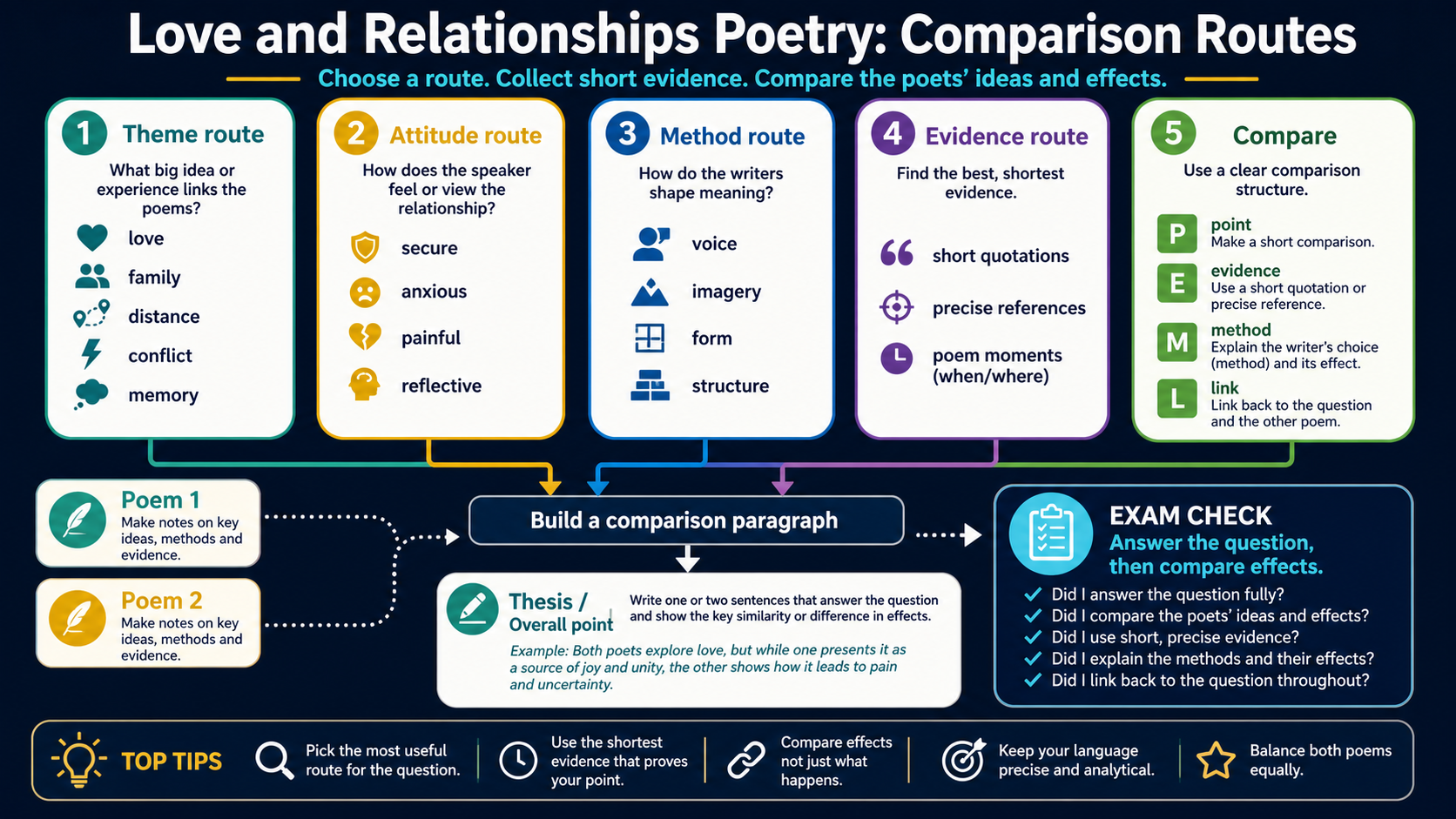
After viewing
After viewing, select one image or structural choice from a poem and write one sentence explaining its effect.
Clear explanation
Main idea
Useful routes include romantic love, family bonds, parent-child relationships, loss, distance, memory, control and changing feelings.
Essay route
Compare attitudes: one poem may idealise a relationship while another questions it or shows its cost.
Context and method
Form and structure matter because relationships often change across the poem through shifts in tone, perspective or time.
Worked examples
Comparison route
Both poems explore distance, but one treats it as painful while another treats it as protective.
Structure route
A shift from past to present can show how memory affects the speaker now.
Quick checks
Choose an answer, then check your thinking.
1. Which comparison route best links Love’s Philosophy and When We Two Parted?
2. A question asks about painful relationships. Which pair gives the strongest starting route?
Practice questions
Question 1
Compare Love’s Philosophy and When We Two Parted.
Reveal answer and marking guidance
Answer: Shelley presents love as natural union; Byron presents love as painful separation and secrecy.
Marking: Credit clear route.
Question 2
How could Sonnet 29 compare with Love’s Philosophy?
Reveal answer and marking guidance
Answer: Both use natural imagery for intense attachment, but Browning’s image suggests thought wrapping around the beloved.
Marking: Reward method and attitude.
Question 3
Write a thesis for painful relationships.
Reveal answer and marking guidance
Answer: Relationship poems can present love as emotionally binding even when closeness is impossible or damaging.
Marking: Credit broad but text-ready argument.
Question 4
What should you do before writing a comparison paragraph?
Reveal answer and marking guidance
Answer: Decide whether the poems agree, contrast or complicate the same idea about love.
Marking: Reward comparison planning.
Answers and marking guidance
The exact practice answers are hidden under each question so you can try first. For love and relationships poetry, reward comparison routes that name attitude and method: Shelley’s confident persuasion, Byron’s grief and secrecy, Rossetti’s reflective voice or Burns’s song-like devotion should be paired for a reason.
Common mistakes
- Saying both poems are about love: define the attitude to love.
- Ignoring voice: persuasion, grief and memory sound different.
- Using one poem as an afterthought: keep comparison balanced.
- Forcing happy/sad only: relationships can involve power, secrecy and distance.
Extension challenge
Build two love-poetry routes: Shelley with Burns for persuasion/devotion, and Byron with Rossetti for separation/memory.
Reveal answer
Example answer: A strong route explains how each speaker presents relationship pressure through voice, image and structure.
Exam-board guidance
Love and relationships clusters differ by board and school. Use classic pairings to practise routes, then transfer the method to the poems your teacher confirms.
AQA GCSE English
Check the mark value and assessment focus, then keep evidence and analysis tied to the exact question.
OCR GCSE English
Use precise references and organise the response around the command word rather than a memorised answer.
Pearson Edexcel GCSE English
Match the lesson skill to the relevant paper question, source, set text or writing form.
Eduqas GCSE English
Adapt the technique to the component your school is preparing for, especially timing and question wording.
WJEC Wales
Check whether your course uses current Wales-specific routes, then apply the same evidence and accuracy habits.
CCEA GCSE English
Use the unit focus to balance evidence, explanation, comparison, context and written accuracy.
Next lesson
Next, move into full exam-paper technique with an unseen fiction paper walkthrough.