
Lesson overview
Use this lesson when this text or poetry cluster is on your course.
Revise Romeo and Juliet through love, family conflict, fate, youth and dramatic structure. Set texts and anthology clusters vary by routes and school, so check your class list before revising this page in depth.
What you will learn
Key habits before you start
Shakespeare response route
- Question focus: Track the named character, theme or idea before choosing evidence.
- Evidence: Use concise quotations and stage moments rather than retelling the plot.
- Dramatic method: Comment on language, stagecraft, contrast, audience response or structure.
- Context: Use context to sharpen interpretation, not as a separate history paragraph.
Why this matters
Romeo and Juliet works well for GCSE revision because the same moments can support questions on love, conflict, fate, family and violence.
Prior knowledge
You should already be comfortable with:
Romeo and Juliet practice material
Use Shakespeare's tragedy to practise love, conflict and fate. Select scene moments that show how private feeling is trapped by public violence.
Shakespeare reference bank
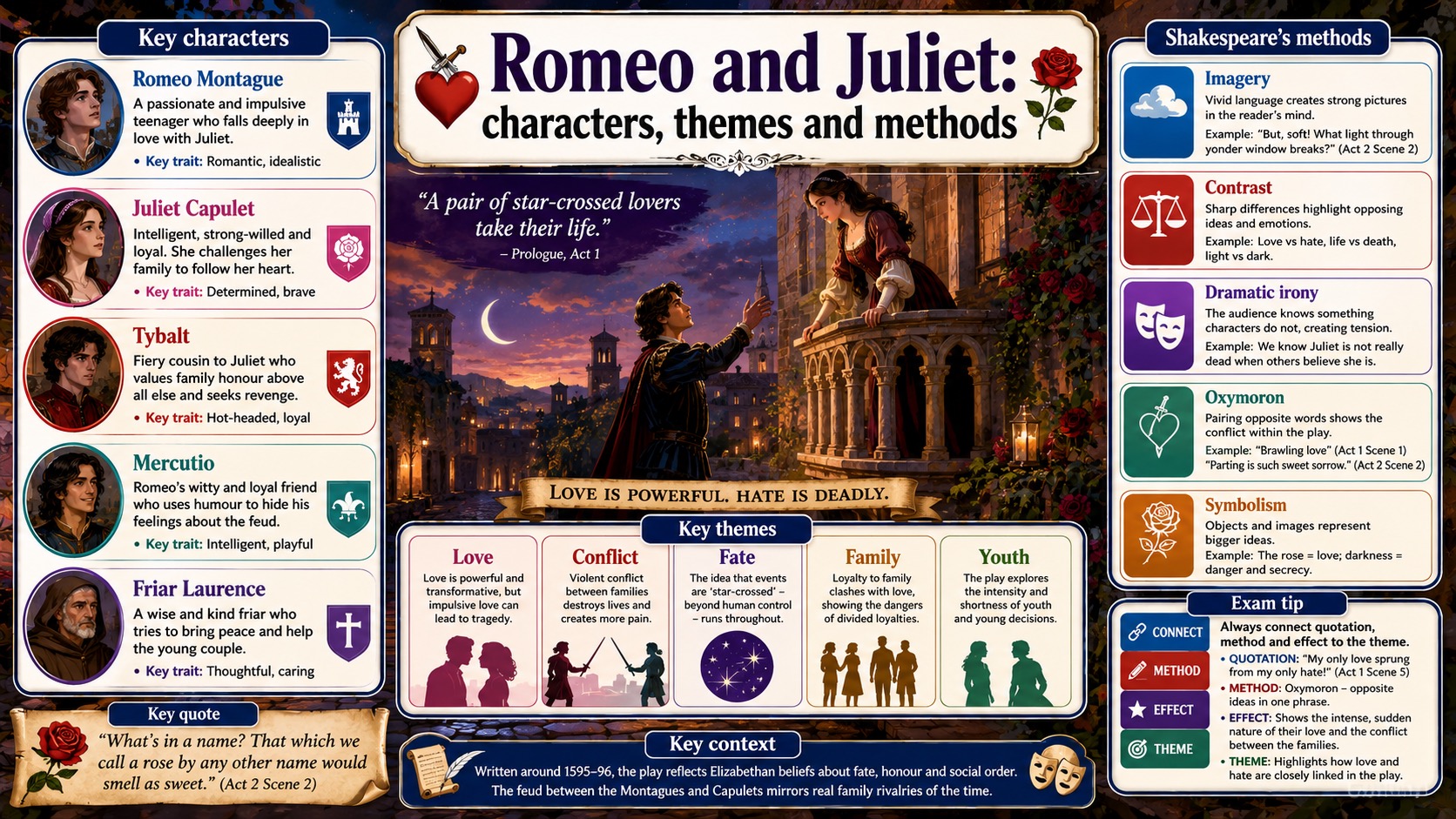
Romeo and Juliet characters, themes and methods infographic
Before viewing
Before viewing, choose one theme, character or turning point that the visual should help you connect to evidence.
After viewing
After viewing, write one thesis sentence and one evidence sentence using the route shown in the visual.
Clear explanation
Main idea
Avoid treating the play as only a love story. Shakespeare presents private love inside a public culture of feud, honour and control.
Essay route
Fate and choice work together: the prologue frames the ending, but characters still make impulsive decisions.
Context and method
Dramatic irony is central because the audience often understands danger before characters do.
Worked examples
Theme route
Love can be presented as sincere, intense, risky and socially disruptive.
Structure route
The prologue shapes audience expectations from the start.
Quick checks
Choose an answer, then check your thinking.
1. What makes Romeo and Juliet more than a simple love story?
2. Which stage moment would support a point about secrecy and danger?
Practice questions
Question 1
Why is the balcony scene not just romantic?
Reveal answer and marking guidance
Answer: It is private love surrounded by danger from the Capulet household and the feud.
Marking: Credit conflict around love.
Question 2
What does fate add to the tragedy?
Reveal answer and marking guidance
Answer: It makes the lovers’ choices feel trapped by forces already moving against them.
Marking: Reward theme awareness.
Question 3
Write a thesis about love in the play.
Reveal answer and marking guidance
Answer: Shakespeare presents love as intense and sincere, but dangerously compressed by conflict and haste.
Marking: Credit balanced argument.
Question 4
Which moments show public conflict shaping private love?
Reveal answer and marking guidance
Answer: The opening brawl, Tybalt’s challenge, Mercutio’s death and the banishment.
Marking: Reward whole-play route.
Answers and marking guidance
The exact practice answers are hidden under each question so you can try first. For Romeo and Juliet, reward arguments that connect love to conflict, secrecy, family pressure and fate. Strong answers treat the play as drama, using scene moments and short references to show how Shakespeare stages danger.
Common mistakes
- Writing a simple romance answer: conflict and danger shape the love story.
- Ignoring public violence: the feud controls private choices.
- Forgetting fate language: chance and inevitability run through the play.
- Missing stage action: duels, secrecy and timing are dramatic methods.
Extension challenge
Plan a Romeo and Juliet essay route through meeting, secrecy, violence and final tragedy.
Reveal answer
Example answer: A strong route links love to conflict and fate, showing how private feeling is trapped by public pressure.
Exam-board guidance
Romeo and Juliet is widely studied but not on every route. Use this lesson when it is your set Shakespeare text and practise exact extract-to-whole links.
AQA GCSE English
Check the mark value and assessment focus, then keep evidence and analysis tied to the exact question.
OCR GCSE English
Use precise references and organise the response around the command word rather than a memorised answer.
Pearson Edexcel GCSE English
Match the lesson skill to the relevant paper question, source, set text or writing form.
Eduqas GCSE English
Adapt the technique to the component your school is preparing for, especially timing and question wording.
WJEC Wales
Check whether your course uses current Wales-specific routes, then apply the same evidence and accuracy habits.
CCEA GCSE English
Use the unit focus to balance evidence, explanation, comparison, context and written accuracy.
Next lesson
Next, continue with A Christmas Carol: Redemption and Social Responsibility.