
Lesson overview
tropical rainforest ecosystems appears across GCSE Geography specifications through physical geography, human geography, geographical skills, fieldwork or issue evaluation.
Use the notes on this page first. They give the terms, processes, evidence types and answer routines needed to practise tropical rainforest ecosystems without leaving the lesson.
What you will learn
- Explain tropical rainforest ecosystems using accurate geographical vocabulary.
- Use place, scale and evidence rather than vague general statements.
- Interpret maps, graphs, photographs or data where the topic needs them.
- Write concise GCSE answers with clear cause, effect and judgement.
Core knowledge
- Main idea: Explain ecosystem interdependence, rainforest characteristics, threats and sustainable management.
- Useful evidence includes nutrient cycle, forest layers, biodiversity maps, deforestation data.
- An ecosystem links living organisms with climate, soil, water and nutrients.
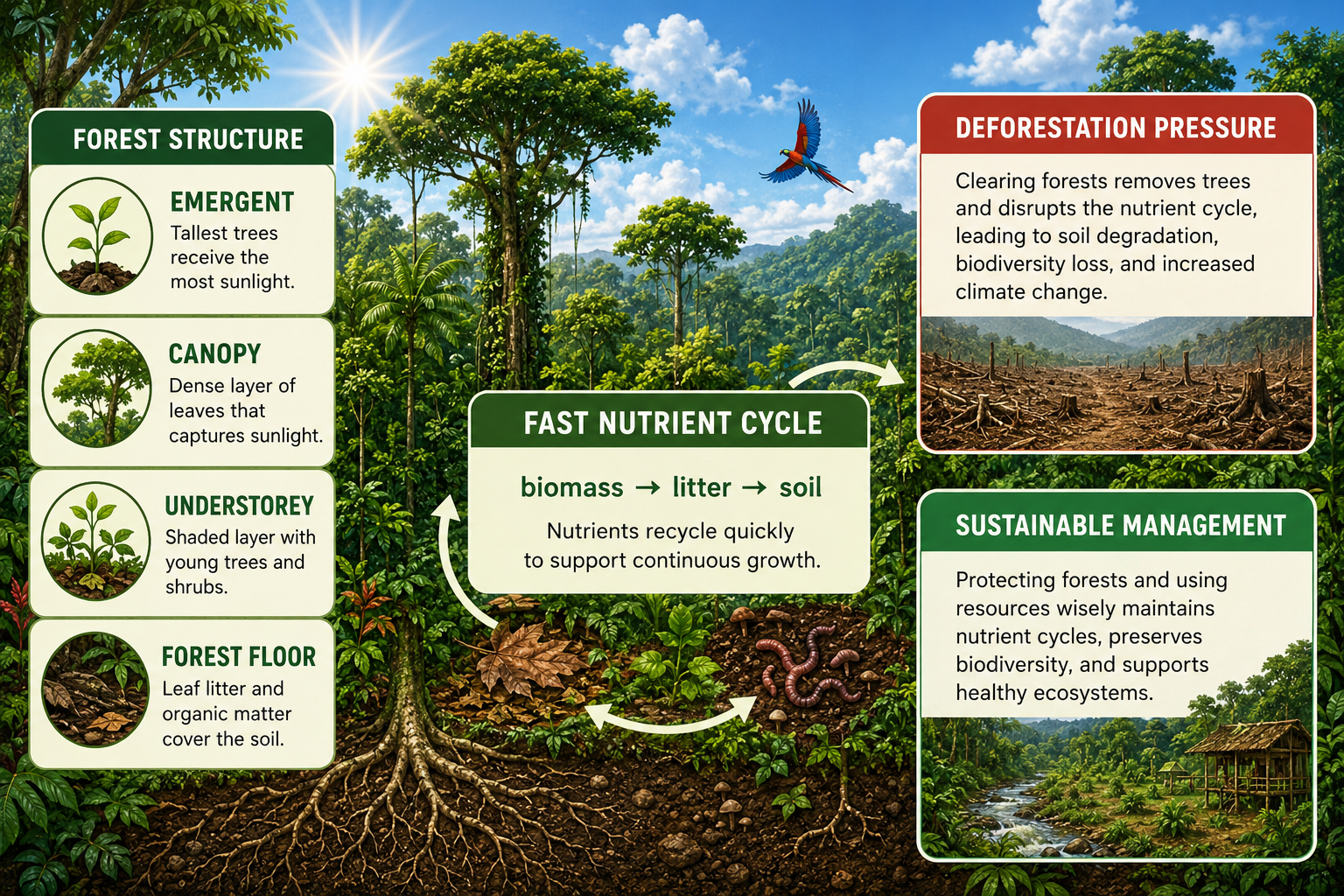
- Tropical rainforests are warm, wet and highly biodiverse, with layered vegetation and rapid nutrient cycling.
- Interdependence means changes to one part of the ecosystem affect others, such as forest clearance changing soils, habitats and water cycles.
- Deforestation is driven by logging, farming, mining, roads, energy projects and settlement.
- Impacts include biodiversity loss, carbon emissions, soil erosion, river pollution and effects on indigenous communities.
- Sustainable management can include selective logging, conservation, ecotourism, protected areas and international agreements.
Tropical Rainforests: study route
Use this as a reading route, not as a diagram to memorise.
- Climate
- Vegetation layers
- Interdependence
- Deforestation
- Sustainable management
Rainforest layers and nutrient cycle
Self-contained notes and practice
Use the notes on this page first. They give the terms, processes, evidence types and answer routines needed to practise tropical rainforest ecosystems without leaving the lesson.
Explanation
A strong geography answer on tropical rainforest ecosystems starts with a precise process or pattern, then adds place, scale and evidence. The answer should explain cause and effect rather than listing disconnected facts.
When using resources, describe what the evidence shows first, then infer carefully. If the question asks for a decision, weigh benefits, costs, risks and sustainability before reaching a judgement.
Worked examples
Explaining ecosystem
Question: Explain how ecosystem helps a geographer understand vegetation layers in tropical rainforest ecosystems.
Method: Start with ecosystem, use nutrient cycle, then explain the link to vegetation layers.
Reveal answer and marking guidance
An ecosystem links living organisms with climate, soil, water and nutrients. A strong answer would use nutrient cycle to show the pattern or process, then explain how this changes vegetation layers in tropical rainforest ecosystems.
Judging sustainable management
Question: A student says that sustainable management is the main issue in Tropical Rainforests. What evidence would make that judgement convincing?
Method: Use interdependence, forest layers and one clear impact or management point before making the judgement.
Reveal answer and marking guidance
A convincing judgement would use interdependence and evidence such as forest layers. It should explain why sustainable management matters for tropical rainforest ecosystems, then weigh it against another part of the lesson such as vegetation layers.
Quick checks
Choose an answer, then check your thinking.
1. For Tropical Rainforests, which evidence would best support an answer about tropical rainforest ecosystems?
2. For Tropical Rainforests, what should a student explain after naming ecosystem?
Practice
Question 1
For Tropical Rainforests, write a two-step process chain linking ecosystem to vegetation layers.
Reveal answer and marking guidance
Answer: A strong chain starts with ecosystem, uses nutrient cycle, and explains how it changes vegetation layers in tropical rainforest ecosystems.
Marking: Credit accurate use of ecosystem, nutrient cycle and a clear cause-effect link.
Question 2
Use forest layers to describe what a geographer should notice about tropical rainforest ecosystems.
Reveal answer and marking guidance
Answer: The answer should describe a visible or measurable pattern in forest layers, then use terms such as interdependence and biodiversity.
Marking: Credit a precise description of forest layers; do not credit a vague description with no evidence.
Question 3
Explain why interdependence changes the answer a student should give about Tropical Rainforests.
Reveal answer and marking guidance
Answer: Interdependence changes the answer because it adds a specific part of the process or issue. Useful evidence includes biodiversity maps, alongside the lesson note: Tropical rainforests are warm, wet and highly biodiverse, with layered vegetation and rapid nutrient cycling.
Marking: Credit explanation that links interdependence to tropical rainforest ecosystems with evidence.
Question 4
Make a justified decision about whether sustainable management is the most important part of tropical rainforest ecosystems.
Reveal answer and marking guidance
Answer: A justified decision should weigh sustainable management against vegetation layers, using evidence such as nutrient cycle and forest layers. One useful lesson detail is: Deforestation is driven by logging, farming, mining, roads, energy projects and settlement.
Marking: Credit a balanced judgement with evidence from Tropical Rainforests, not a one-sentence opinion.
Exam ladder
- Describe the pattern or process using precise vocabulary.
- Add map, graph, data, photograph or case-study evidence.
- Explain cause and effect using place and scale.
- Reach a judgement when the question asks you to assess, evaluate or decide.
Answers and marking guidance
The exact practice answers are hidden under each question so you can try first. Marks come from accurate geography, evidence from maps or data where useful, clear cause-and-effect language, and a judgement that follows from the evidence.
Common mistakes
- Using a place name without explaining the process.
- Describing a graph or map without quoting any evidence.
- Writing a one-sided judgement when the question needs balance.
- Mixing up cause, impact, response and evaluation.
Extension
Create a one-page revision sheet for tropical rainforest ecosystems with five key terms, three evidence types, one process chain and two exam-style judgement sentences.
Exam-board guidance
Short board notes only. Learn the core geography above first.
AQA GCSE Geography
AQA GCSE Geography students should use this lesson for tropical rainforest ecosystems, then match the final case-study detail and question style to the route taught by their school.
OCR GCSE Geography A
OCR GCSE Geography A students should use this lesson for tropical rainforest ecosystems, then match the final case-study detail and question style to the route taught by their school.
OCR GCSE Geography B
OCR GCSE Geography B students should use this lesson for tropical rainforest ecosystems, then match the final case-study detail and question style to the route taught by their school.
Pearson Edexcel GCSE Geography A
Pearson Edexcel GCSE Geography A students should use this lesson for tropical rainforest ecosystems, then match the final case-study detail and question style to the route taught by their school.
Pearson Edexcel GCSE Geography B
Pearson Edexcel GCSE Geography B students should use this lesson for tropical rainforest ecosystems, then match the final case-study detail and question style to the route taught by their school.
Eduqas GCSE Geography A
Eduqas GCSE Geography A students should use this lesson for tropical rainforest ecosystems, then match the final case-study detail and question style to the route taught by their school.
Eduqas GCSE Geography B
Eduqas GCSE Geography B students should use this lesson for tropical rainforest ecosystems, then match the final case-study detail and question style to the route taught by their school.
WJEC Wales GCSE Geography
WJEC Wales GCSE Geography students should use this lesson for tropical rainforest ecosystems, then match the final case-study detail and question style to the route taught by their school.
CCEA GCSE Geography
CCEA GCSE Geography students should use this lesson for tropical rainforest ecosystems, then match the final case-study detail and question style to the route taught by their school.