
Lesson overview
The core idea is that students understand historical interpretations by connecting precise historical knowledge to evidence and judgement.
Learn
Before you start
Core knowledge
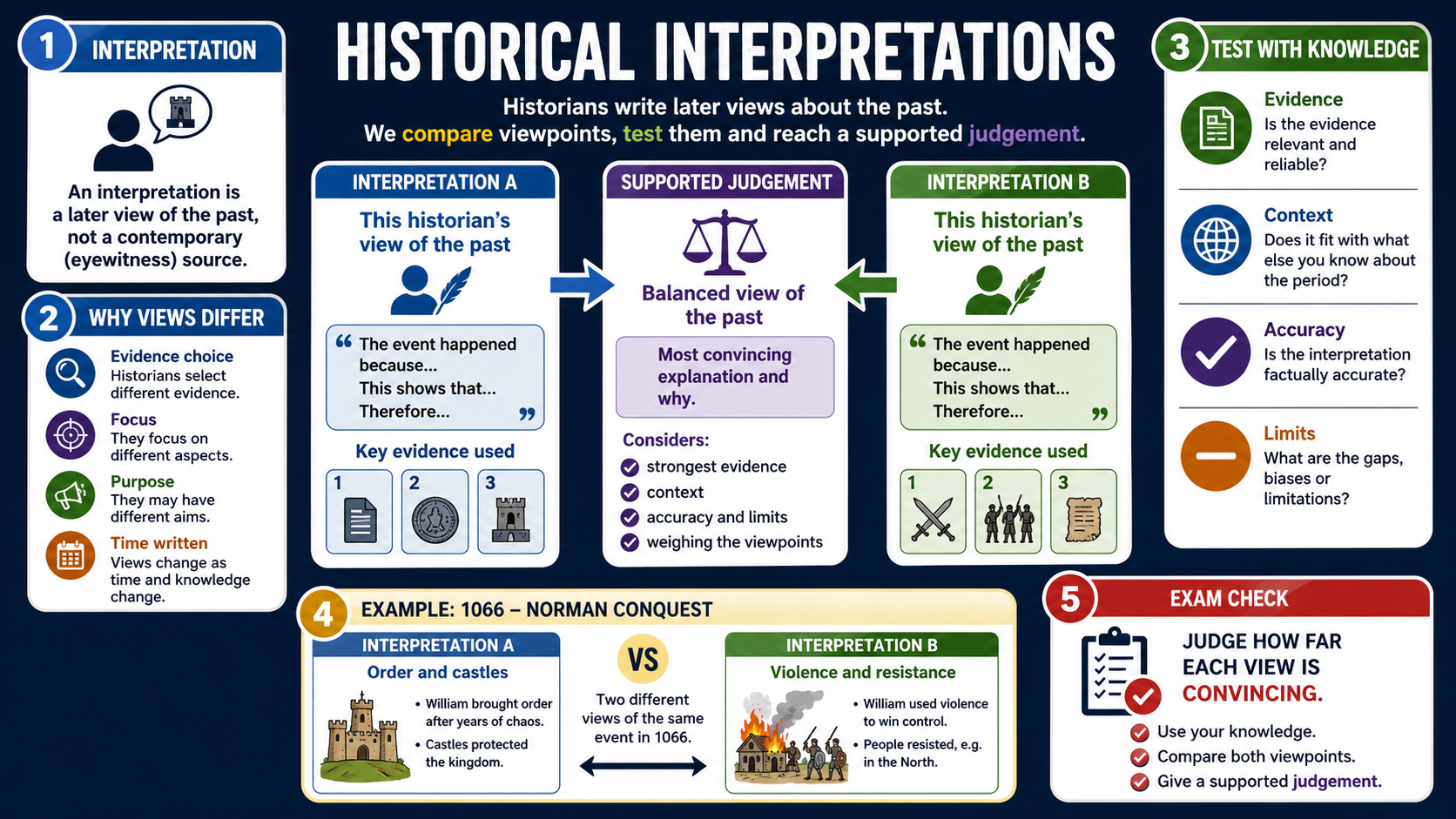
Historical interpretations infographic
Practice material
Use the notes on this page first. They include the dates, people, evidence and answer routines needed to practise historical interpretations without leaving the lesson.
Clear explanation
Interpretations are constructed after the events. They might appear in textbooks, museum displays, documentaries, articles or historians' arguments.
Interpretations differ because writers choose different evidence, focus on different groups, write at different times or have different purposes.
Do not simply say one interpretation is 'right' and the other is 'wrong'. Judge how far each is supported by accurate knowledge.
A view of Elizabeth I as a strong ruler might use evidence from the defeat of the Armada; a more critical view might stress poverty, plots and religious tension.
A view of the New Deal as successful might stress job creation and relief; a different view might stress continued unemployment and unequal benefits.
A good judgement recognises both support and limits, then explains which interpretation is more convincing for the question.
Worked examples
Building a supported explanation
Explain one reason why this topic matters when studying historical interpretations.
Method: Start with a claim, add one named detail such as 1066 or historians, then explain how it answers the question.
Reveal worked answer
This topic matters because it helps explain a wider pattern in the past. For example, Interpretations are constructed after the events. They might appear in textbooks, museum displays, documentaries, articles or historians' arguments. This turns the answer from a general statement into a supported explanation.
Using evidence for judgement
A student writes: "This changed everything." Improve the answer using evidence from this lesson.
Method: Replace the vague phrase with a named event, person, group or consequence, then explain what changed and what stayed similar.
Reveal worked answer
A stronger answer would use precise evidence such as 1066 and 1588 and named people or groups such as historians and film-makers. It should explain the scale of change, who was affected, and whether the change was complete or limited.
Quick checks
Choose an answer, then check your thinking.
1. For historical interpretations, why might two views of Elizabeth I differ?
2. For historical interpretations, what makes a judgement convincing?
Practice questions
Question 1
Write two bullet-point notes that would help revise this lesson topic.
Reveal answer and marking guidance
Answer: One note should use a precise date such as 1066; the other should name a person, group, place or event such as 1066.
Marking: Credit accurate, topic-specific notes. Do not credit vague notes that could apply to any History topic.
Question 2
Explain one cause, consequence, change or judgement linked to historical interpretations.
Reveal answer and marking guidance
Answer: A good answer names the issue, uses evidence from the notes, and explains the link to the question. For this lesson, useful evidence includes interpretation, viewpoint, evidence.
Marking: Credit explanation that links evidence to the question, not just copied facts.
Question 3
How could a source or interpretation question connect to this lesson?
Reveal answer and marking guidance
Answer: It could present a view, image, extract or statement about historical interpretations and ask how useful or convincing it is. The answer should use content, provenance and context.
Marking: Credit answers that mention both the source or view and the student's own contextual knowledge.
Question 4
Write one exam-ready sentence about historical interpretations.
Reveal answer and marking guidance
Answer: An exam-ready sentence should use a precise detail, then explain its importance. Example structure: 'interpretation mattered because it affected historians by changing what they could do or how they were treated.'
Marking: Credit a complete sentence with evidence and explanation. Do not credit a bare fact with no link to importance.
Practice ladder
- Secure the chronology: place the issue in the right period.
- Select precise evidence: date, person, event, law, source detail or statistic.
- Explain the link: show how the evidence proves the point.
- Make a judgement: decide how far, how important or how useful.
Answers
Worked and practice answers are hidden under each question so students can attempt the task before revealing support.
Common mistakes
- Retelling the whole topic instead of answering the exact question.
- Writing that something was important without explaining why, for whom or with what evidence.
- Using source or interpretation comments that could apply to any topic.
- Forgetting precise details such as 1066, historians or interpretation.
Extension challenge
Create a one-page revision sheet for historical interpretations with a five-point timeline or model, six key terms, four named people or groups, and two practice judgement sentences.
Reveal example response
Example: A useful revision sheet has a dated model, precise terms and two judgement sentences. It is useful because it turns notes into answer-ready evidence.
Exam-board guidance
Aplailasain is an independent learning resource and is not endorsed by any exam board.
AQA GCSE History 8145
AQA students should match this lesson to the relevant period, wider-world, thematic or British depth option, then practise using precise evidence for historical interpretations.
OCR GCSE History A J410
OCR History A students should connect this lesson to their chosen modern-world, British thematic or British depth route, especially where historical interpretations is tested through explanation and judgement.
OCR GCSE History B J411
OCR History B students should use this lesson alongside their thematic, British depth, history-around-us, period or world depth option where historical interpretations appears.
Pearson Edexcel GCSE History 1HI0
Pearson Edexcel students should link this lesson to their chosen thematic, period, British depth or modern depth study and revise exact evidence for historical interpretations.
Eduqas GCSE History C100QS
Eduqas students should place this lesson within their British depth, non-British depth, period or thematic option and practise explaining historical interpretations with accurate detail.
WJEC Wales GCSE History 3100QS
WJEC Wales students should connect this lesson to the relevant Wales/wider, European/world, thematic or historian-enquiry unit and include Welsh context where their route requires it.
CCEA GCSE History 4010
CCEA students should use this lesson where it supports modern-world depth, local study or international relations work, then add the named detail required for their class route.