
Lesson overview
A core algebra step before factorising, equations and quadratics.
Expanding brackets means removing brackets by multiplying correctly. GCSE questions often ask you to expand and then simplify.
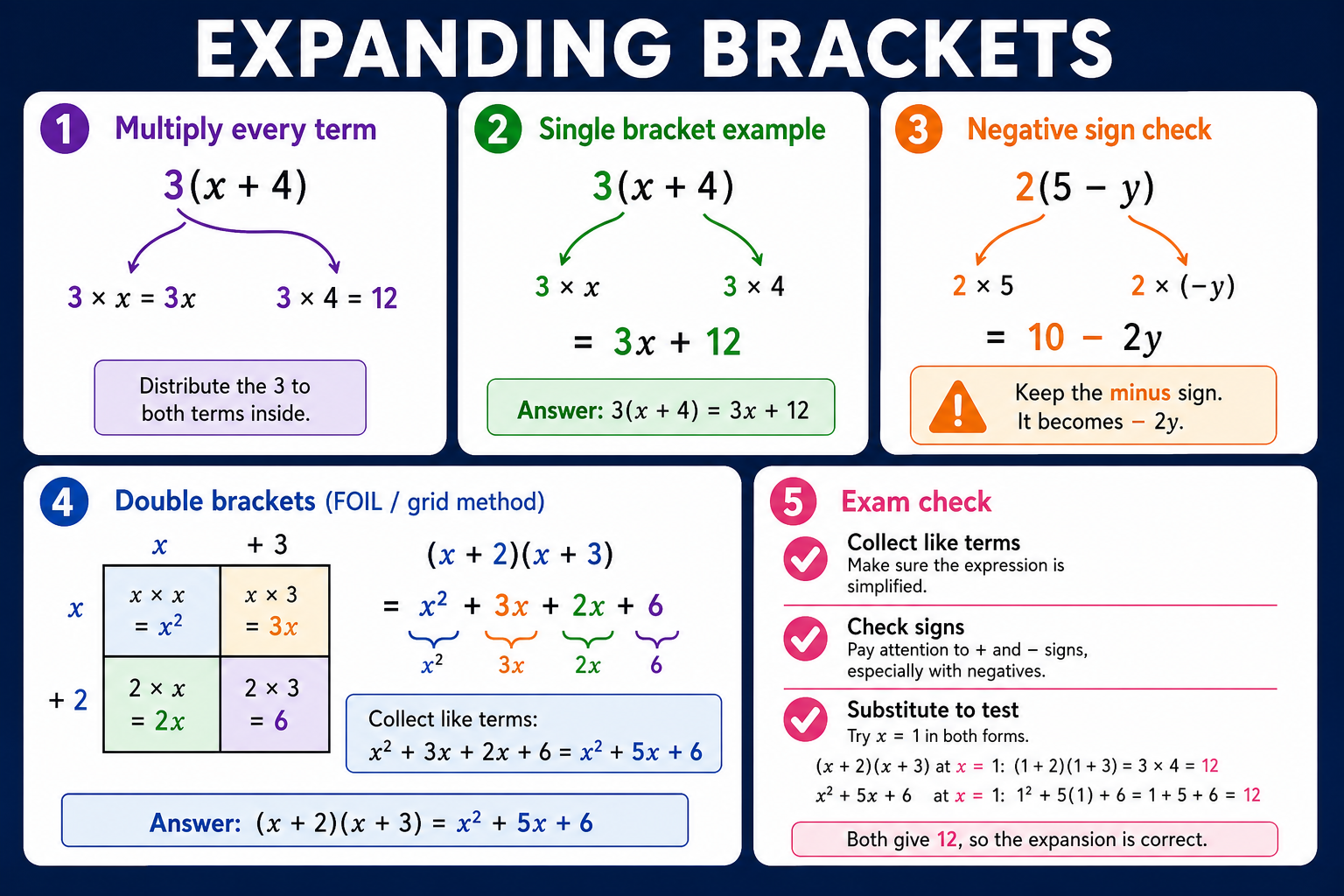
Expanding brackets infographic
Before viewing
Before viewing, identify each multiplication arrow needed to expand the bracket.
After viewing
After viewing, expand one bracket and check each term has been multiplied.
What you will learn
Key facts before you start
Why this matters
Brackets are used to keep expressions compact. Expanding them lets you compare expressions, solve equations and move into factorising.
In exams, a correct expansion line often earns method marks even if the problem has more steps afterwards.
Prior knowledge
You should already be comfortable with:
Clear explanation
What expanding means
To expand a bracket, multiply the term outside the bracket by every term inside the bracket.
The 3 multiplies both terms inside the bracket. It is not enough to multiply only the first term.
Brackets with subtraction
Keep the sign with each term inside the bracket. In 5(y − 2), the second term is −2.
Negative multipliers
A negative term outside the bracket changes signs when it multiplies positive and negative terms.
Expand, then simplify
Some questions have terms outside the bracket too. Expand first, then collect like terms.
Expanding two brackets
For two brackets, multiply each term in the first bracket by each term in the second bracket. A grid can help make sure no product is missed.
Checking by substitution
The expanded expression should have the same value as the bracketed expression. Try an easy value to check.
Worked examples
Example 1: Expand a single bracket
Expand 6(x + 2).
6(x + 2) = 6x + 12Reveal answer
Answer: 6x + 12.
Example 2: Expand with subtraction
Expand 4(3a − 5).
4 × 3a = 12a 4 × (−5) = −20Reveal answer
Answer: 12a − 20.
Example 3: Expand and simplify
Simplify 2m + 5(m + 1).
2m + 5(m + 1) = 2m + 5m + 5 = 7m + 5Reveal answer
Answer: 7m + 5.
Example 4: Expand two brackets
Expand and simplify (x + 4)(x − 2).
(x + 4)(x − 2) = x² − 2x + 4x − 8 = x² + 2x − 8Reveal answer
Answer: x² + 2x − 8.
Quick checks
Choose an answer, then check your thinking.
1. Expand 2(x + 7).
2. Expand 3(y − 4).
3. Expand (x + 2)(x + 3).
Practice questions
Question 1
Expand 4(x + 5).
Reveal answer and marking guidance
Answer: 4x + 20.
Marking: Multiply 4 by x and by 5.
Question 2
Expand 7(a − 3).
Reveal answer and marking guidance
Answer: 7a − 21.
Marking: 7 × a = 7a and 7 × (−3) = −21.
Question 3
Expand −3(2y + 5).
Reveal answer and marking guidance
Answer: −6y − 15.
Marking: −3 × 2y = −6y and −3 × 5 = −15.
Question 4
Simplify 5p + 2(p − 4).
Reveal answer and marking guidance
Answer: 7p − 8.
Marking: Expand to 5p + 2p − 8, then collect the p terms.
Question 5
Expand and simplify (x + 6)(x + 2).
Reveal answer and marking guidance
Answer: x² + 8x + 12.
Marking: The four products are x², 2x, 6x and 12; collect 2x + 6x.
Question 6
Expand and simplify (x − 4)(x + 3).
Reveal answer and marking guidance
Answer: x² − x − 12.
Marking: The four products are x², 3x, −4x and −12; collect to −x.
Question 7
Simplify 5x − (2x − 7).
Reveal answer and marking guidance
Answer: 3x + 7.
Marking: Subtract every term in the bracket: 5x − 2x + 7 = 3x + 7.
Question 8
Expand and simplify (2x − 5)(x − 4).
Reveal answer and marking guidance
Answer: 2x² − 13x + 20.
Marking: The four products are 2x², −8x, −5x and 20; collect −8x − 5x to get −13x.
Question 9
Expand and simplify 3(x − 2) − 2(4 − x).
Reveal answer and marking guidance
Answer: 5x − 14.
Marking: Expand both parts: 3x − 6 − 8 + 2x, then collect to get 5x − 14.
Question 10
A rectangle has length x + 4 and width 2x − 3. Write an expanded expression for its area.
Reveal answer and marking guidance
Answer: 2x² + 5x − 12.
Marking: Area = (x + 4)(2x − 3). The four products are 2x², −3x, 8x and −12, then −3x + 8x = 5x.
Answers and marking guidance
The exact practice answers are hidden under each question so you can try first. For expanding brackets, marks usually come from multiplying every term in the bracket, carrying signs carefully, showing the products for two brackets, and collecting like terms only after the expansion is complete. In area or formula questions, write the expression being expanded before simplifying so the algebra still matches the context.
Common mistakes
- Only multiplying the first term: 3(x + 4) is 3x + 12, not 3x + 4.
- Losing a negative sign: 5(x − 2) gives 5x − 10.
- Changing signs incorrectly: −2(x − 6) gives −2x + 12.
- Missing a product in two brackets: four products are needed before collecting like terms.
- Collecting unlike terms: x² and x are different types of term.
Extension challenge
Expand and simplify (2x − 3)(x + 5).
Reveal answer
Answer: 2x² + 7x − 15.
The four products are 2x², 10x, −3x and −15, then 10x − 3x = 7x.
Exam-board guidance
Expanding brackets questions test whether every term has been multiplied, signs have been controlled and any later simplification is done only after the expansion line is complete.
AQA GCSE Maths
Focus on the shared method, notation and checking habit; wording and context can vary by route.
OCR GCSE Maths
Show clear method steps and use precise notation; question wording may vary by route.
Pearson Edexcel GCSE Maths
Keep working visible and check units or notation; contexts may vary by route.
Eduqas GCSE Maths
Use the same core skill in practical contexts, with clear reasoning and final checks.
WJEC Wales
Connect the method to the context and state what the result means.
CCEA GCSE Maths
Make each method step visible and keep notation, units and final checks clear.
Next lesson
Next, move into Factorising Expressions.