
Energy
Lesson overview
This lesson introduces the core physics idea, the useful equipment and the calculation or data skills used on this page.
What you will learn
Power station and device data supplied on this page
Use the lamp, turbine and power station examples to practise power, efficiency and resource evaluation.
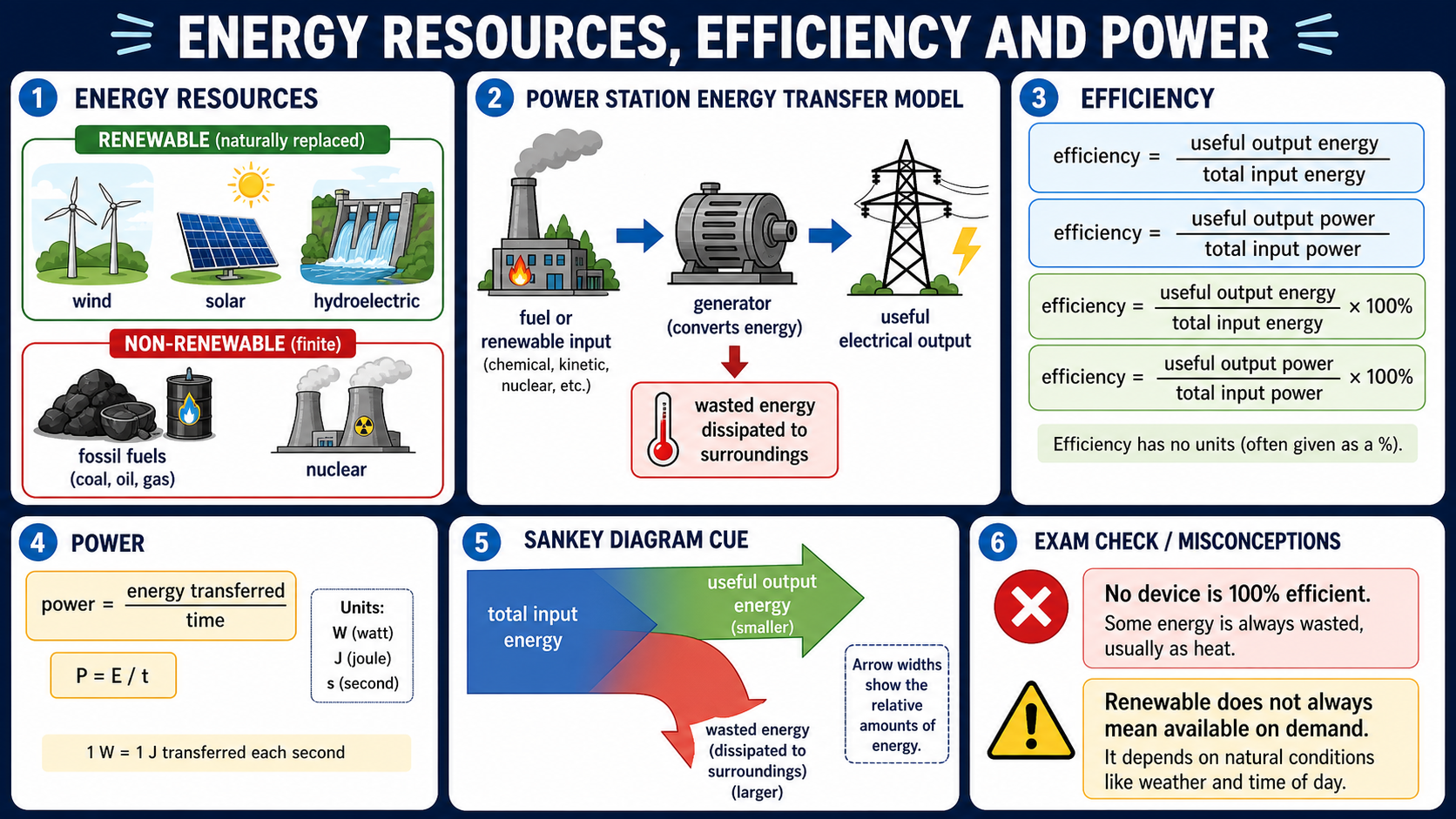
Energy resources, efficiency and power infographic
Clear explanation
Power is the rate of energy transfer. A device with a higher power transfers energy more quickly.
Energy resources can be renewable, such as wind and solar, or non-renewable, such as coal, oil, gas and nuclear fuels. Evaluation questions need balanced reasons, not just a list.
Efficiency compares useful output with total input. It is never above 100% because energy is conserved, although some is dissipated to less useful stores.
Worked examples
Calculating power
A motor transfers 3600 J in 60 s.
power = energy transferred ÷ time
power = 3600 ÷ 60 = 60
Quick checks
Choose an answer, then check your thinking.
1. A device transfers 500 J in 10 s. What is its power?
2. Which resource is renewable?
Practice questions
Question 1
A kettle transfers 120 000 J in 80 s. Calculate its power.
Reveal answer and marking guidance
Answer: 1500 W.
Marking: Credit power = energy ÷ time and 120 000 ÷ 80 = 1500 W.
Question 2
A device takes in 900 J and transfers 540 J usefully. Calculate efficiency as a percentage.
Reveal answer and marking guidance
Answer: 60%.
Marking: Credit 540 ÷ 900 = 0.6 and converting to 60%.
Question 3
Give one advantage and one disadvantage of wind power.
Reveal answer and marking guidance
Answer: It is renewable and produces no carbon dioxide during operation, but output depends on wind conditions.
Marking: Credit a balanced evaluation with one sensible advantage and one limitation.
Question 4
Why can a non-renewable fuel still be reliable for electricity generation?
Reveal answer and marking guidance
Answer: Fuel can be stored and burned when demand rises.
Marking: Credit control of supply or ability to meet demand.
Practice ladder
Answers and marking guidance
The exact practice answers are hidden under each question so you can try first. For this lesson, marks come from using the correct physics model, choosing the right equation where needed, keeping units with values, and explaining changes with precise words such as transfer, resultant force, acceleration, evidence and uncertainty.
Common mistakes
- Confusing energy with power.
- Writing efficiency above 100%.
- Calling nuclear fuel renewable.
- Giving one-sided resource evaluations.
Extension challenge
Compare wind, gas and nuclear electricity generation for a town that needs reliable low-carbon supply.
Reveal answer
Example answer: A strong extension response names the physics model, uses accurate units and explains why the evidence supports the conclusion.
Exam-board guidance
Short board notes only. Learn the core physics above first.
AQA GCSE Physics
AQA GCSE Physics: often rewards clear physics explanations, correct equations, units and practical evidence for energy resources, efficiency and power.
OCR GCSE Physics
OCR GCSE Physics: often values precise definitions, clear working, graph interpretation and links between models and evidence.
Pearson Edexcel GCSE Physics
Pearson Edexcel GCSE Physics: often combines the concept with equation use, data handling and practical interpretation.
Eduqas GCSE Physics
Eduqas GCSE Physics: learn the core explanation and practise applying it to unfamiliar contexts, data and practical questions.
WJEC Wales
WJEC Wales: often expects accurate terms, units and evidence-based explanations using the shared physics idea.
CCEA GCSE Physics
CCEA GCSE Physics: connect the idea to your current unit and use the same practical method language your class uses.
Next lesson
Next, continue with Current, Potential Difference and Resistance.