
Calculation skills
Lesson overview
This lesson introduces the core physics idea, the useful equipment and the calculation or data skills used on this page.
What you will learn
Equation practice set supplied on this page
Use the mixed equation prompts to practise identifying quantities first, then substituting values with units.
Physics equations and unit conversions infographic
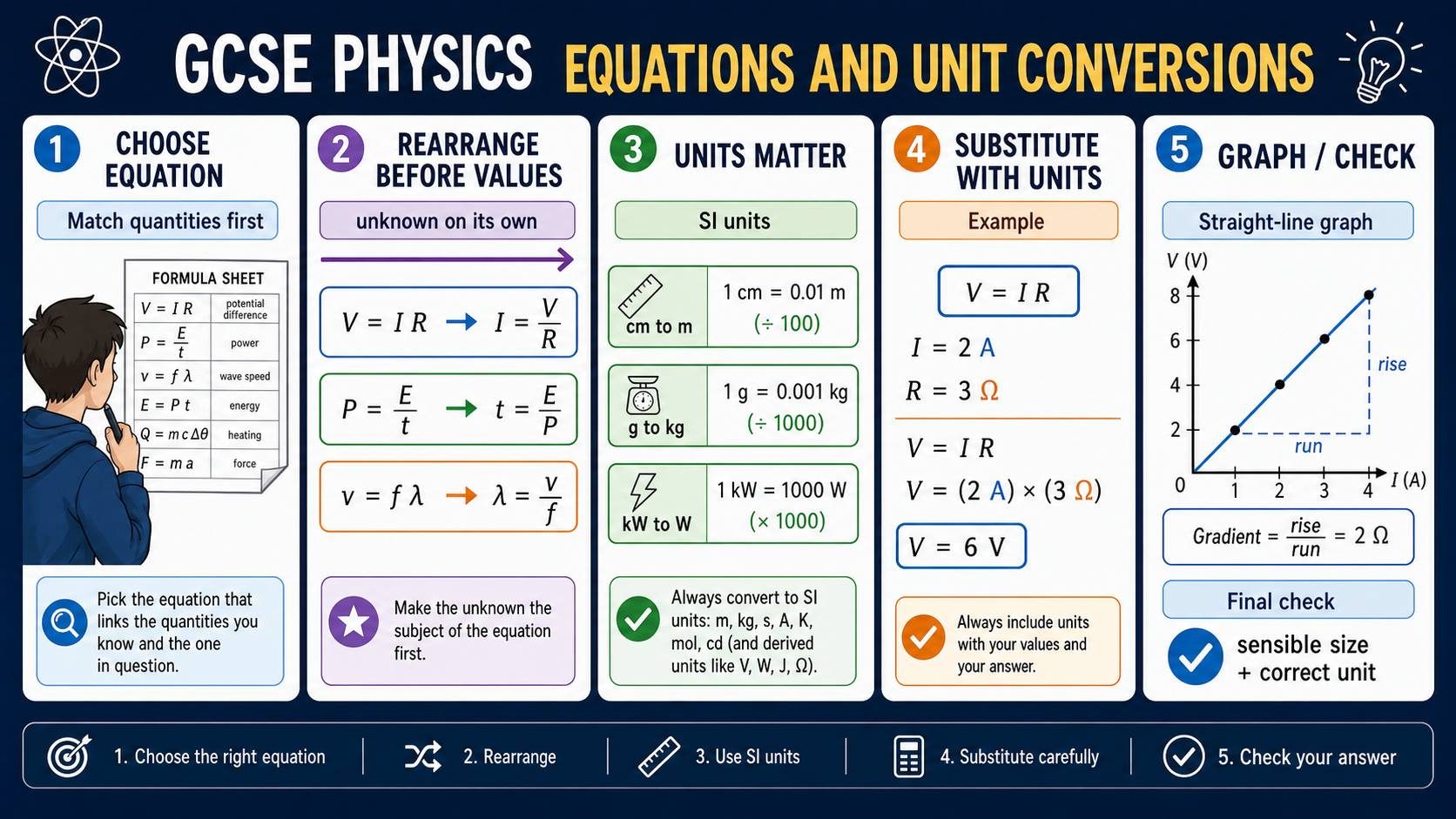
Clear explanation
The safest calculation routine is: identify the quantity asked for, write down the known values, choose the equation, rearrange if needed, substitute with units, calculate and check the answer.
Unit conversion matters because GCSE Physics equations usually expect standard units. For example, 2.5 kJ is 2500 J, 30 cm is 0.30 m and 4 minutes is 240 s.
If an answer looks impossible, check powers of ten, whether you used seconds rather than minutes, and whether the equation was rearranged the right way round.
Worked examples
Convert before calculating
A device transfers 3.6 kJ in 2 minutes.
Convert 3.6 kJ to 3600 J and 2 minutes to 120 s.
power = energy transferred ÷ time = 3600 ÷ 120
Quick checks
Choose an answer, then check your thinking.
1. What should you do before substituting values into an equation?
2. What is 0.45 kJ in joules?
Practice questions
Question 1
Convert 75 cm into metres.
Reveal answer and marking guidance
Answer: 0.75 m.
Marking: Credit dividing by 100.
Question 2
A motor transfers 4800 J in 60 s. Calculate power.
Reveal answer and marking guidance
Answer: 80 W.
Marking: Credit power = energy ÷ time and 4800 ÷ 60 = 80 W.
Question 3
Rearrange speed = distance ÷ time to make distance the subject.
Reveal answer and marking guidance
Answer: distance = speed x time.
Marking: Credit multiplying both sides by time.
Question 4
A student gets a car speed of 4000 m/s in a school problem. What should they do?
Reveal answer and marking guidance
Answer: Check units, substitution and equation choice because the answer is not sensible for a normal car.
Marking: Credit reasonableness check and a specific likely error such as minutes not seconds.
Practice ladder
Answers and marking guidance
The exact practice answers are hidden under each question so you can try first. For this lesson, marks come from using the correct physics model, choosing the right equation where needed, keeping units with values, and explaining changes with precise words such as transfer, resultant force, acceleration, evidence and uncertainty.
Common mistakes
- Using minutes when the equation needs seconds.
- Forgetting to convert centimetres to metres.
- Rearranging by guessing rather than doing the same operation to both sides.
- Writing a number without the final unit.
Extension challenge
Create a three-column table for five equations: quantity asked for, values given, and final unit.
Reveal answer
Example answer: A strong extension response names the physics model, uses accurate units and explains why the evidence supports the conclusion.
Exam-board guidance
Short board notes only. Learn the core physics above first.
AQA GCSE Physics
AQA GCSE Physics: often rewards clear physics explanations, correct equations, units and practical evidence for equation selection, rearranging and unit conversion.
OCR GCSE Physics
OCR GCSE Physics: often values precise definitions, clear working, graph interpretation and links between models and evidence.
Pearson Edexcel GCSE Physics
Pearson Edexcel GCSE Physics: often combines the concept with equation use, data handling and practical interpretation.
Eduqas GCSE Physics
Eduqas GCSE Physics: learn the core explanation and practise applying it to unfamiliar contexts, data and practical questions.
WJEC Wales
WJEC Wales: often expects accurate terms, units and evidence-based explanations using the shared physics idea.
CCEA GCSE Physics
CCEA GCSE Physics: connect the idea to your current unit and use the same practical method language your class uses.
Next lesson
Next, continue with Circuit Calculations.