
Atomic structure
Lesson overview
This lesson introduces the core physics idea, the useful equipment and the calculation or data skills used on this page.
What you will learn
Radiation safety scenarios supplied on this page
Use tracer, thickness gauge, sterilisation and contamination examples to practise choosing radiation and safety controls.
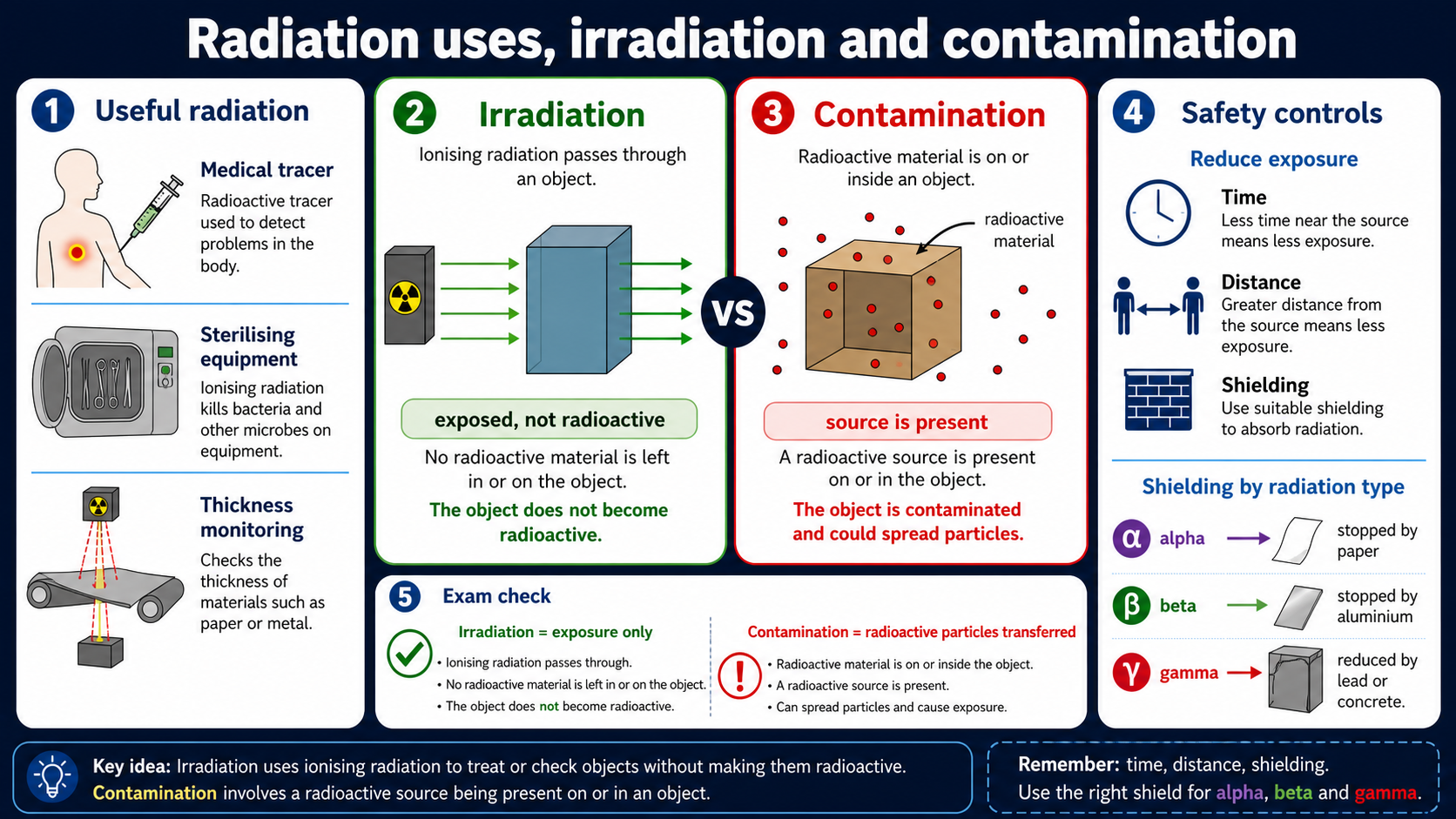
Radiation uses, irradiation and contamination infographic
Clear explanation
Irradiation means an object is exposed to radiation from a source outside it. Contamination means radioactive material gets onto or into the object.
Alpha radiation is strongly ionising but weakly penetrating. Beta has medium penetration. Gamma is weakly ionising but highly penetrating, so it is useful where radiation must pass through objects.
A medical tracer needs a half-life long enough to be detected but short enough to reduce dose. Safety choices depend on time, distance, shielding and avoiding contamination.
Worked examples
Choosing radiation for a thickness gauge
A factory monitors paper thickness using a detector.
Alpha would be stopped too easily by air or paper.
Gamma may pass through too much to show small changes clearly.
Quick checks
Choose an answer, then check your thinking.
1. What is contamination?
2. Why should a medical tracer not have a very long half-life?
Practice questions
Question 1
State one difference between irradiation and contamination.
Reveal answer and marking guidance
Answer: Irradiation is exposure to radiation; contamination is radioactive material on or inside an object.
Marking: Credit clear distinction between exposure and material transfer.
Question 2
Why is gamma radiation useful for sterilising medical equipment?
Reveal answer and marking guidance
Answer: It penetrates packaging and kills microorganisms.
Marking: Credit high penetration and ionising effect.
Question 3
Why can alpha radiation be dangerous if swallowed?
Reveal answer and marking guidance
Answer: It is strongly ionising and close to body cells inside the body.
Marking: Credit internal contamination and strong ionisation.
Question 4
Name two ways to reduce risk when using a sealed source.
Reveal answer and marking guidance
Answer: Use shielding and increase distance with tongs.
Marking: Credit time, distance and shielding controls.
Practice ladder
Answers and marking guidance
The exact practice answers are hidden under each question so you can try first. For this lesson, marks come from using the correct physics model, choosing the right equation where needed, keeping units with values, and explaining changes with precise words such as transfer, resultant force, acceleration, evidence and uncertainty.
Common mistakes
- Using irradiation and contamination as if they mean the same thing.
- Choosing alpha for a source that must penetrate thick material.
- Ignoring half-life when selecting tracers.
- Thinking a sealed source cannot be hazardous.
Extension challenge
Choose the best radiation for smoke alarms, thickness monitoring and sterilisation, then justify each choice using penetration and ionisation.
Reveal answer
Example answer: A strong extension response names the physics model, uses accurate units and explains why the evidence supports the conclusion.
Exam-board guidance
Short board notes only. Learn the core physics above first.
AQA GCSE Physics
AQA GCSE Physics: often rewards clear physics explanations, correct equations, units and practical evidence for radiation uses, irradiation, contamination and safety.
OCR GCSE Physics
OCR GCSE Physics: often values precise definitions, clear working, graph interpretation and links between models and evidence.
Pearson Edexcel GCSE Physics
Pearson Edexcel GCSE Physics: often combines the concept with equation use, data handling and practical interpretation.
Eduqas GCSE Physics
Eduqas GCSE Physics: learn the core explanation and practise applying it to unfamiliar contexts, data and practical questions.
WJEC Wales
WJEC Wales: often expects accurate terms, units and evidence-based explanations using the shared physics idea.
CCEA GCSE Physics
CCEA GCSE Physics: connect the idea to your current unit and use the same practical method language your class uses.
Next lesson
Next, continue with Gas Pressure and Pressure in Fluids.