
Electricity
Lesson overview
This lesson introduces the core physics idea, the useful equipment and the calculation or data skills used on this page.
What you will learn
Grid examples supplied on this page
Use the power station, pylon and home supply examples to practise transformer and transmission reasoning.
Transformers and the National Grid infographic
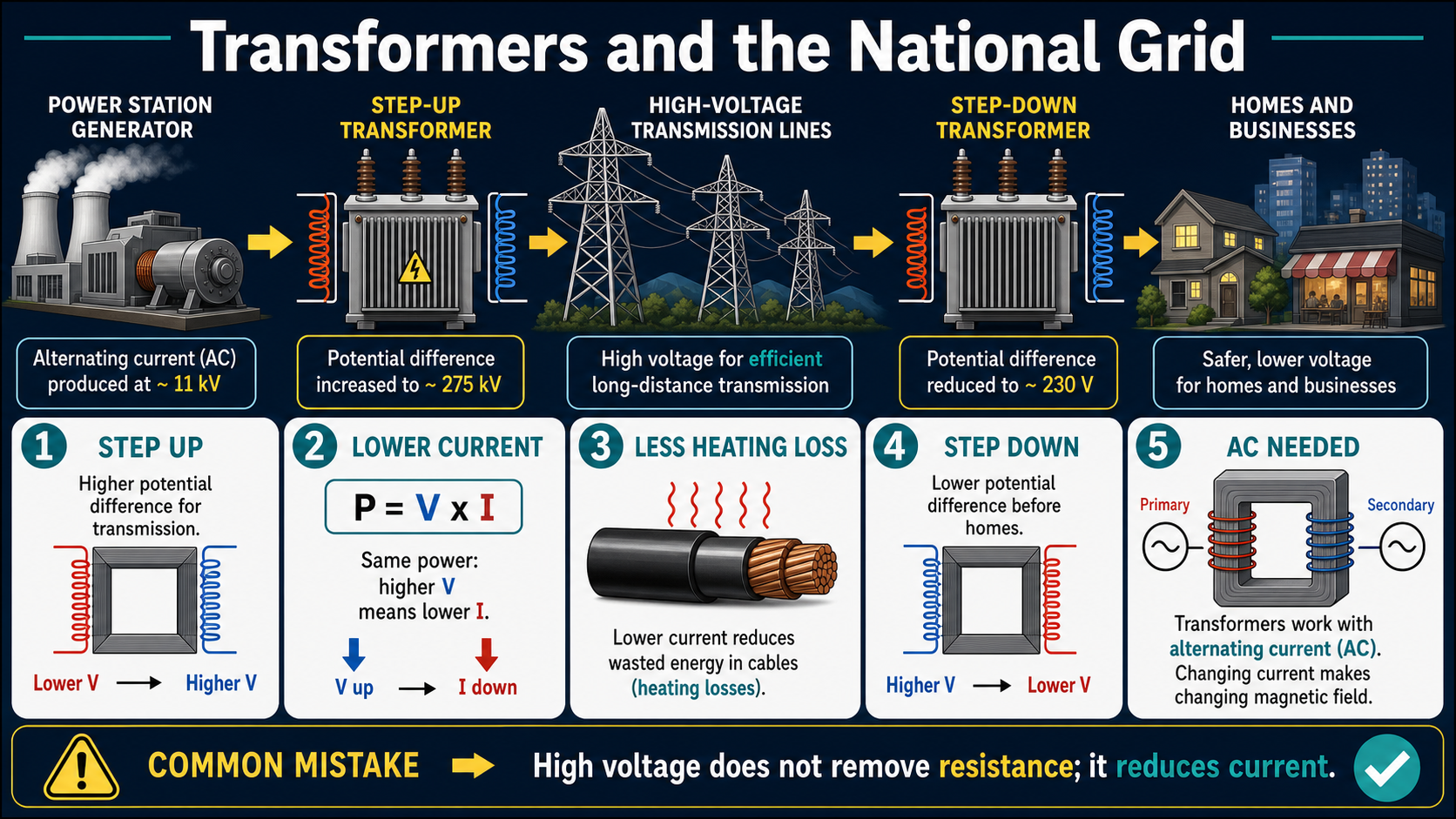
Clear explanation
The National Grid transfers electrical power from power stations to consumers. High potential difference is used for transmission because it allows lower current for the same power.
Lower current reduces heating losses in cables. Step-up transformers increase potential difference before transmission; step-down transformers reduce it before homes and businesses.
Transformers work with alternating current because changing magnetic fields are needed for induction between coils.
Key diagram
Worked examples
Why step up voltage?
The same power can be transmitted at high potential difference and low current.
Heating loss depends strongly on current.
Reducing current reduces wasted energy in cables.
Quick checks
Choose an answer, then check your thinking.
1. What does a step-up transformer do?
2. Why is high potential difference useful for long-distance transmission?
Practice questions
Question 1
Name the transformer used before long-distance transmission.
Reveal answer and marking guidance
Answer: Step-up transformer.
Marking: Credit step-up because potential difference is increased.
Question 2
Name the transformer used before electricity enters homes.
Reveal answer and marking guidance
Answer: Step-down transformer.
Marking: Credit step-down because potential difference is reduced for safer use.
Question 3
Explain why lower current reduces wasted energy in transmission cables.
Reveal answer and marking guidance
Answer: Less energy is transferred to the thermal stores of the cables due to resistance.
Marking: Credit reduced heating losses in cables.
Question 4
Why do transformers require alternating current?
Reveal answer and marking guidance
Answer: A changing current produces a changing magnetic field, which induces potential difference in the secondary coil.
Marking: Credit changing magnetic field and induction.
Practice ladder
Answers and marking guidance
The exact practice answers are hidden under each question so you can try first. For this lesson, marks come from using the correct physics model, choosing the right equation where needed, keeping units with values, and explaining changes with precise words such as transfer, resultant force, acceleration, evidence and uncertainty.
Common mistakes
- Saying high voltage is used because it increases current.
- Confusing step-up and step-down roles.
- Ignoring heating losses in cables.
- Forgetting transformers need alternating current.
Extension challenge
Describe the full route from power station generator to home socket, naming the transformer type at each stage.
Reveal answer
Example answer: A strong extension response names the physics model, uses accurate units and explains why the evidence supports the conclusion.
Exam-board guidance
Short board notes only. Learn the core physics above first.
AQA GCSE Physics
AQA GCSE Physics: often rewards clear physics explanations, correct equations, units and practical evidence for transformers and electricity transmission.
OCR GCSE Physics
OCR GCSE Physics: often values precise definitions, clear working, graph interpretation and links between models and evidence.
Pearson Edexcel GCSE Physics
Pearson Edexcel GCSE Physics: often combines the concept with equation use, data handling and practical interpretation.
Eduqas GCSE Physics
Eduqas GCSE Physics: learn the core explanation and practise applying it to unfamiliar contexts, data and practical questions.
WJEC Wales
WJEC Wales: often expects accurate terms, units and evidence-based explanations using the shared physics idea.
CCEA GCSE Physics
CCEA GCSE Physics: connect the idea to your current unit and use the same practical method language your class uses.
Next lesson
Next, continue with Space Physics: Solar System and Orbits.