
Lesson overview
Islamic beliefs is a useful GCSE Religious Studies revision topic because it builds knowledge, understanding, explanation and evaluation without assuming one single exam-board route.
Use the notes on this page first. They give the key vocabulary, beliefs, practices, viewpoints and answer routines needed to practise Islamic beliefs without leaving the lesson.
What you will learn
- Explain Islamic beliefs using accurate Religious Studies vocabulary.
- Connect belief, teaching, practice, source evidence and real ethical issues.
- Compare religious and non-religious viewpoints carefully where the topic needs it.
- Write developed GCSE answers with reasons, evidence and judgement.
Core knowledge
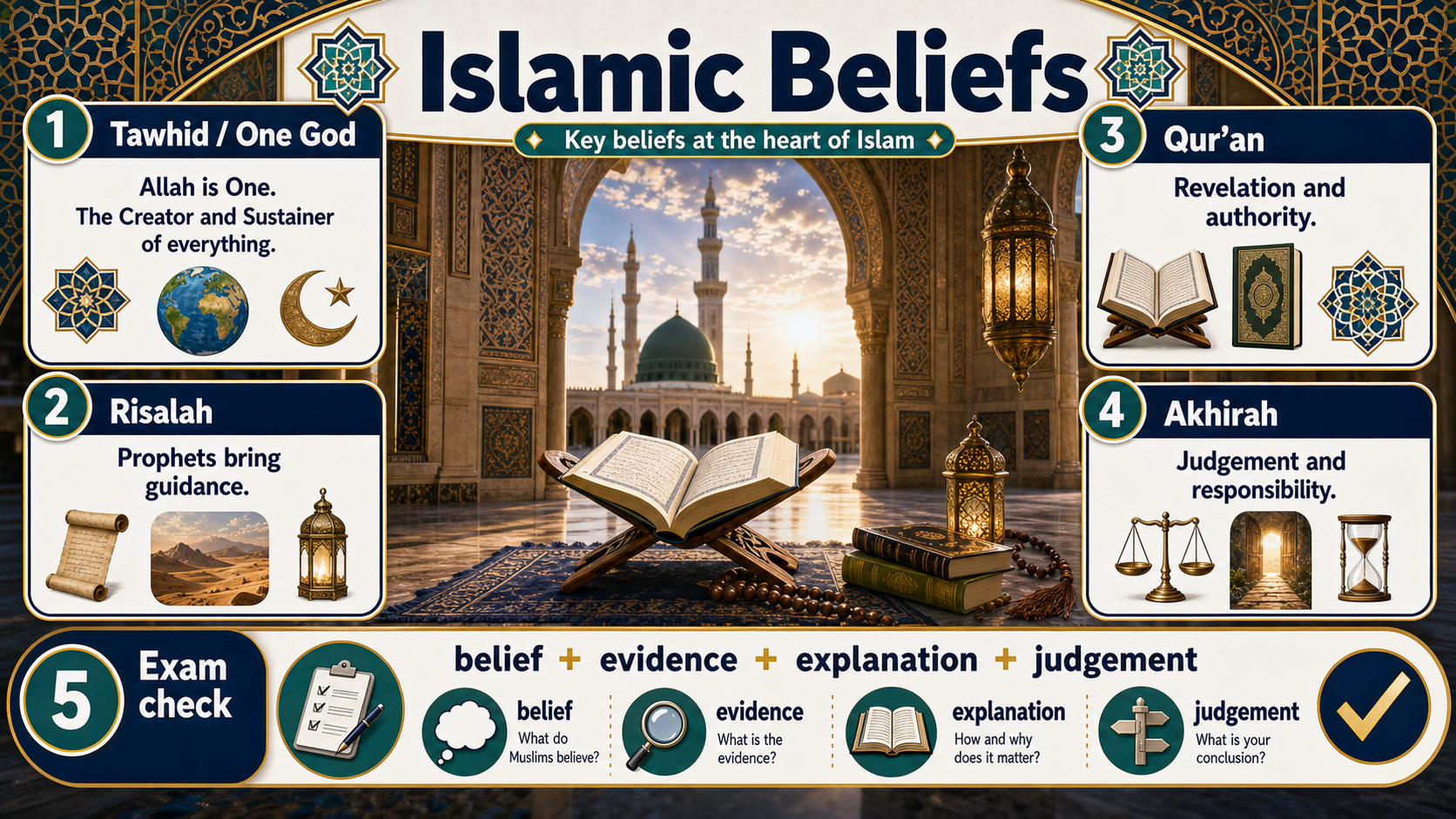
- Main idea: Explain Tawhid, prophethood, revelation, angels, akhirah and human responsibility in Islam.
- Useful evidence includes Qur'an references, Articles of Faith, Sunni and Shi'a examples.
- Tawhid is belief in the oneness of Allah and is central to Muslim belief and worship.
- Risalah means prophethood. Muslims believe Allah has guided humanity through prophets.
- The Qur'an is understood by Muslims as revelation from Allah, given in Arabic to Muhammad.
- Akhirah means life after death and includes judgement, accountability and the consequences of actions.
- Belief in angels links to revelation, recording deeds and carrying out Allah's commands.
- Sunni and Shi'a Muslims share many core beliefs while also having distinct emphases and histories.
Islamic Beliefs: study route
Use this as a reading route, not as a diagram to memorise.
- Allah
- Revelation
- Prophets
- Judgement
- Responsibility
Islamic Beliefs infographic
Self-contained notes and practice
Use the notes on this page first. They give the key vocabulary, beliefs, practices, viewpoints and answer routines needed to practise Islamic beliefs without leaving the lesson.
Explanation
A strong RS answer on Islamic beliefs starts with accurate vocabulary, then connects belief, practice, source evidence or ethical reasoning. Avoid stereotypes and explain the viewpoint before judging it.
For evaluation, build both sides carefully. A conclusion should say which argument is stronger and why, using evidence from the lesson rather than a personal reaction alone.
Worked examples
Explaining Tawhid
Question: Explain how Tawhid helps a GCSE Religious Studies student understand Islamic beliefs.
Method: Define Tawhid, connect it to Qur'an references, then explain why it matters for Revelation.
Reveal answer and marking guidance
Tawhid is belief in the oneness of Allah and is central to Muslim belief and worship. A strong answer would use Qur'an references to show how Tawhid shapes belief, practice or ethical reasoning in Islamic beliefs.
Evaluating Responsibility
Question: A student says that Responsibility is the most important part of Islamic Beliefs. What would make that Religious Studies judgement convincing?
Method: Use prophethood, Articles of Faith, one different viewpoint and a clear final judgement.
Reveal answer and marking guidance
A convincing judgement would explain prophethood with evidence such as Articles of Faith. It should then weigh Responsibility against another part of Islamic beliefs, such as Revelation, before deciding which argument is stronger.
Quick checks
Choose an answer, then check your thinking.
1. For Islamic Beliefs, which evidence best supports an answer about Islamic beliefs?
2. For Islamic Beliefs, what should a student do after defining Tawhid?
Practice
Question 1
For Islamic Beliefs, write a two-step explanation linking Tawhid to Revelation.
Reveal answer and marking guidance
Answer: A strong explanation starts with Tawhid, uses Qur'an references, and explains how it changes Revelation in Islamic beliefs.
Marking: Credit accurate use of Tawhid, Qur'an references and a clear belief-practice or belief-ethics link.
Question 2
Use Articles of Faith to explain one viewpoint about Islamic beliefs.
Reveal answer and marking guidance
Answer: The answer should describe Articles of Faith, then use terms such as prophethood and Qur'an to explain the viewpoint clearly.
Marking: Credit a precise explanation of Articles of Faith; do not credit vague comments about religion generally.
Question 3
Explain why Prophets changes the way a student should answer a question on Islamic Beliefs.
Reveal answer and marking guidance
Answer: Prophets changes the answer because it adds a specific belief, practice, source or ethical issue. Useful evidence includes Sunni and Shi'a examples. Lesson detail: Risalah means prophethood. Muslims believe Allah has guided humanity through prophets.
Marking: Credit explanation that links Prophets to Islamic beliefs with evidence.
Question 4
Make a justified judgement about whether Responsibility is the most important part of Islamic beliefs.
Reveal answer and marking guidance
Answer: A justified judgement should weigh Responsibility against Revelation, using evidence such as Qur'an references and Articles of Faith. Lesson detail: Akhirah means life after death and includes judgement, accountability and the consequences of actions.
Marking: Credit a balanced judgement with evidence from Islamic Beliefs, not a one-sentence opinion.
Exam ladder
- Define the key term accurately.
- Explain the belief, practice, source or ethical issue in context.
- Add a contrasting viewpoint where the question needs balance.
- Reach a justified judgement when the question asks you to evaluate.
Answers and marking guidance
The exact practice answers are hidden under each question so you can try first. Marks come from accurate vocabulary, clear explanation, careful use of religious or ethical evidence, and balanced judgement where required.
Common mistakes
- Describing all followers of a religion as if they think exactly the same thing.
- Using a quotation or source reference without explaining its meaning.
- Giving a personal opinion when the question asks for religious or ethical reasoning.
- Writing both sides of an evaluation but forgetting to reach a justified conclusion.
Extension
Create a one-page revision sheet for Islamic beliefs with five key terms, three pieces of evidence, two contrasting viewpoints and one final judgement sentence.
Exam-board guidance
Short board notes only. Learn the core Religious Studies above first.
AQA GCSE Religious Studies A
AQA GCSE Religious Studies A students can use this lesson for Islamic beliefs, then match named religions, themes and question style to the route taught by their school.
OCR GCSE Religious Studies
OCR GCSE Religious Studies students can use this lesson for Islamic beliefs, then match named religions, themes and question style to the route taught by their school.
Pearson Edexcel GCSE Religious Studies A
Pearson Edexcel GCSE Religious Studies A students can use this lesson for Islamic beliefs, then match named religions, themes and question style to the route taught by their school.
Pearson Edexcel GCSE Religious Studies B
Pearson Edexcel GCSE Religious Studies B students can use this lesson for Islamic beliefs, then match named religions, themes and question style to the route taught by their school.
Eduqas GCSE Religious Studies
Eduqas GCSE Religious Studies students can use this lesson for Islamic beliefs, then match named religions, themes and question style to the route taught by their school.
WJEC GCSE Religious Studies
WJEC GCSE Religious Studies students can use this lesson for Islamic beliefs, then match named religions, themes and question style to the route taught by their school.
CCEA GCSE Religious Studies
CCEA GCSE Religious Studies students can use this lesson for Islamic beliefs, then match named religions, themes and question style to the route taught by their school.