
Practical skills
Lesson overview
This lesson introduces the core biology idea, the useful equipment and the calculation or data skills used on this page.
What you will learn
Core knowledge
Microscopy practical infographic
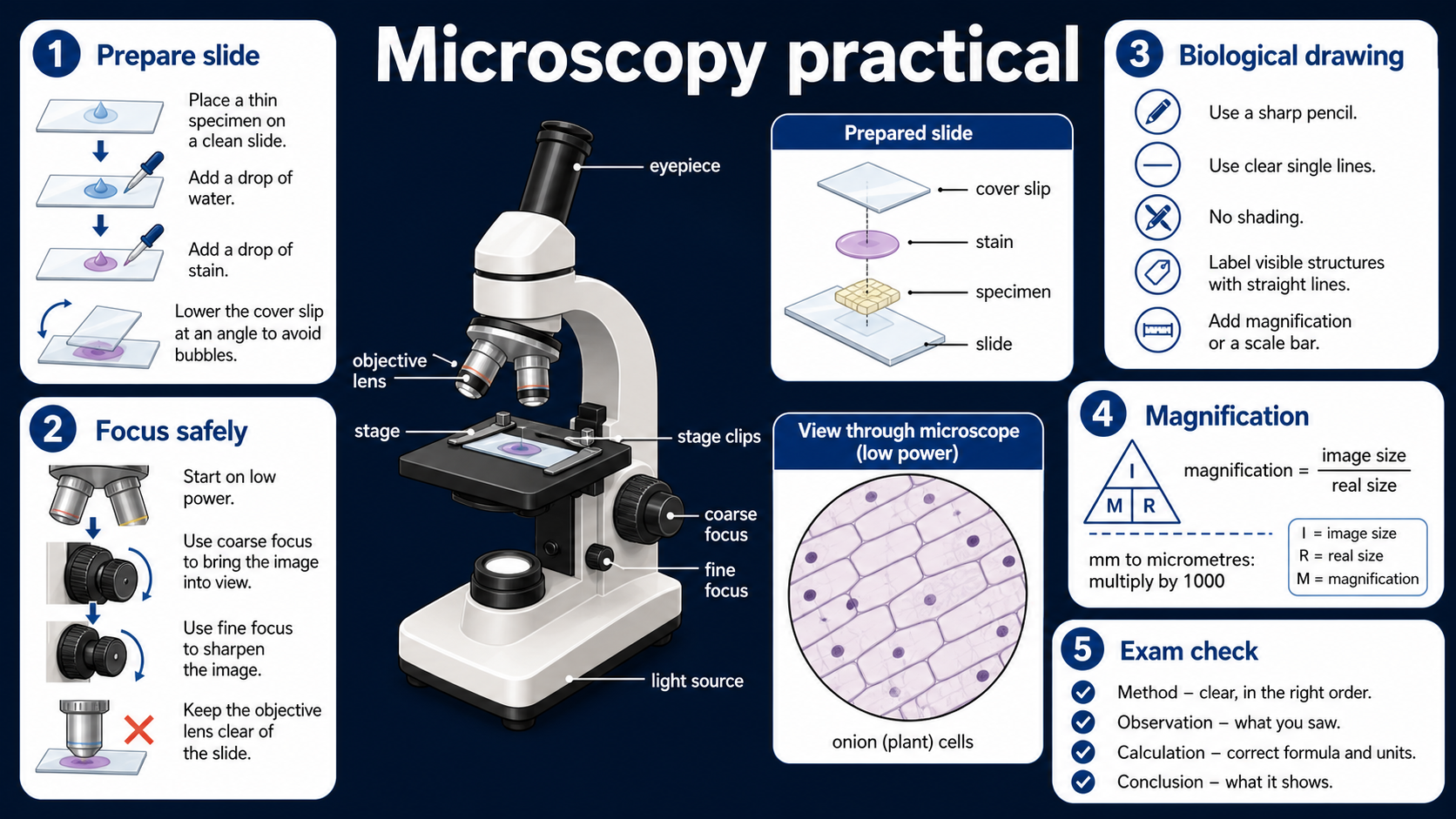
Microscopy Practical practice set
Use the worked examples and practice questions on this page as a complete study task: learn the definitions of microscope and slide, summarise the infographic in your own words, then answer the questions using the data, equations and observations given here. Check every answer for magnification, image size, real size and unit conversion.
Clear explanation
First secure the anchor idea: microscopy practical method. In ordinary language, this means using microscope, slide and stain to explain what is happening, not just spotting those words in the question.
Next look for the evidence. In this lesson it is likely to come from slide preparation steps, microscope labels, drawing rules, image sizes, scale bars and magnification equations.
Then build the answer in order: Understand microscopy practical method then use slide preparation and biological drawing evidence then process data with magnification, image size, real size and unit conversion. This stops the answer becoming a list of disconnected facts.
If the question includes data, use magnification, image size, real size and unit conversion. Keep the unit or comparison visible, then link the result back to microscope or slide.
Exam-ready model sentence: The drawing is useful because it shows only observed structures with clear labels and a magnification or scale check.
Worked examples
Microscopy Practical: from idea to explanation
Question: Explain microscopy practical method using the model.
Start with the idea: Understand microscopy practical method.
Add the mechanism: use slide preparation and biological drawing evidence.
Finish with the consequence: process data with magnification, image size, real size and unit conversion.
Reveal worked answer
Answer: A good answer uses microscope (an instrument used to view cells and other small structures clearly), slide (a thin piece of glass used to hold a microscope specimen) and stain (a dye used to make cell structures easier to see) in one connected explanation. For example: The drawing is useful because it shows only observed structures with clear labels and a magnification or scale check.
Microscopy Practical: from evidence to marks
Question: A student has evidence from slide preparation steps, microscope labels, drawing rules, image sizes, scale bars and magnification equations. What should their answer include?
Step 1: name the useful evidence rather than writing a general fact about the topic.
Step 2: process any data with magnification, image size, real size and unit conversion.
Step 3: explain what the evidence shows about microscope and slide.
Reveal worked answer
Answer: The answer earns marks by joining evidence, method or data to a biological reason. Avoid listing apparatus without explaining variables, reliability, uncertainty or how the data supports the conclusion.
Quick checks
Choose an answer, then check your thinking.
1. Which answer would make microscopy practical clearer?
2. What should you check before finishing an answer on this lesson?
Practice questions
Question 1
Define microscope and use it in a complete sentence about microscopy practical method.
Reveal answer and marking guidance
Answer: Microscope means an instrument used to view cells and other small structures clearly. In microscopy practical method, it helps explain understand microscopy practical method.
Marking: Credit the definition and a sentence that uses the term in the lesson context.
Question 2
Explain the main sequence in Microscopy Practical using the infographic.
Reveal answer and marking guidance
Answer: Understand microscopy practical method -> Use slide preparation and biological drawing evidence -> Process data with magnification, image size, real size and unit conversion. A strong answer says why the final step follows from the first two steps.
Marking: Credit the correct order plus a biological link between the steps.
Question 3
A question gives evidence such as slide preparation steps, microscope labels, drawing rules, image sizes, scale bars and magnification equations. What should you do with that evidence?
Reveal answer and marking guidance
Answer: Identify the useful observation, method detail or data first. Then use magnification, image size, real size and unit conversion where relevant and explain what it shows about microscope, slide or stain.
Marking: Credit evidence use, relevant data handling and a clear biology explanation.
Question 4
A student writes: 'microscope is involved, so the answer is correct.' What detail is missing?
Reveal answer and marking guidance
Answer: Microscope means an instrument used to view cells and other small structures clearly. A better answer also uses slide (a thin piece of glass used to hold a microscope specimen) and explains the evidence route: Understand microscopy practical method then use slide preparation and biological drawing evidence. An exam-ready version could be: The drawing is useful because it shows only observed structures with clear labels and a magnification or scale check.
Marking: Credit a precise definition, a second linked term and use of evidence or model steps.
Practice ladder
Answers and marking guidance
The exact practice answers are hidden under each question so you can try first. Marks come from using the correct biology model, choosing the right calculation where needed, keeping units with values, labelling diagrams clearly, and explaining changes with precise words such as cells, enzymes, hormones, genes, adaptation, rate, evidence and uncertainty.
Common mistakes
- Using microscope, slide or stain as labels without explaining what they mean.
- Forgetting to connect the answer to likely evidence, such as slide preparation steps, microscope labels, drawing rules, image sizes, scale bars and magnification equations.
- Missing the maths or data habit: magnification, image size, real size and unit conversion.
- Falling into the common trap of listing apparatus without explaining variables, reliability, uncertainty or how the data supports the conclusion.
Extension challenge
Create a focused revision card for microscopy practical method: three exact definitions, one model sequence, one evidence detail such as slide preparation steps, microscope labels, drawing rules, image sizes, scale bars and magnification equations, one data check using magnification, image size, real size and unit conversion, one common misconception, and one exam-ready explanation sentence: The drawing is useful because it shows only observed structures with clear labels and a magnification or scale check.
Reveal answer
Example answer: A complete response names the biology model, uses accurate units or observations, and explains why the evidence supports the conclusion.
Exam-board guidance
Short board notes only. Learn the core biology above first.
AQA GCSE Biology
Often links this topic to practical skills through microscope and slide. Question wording and depth can vary by board.
OCR GCSE Biology
Often links this topic to practical skills through microscope and slide. Question wording and depth can vary by board.
Pearson Edexcel GCSE Biology
Often links this topic to practical skills through microscope and slide. Question wording and depth can vary by board.
Eduqas GCSE Biology
Often links this topic to practical skills through microscope and slide. Question wording and depth can vary by board.
WJEC Wales
Often links this topic to practical skills through microscope and slide. Question wording and depth can vary by board.
CCEA GCSE Biology
Often links this topic to practical skills through microscope and slide. Question wording and depth can vary by board.
Next lesson
Next, continue with Osmosis practical method.