
Quantitative chemistry
Lesson overview
This lesson introduces the core chemistry idea, the useful equipment and the calculation or data skills used on this page.
What you will learn
Core knowledge
Titration calculations infographic
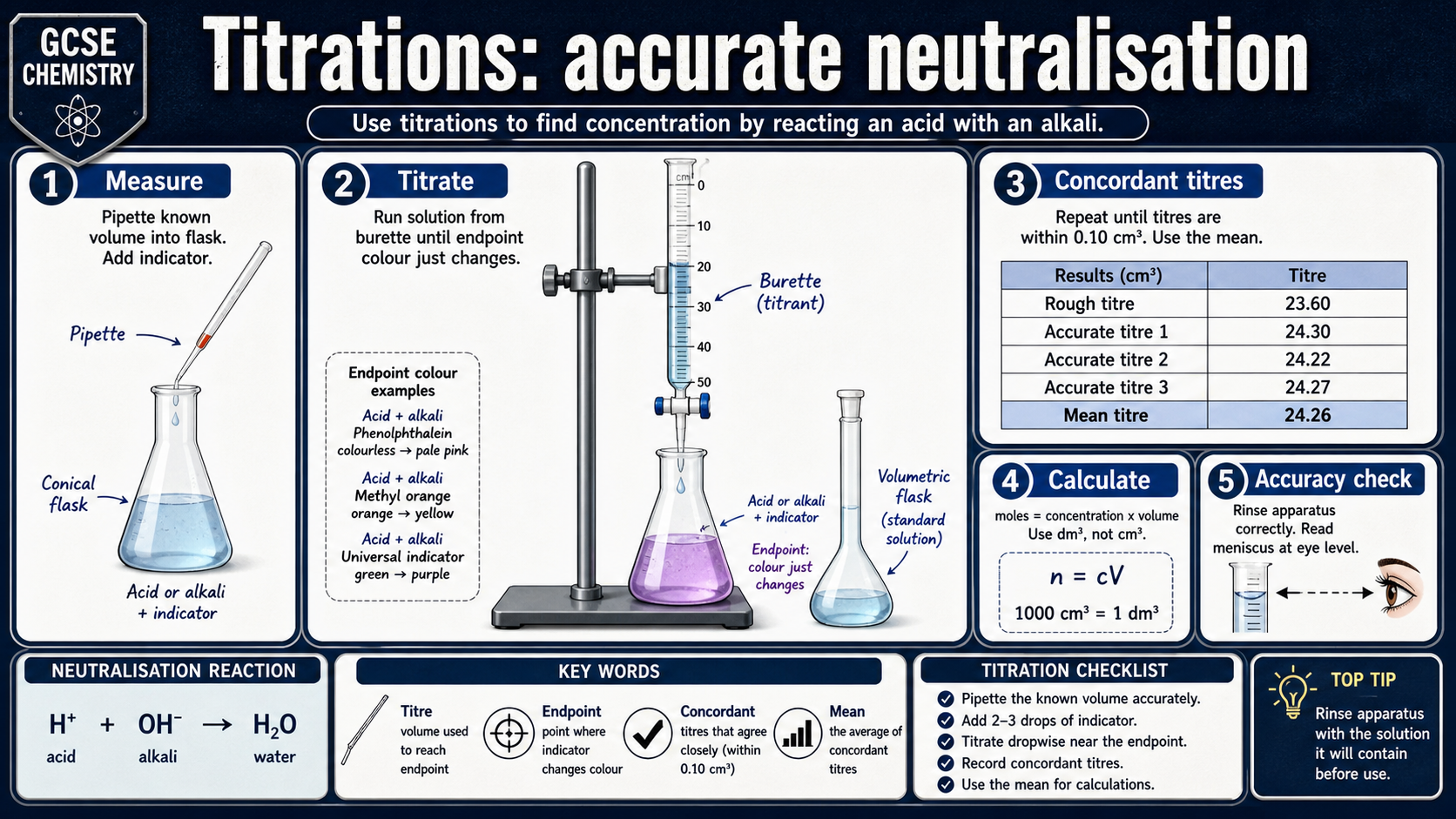
Titrations practice set
Use the worked examples and practice questions on this page as a complete study task: learn the titre and pipette meanings, summarise the infographic in your own words, then answer the questions using the data, equations and observations given here. Check every answer for mean titre, molar ratio and concentration.
Clear explanation
Titration method and calculations is built around titration method and concentration calculations. Start by learning what titre and pipette mean, then connect them to the sequence in the infographic.
The key GCSE skill is to move from evidence to explanation: name the observation, data trend, particle model, structure or reaction, then explain why it supports the conclusion.
For calculation or data work, show mean titre, molar ratio and concentration. For written explanations, include the specific chemistry reason rather than a memorised topic sentence.
Worked examples
Titrations: explaining the model
Start with the first relevant idea: Pipette measured acid/alkali into flask.
Then connect it to the next part of the chemistry: Add indicator.
Finish with the result or explanation: Run titrant from burette to endpoint.
Titrations: using evidence
Use this evidence or method detail: titration uses careful pipette, burette and indicator technique to measure reacting volumes.
Identify the useful data, observation or apparatus detail before writing the explanation.
Process the information with mean titre, molar ratio and concentration.
Finish by linking the result to titre and pipette.
Quick checks
Choose an answer, then check your thinking.
1. Which statement is a useful first step for titrations?
2. Which detail makes the answer specific rather than vague?
Practice questions
Question 1
Define titre in the context of titration method and calculations.
Reveal answer and marking guidance
Answer: titre is a key idea in titration method and concentration calculations; define it using the exact particle, structure, reaction or observation language from the lesson.
Marking: Credit a precise topic definition, not just the keyword repeated.
Question 2
Use the infographic to describe the main sequence in Titrations.
Reveal answer and marking guidance
Answer: Pipette measured acid/alkali into flask -> Add indicator -> Run titrant from burette to endpoint -> Use concordant titres for the mean.
Marking: Credit the correct order and a clear chemistry link between steps.
Question 3
What specialist term or calculation habit is important for Titrations?
Reveal answer and marking guidance
Answer: A relevant answer should use terms such as titre, pipette, burette, concordant and calculation habits such as mean titre, molar ratio and concentration.
Marking: Credit a topic-relevant term with a reason for using it.
Question 4
A student writes: 'titre is involved.' Add the missing chemistry detail.
Reveal answer and marking guidance
Answer: A stronger answer uses pipette accurately and adds evidence from the model: Pipette measured acid/alkali into flask then Add indicator.
Marking: Credit precise topic language plus evidence from the model, data or practical context.
Practice ladder
Answers and marking guidance
The exact practice answers are hidden under each question so you can try first. Marks come from using the correct chemistry model, choosing the right equation where needed, keeping units with values, and explaining changes with precise words such as particles, ions, bonds, energy, rate, evidence and uncertainty.
Common mistakes
- Describing the model steps without using titre or pipette to explain the chemistry behind them.
- Forgetting mean titre, molar ratio and concentration when they matter.
- Mixing up atoms, ions, molecules and compounds.
- Writing a memorised sentence about burette that does not match the substances in the question.
Extension challenge
Create a six-line revision card for titration method and calculations: two definitions, one infographic detail or equation line, one equation or data check, one common mistake, and one complete explanation sentence using titre, pipette, burette.
Reveal answer
Example answer: A complete response names the chemistry model, uses accurate units or observations, and explains why the evidence supports the conclusion.
Exam-board guidance
Short board notes only. Learn the core chemistry above first.
AQA GCSE Chemistry
Often links this topic to quantitative chemistry through titre and pipette. Question wording and depth can vary by board.
OCR GCSE Chemistry
Often links this topic to quantitative chemistry through titre and pipette. Question wording and depth can vary by board.
Pearson Edexcel GCSE Chemistry
Often links this topic to quantitative chemistry through titre and pipette. Question wording and depth can vary by board.
Eduqas GCSE Chemistry
Often links this topic to quantitative chemistry through titre and pipette. Question wording and depth can vary by board.
WJEC Wales
Often links this topic to quantitative chemistry through titre and pipette. Question wording and depth can vary by board.
CCEA GCSE Chemistry
Often links this topic to quantitative chemistry through titre and pipette. Question wording and depth can vary by board.
Next lesson
Next, continue with Acids, alkalis and pH.