
Lesson overview
Explain privacy, legal and ethical issues including personal data, consent, copyright and computer misuse.
Focus: Data privacy, law and ethics.
What you will learn
- Define the key GCSE Computer Science terms used in data privacy, law and ethics.
- Explain how personal data works in a practical scenario.
- Compare consent with an alternative or related method.
- Apply data privacy, law and ethics accurately in exam-style questions.
Before you start
- Cybersecurity.
- Databases.
- Everyday online services.
Privacy and Ethics scenarios
Use the app, school database and media-sharing examples below to separate legal, ethical and privacy issues.
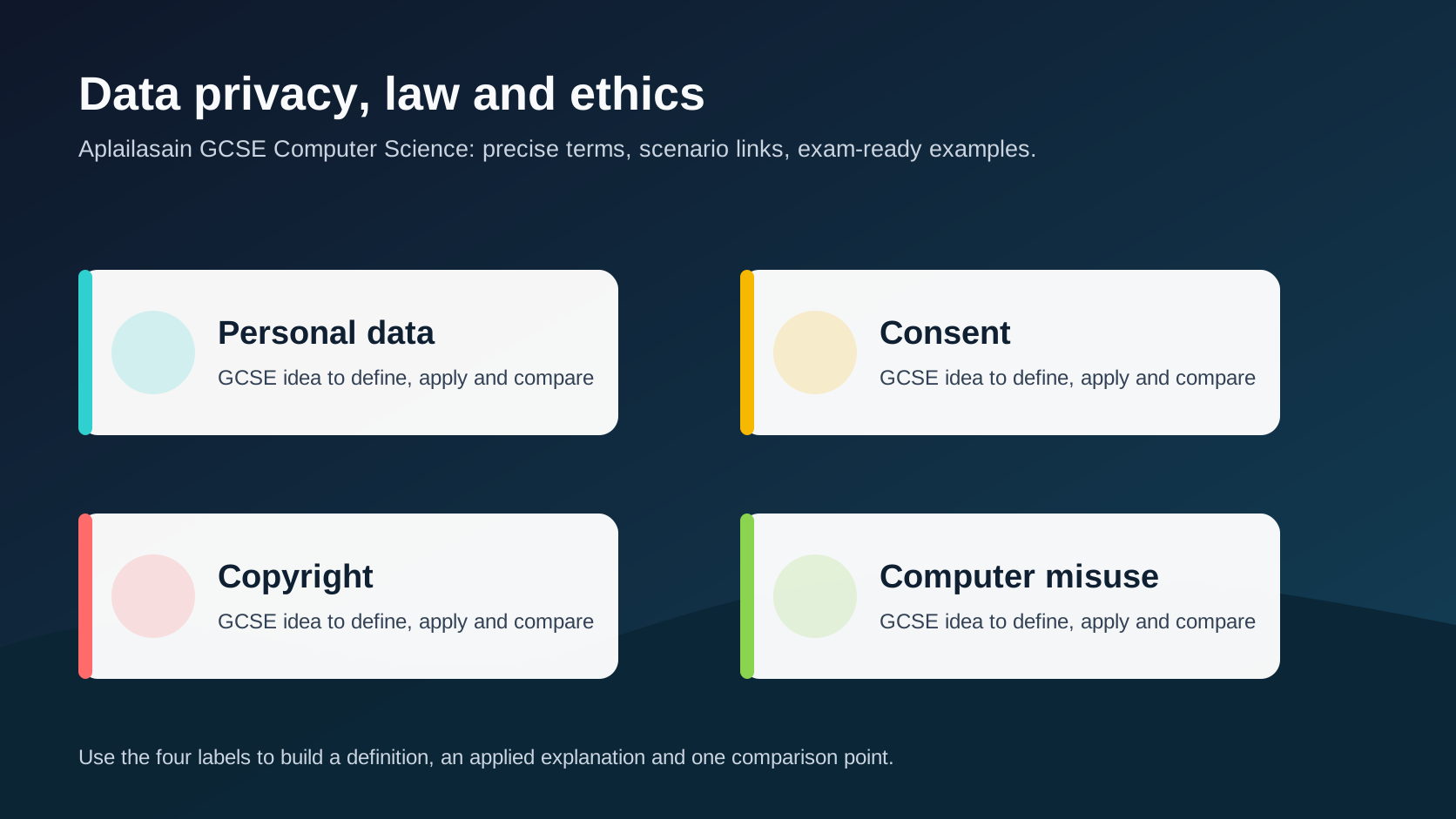
Data privacy, law and ethics infographic
Explanation
Computing decisions affect people, so GCSE answers often ask for legal, ethical, environmental, cultural or privacy impacts.
Personal data must be handled fairly and securely. Users should understand what data is collected, why it is needed and how it will be used.
Copyright protects creative work, and computer misuse laws make unauthorised access or interference illegal. Ethical questions can go beyond what is strictly legal.
Worked examples
Applying privacy and ethics
An app collects location data even when it does not need it for the advertised feature.
The privacy notice is unclear.
Users cannot easily opt out.
Answer: This raises privacy and ethical concerns because data collection is excessive and consent is not clearly informed.
Quick checks
1. What is personal data?
- a. Only binary digits
- b. Only public domain images
- c. Data that can identify a living person
Reveal answer
Answer: c. Correct. Personal data can identify someone directly or indirectly.
Not quite. Focus on personal data in the scenario.
2. Which idea is most closely linked to data privacy, law and ethics?
- a. Computer misuse
- b. A monitor brightness setting
- c. A random file extension
Reveal answer
Answer: a. Correct. Computer misuse is part of this topic.
Not quite. Choose the option that belongs to the Computer Science concept.
Practice
1. Give one example of personal data.
Reveal answer
Answer: Name, address, email, location, photo, ID number or health information.
Marking: Credit valid identifiable data.
2. Why does consent matter?
Reveal answer
Answer: Users should understand and agree to how their data is used.
Marking: Credit informed agreement.
3. What does copyright protect?
Reveal answer
Answer: Creative works such as text, images, music, video or software.
Marking: Credit creative work ownership.
4. Give one example of computer misuse.
Reveal answer
Answer: Unauthorised access, malware creation/distribution or disrupting systems.
Marking: Credit illegal misuse.
Exam practice ladder
- Fluency: recall the key term and use it accurately.
- Application: apply the idea to the scenario rather than giving a generic definition.
- Algorithmic reasoning: show the steps, condition or variable change clearly.
- Evaluation: explain why one method, structure or control is suitable.
Answers and marking guidance
Exact answers and marking guidance are hidden under each question. For this lesson, earn marks by naming the correct Computer Science idea, applying it to the scenario and showing the logic or value change clearly.
Common mistakes
- Saying ethical always means illegal.
- Ignoring indirect identification.
- Assuming anything online can be copied freely.
- Giving vague impacts without naming who is affected.
Extension
Evaluate a school facial-recognition attendance system using privacy, security, fairness and convenience.
Next lesson
Next, continue with Environmental impacts of computing.
Exam-board guidance
Aplailasain is an independent learning resource and is not endorsed by any exam board.
AQA GCSE Computer Science
AQA GCSE Computer Science: this skill supports problem solving, clear algorithms and accurate programming explanations.
OCR GCSE Computer Science
OCR GCSE Computer Science: expect precise algorithm reasoning, trace work and careful use of programming vocabulary.
Pearson Edexcel GCSE Computer Science
Pearson Edexcel GCSE Computer Science: practise explaining the method as well as giving the final answer or code.
Eduqas GCSE Computer Science
Eduqas GCSE Computer Science: secure the transferable idea first, then check how your class applies it in tasks.
WJEC Wales
WJEC Wales: use accurate terminology and show enough working for the examiner to follow your logic.
CCEA
CCEA: connect the idea to your class route and use the same algorithm, programming or systems vocabulary your teacher uses.