
Lesson overview
This lesson teaches reasoned judgement: deciding how far a writer’s choices work.
Judge how successfully a writer creates an effect, using evidence and reasons. It supports GCSE English Language, GCSE English Literature or both, depending on your course.
What you will learn
Key habits before you start
Reading comparison route
- Task focus: Identify whether the question asks you to retrieve, infer, compare, evaluate or summarise.
- Selection: Choose details that answer the question instead of copying long passages.
- Comparison: Link similarities and differences through ideas, attitudes and methods.
- Judgement: Support every evaluation with evidence from the text or source.
Why this matters
Evaluation questions often feel open-ended. They become clearer when you judge how well the writer achieves a specific effect.
Prior knowledge
You should already be comfortable with:
Practice source supplied on this page
Use the station source to practise evaluation: make a judgement about whether a writer’s choice works, then prove it with a precise moment.
Original fiction source for practice
The station clock had stopped at 6:17, though the morning had moved on without it. Maya stood beneath the cracked glass roof and watched rain gather in bright beads along the iron beams. Every few minutes a train passed through without stopping, dragging warm air and newspaper scraps across the platform. She kept one hand around the envelope in her pocket. It was not heavy, but it seemed to pull her shoulder down. At the far end, the old ticket office opened with a click.
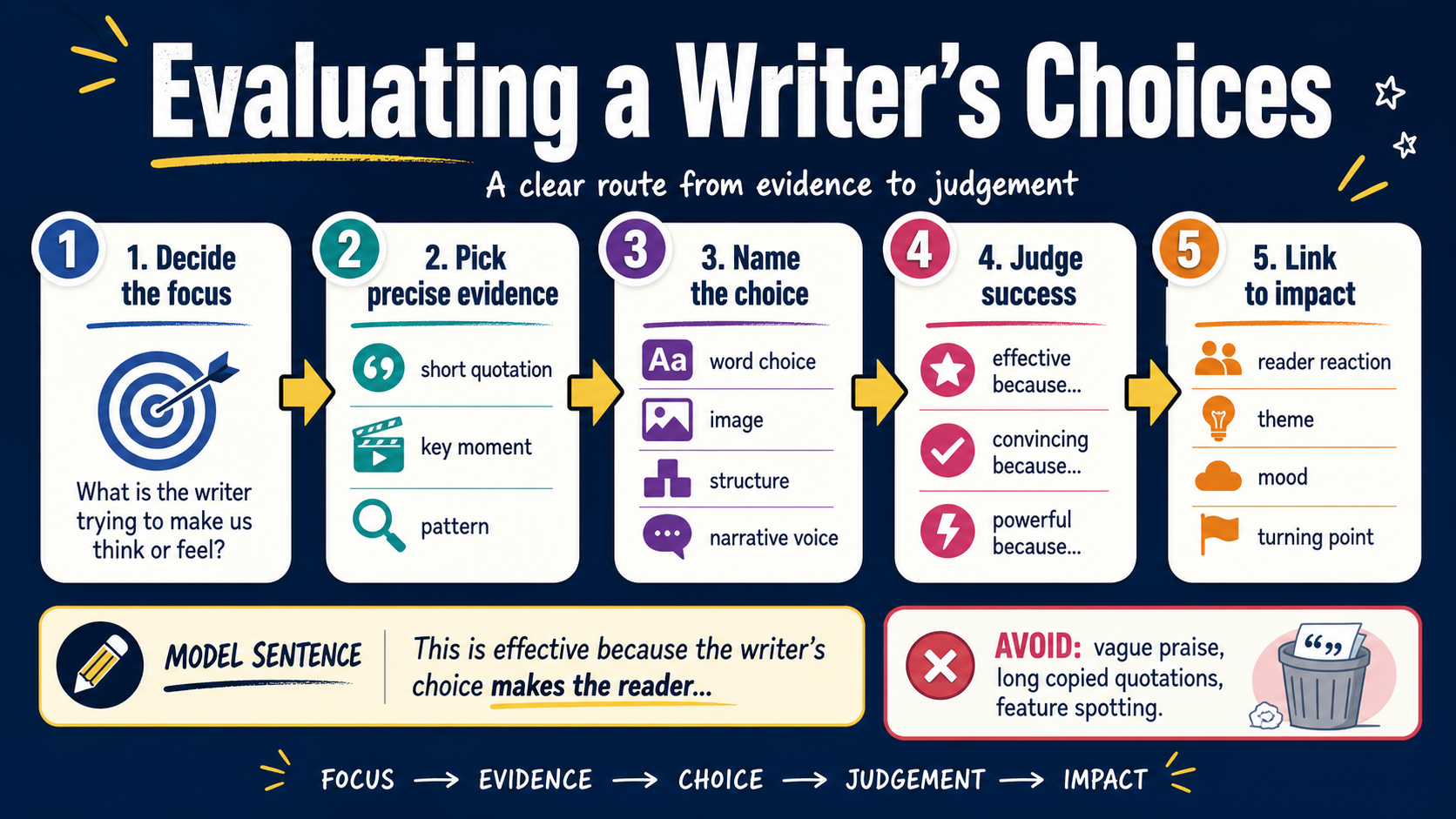
Evaluating a writer's choices infographic
Before viewing
Before viewing, decide whether the task needs selection, comparison, evaluation or synthesis.
After viewing
After viewing, write one sentence that links two details or sources without drifting into unsupported opinion.
Clear explanation
Main idea
Evaluation is not just saying whether you liked the text. It is judging how effectively the writer creates a response.
How to do it
Use the statement or question as your focus. Agree, partly agree or challenge it, then support your view.
Answer habit
Good evaluation uses precise evidence and words such as effective, convincing, powerful, unsettling or limited.
Worked examples
Evaluation statement
“The writer makes the place seem terrifying.”
Avoid vague judgement
Weak: “This is good.”
Quick checks
Choose an answer, then check your thinking.
1. An evaluation question asks whether the ending is effective. Which judgement is most useful?
2. What should you do after making an evaluative judgement?
Practice questions
Question 1
Evaluate the stopped clock as an opening detail.
Reveal answer and marking guidance
Answer: It is effective because it immediately suggests time is wrong or stuck, creating unease before the plot develops.
Marking: Credit judgement plus reason.
Question 2
What makes an evaluation stronger than “I like it”?
Reveal answer and marking guidance
Answer: It explains how a choice affects the reader and why that effect fits the text.
Marking: Reward evidence-based judgement.
Question 3
Evaluate the final ticket-office click.
Reveal answer and marking guidance
Answer: It is effective because it changes stillness into expectation and makes the ending feel like a turning point.
Marking: Credit comment on placement and effect.
Question 4
Write one sentence beginning “This works because…”
Reveal answer and marking guidance
Answer: This works because the ordinary sound of a click becomes important after the long wait.
Marking: Reward precise reference and judgement.
Answers and marking guidance
The exact practice answers are hidden under each question so you can try first. For evaluation, reward a clear judgement about whether a choice works, supported by precise evidence from the station source. The answer should explain why the stopped clock, envelope or final click affects the reader, not just identify a device.
Common mistakes
- Only saying it is effective: give a reasoned judgement.
- Evaluating plot instead of method: judge how the writer creates the effect.
- Using no evidence: anchor judgement in a precise moment.
- Being too absolute: balanced evaluation can be stronger.
Extension challenge
Judge whether the final ticket-office click is an effective ending. Use one reason about structure and one about reader response.
Reveal answer
Example answer: A strong evaluation makes a clear judgement, supports it with the final shift and explains why the uncertainty keeps the reader engaged.
Exam-board guidance
Evaluation questions often reward judgement plus evidence. Use this lesson when asked how far a writer succeeds or whether a moment is effective.
AQA GCSE English
Check the mark value and assessment focus, then keep evidence and analysis tied to the exact question.
OCR GCSE English
Use precise references and organise the response around the command word rather than a memorised answer.
Pearson Edexcel GCSE English
Match the lesson skill to the relevant paper question, source, set text or writing form.
Eduqas GCSE English
Adapt the technique to the component your school is preparing for, especially timing and question wording.
WJEC Wales
Check whether your course uses current Wales-specific routes, then apply the same evidence and accuracy habits.
CCEA GCSE English
Use the unit focus to balance evidence, explanation, comparison, context and written accuracy.
Next lesson
Next, continue with Summary and Synthesis.