
Lesson overview
This lesson is about selecting and combining only the information the question asks for.
Select important information and combine it into a concise answer. It supports GCSE English Language, GCSE English Literature or both, depending on your course.
What you will learn
Key habits before you start
Reading comparison route
- Task focus: Identify whether the question asks you to retrieve, infer, compare, evaluate or summarise.
- Selection: Choose details that answer the question instead of copying long passages.
- Comparison: Link similarities and differences through ideas, attitudes and methods.
- Judgement: Support every evaluation with evidence from the text or source.
Why this matters
Summary skills help with non-fiction comparison and with revising literature texts without drowning in detail.
Prior knowledge
You should already be comfortable with:
Practice sources supplied on this page
Use the two lido sources to practise concise summary and synthesis: select only relevant information and combine linked ideas.
Source A: original article opening
Our town should protect the old lido because public spaces give people more than somewhere to swim. They hold memories, routines and chances for neighbours to meet. A new car park may be convenient, but convenience is a poor exchange for a place that has served generations.
Source B: original letter opening
I understand why some residents feel attached to the old lido, but sentiment cannot repair cracked tiles or pay rising maintenance costs. The site is unused for most of the year. A safer, modern facility would serve more people and cost less to maintain.
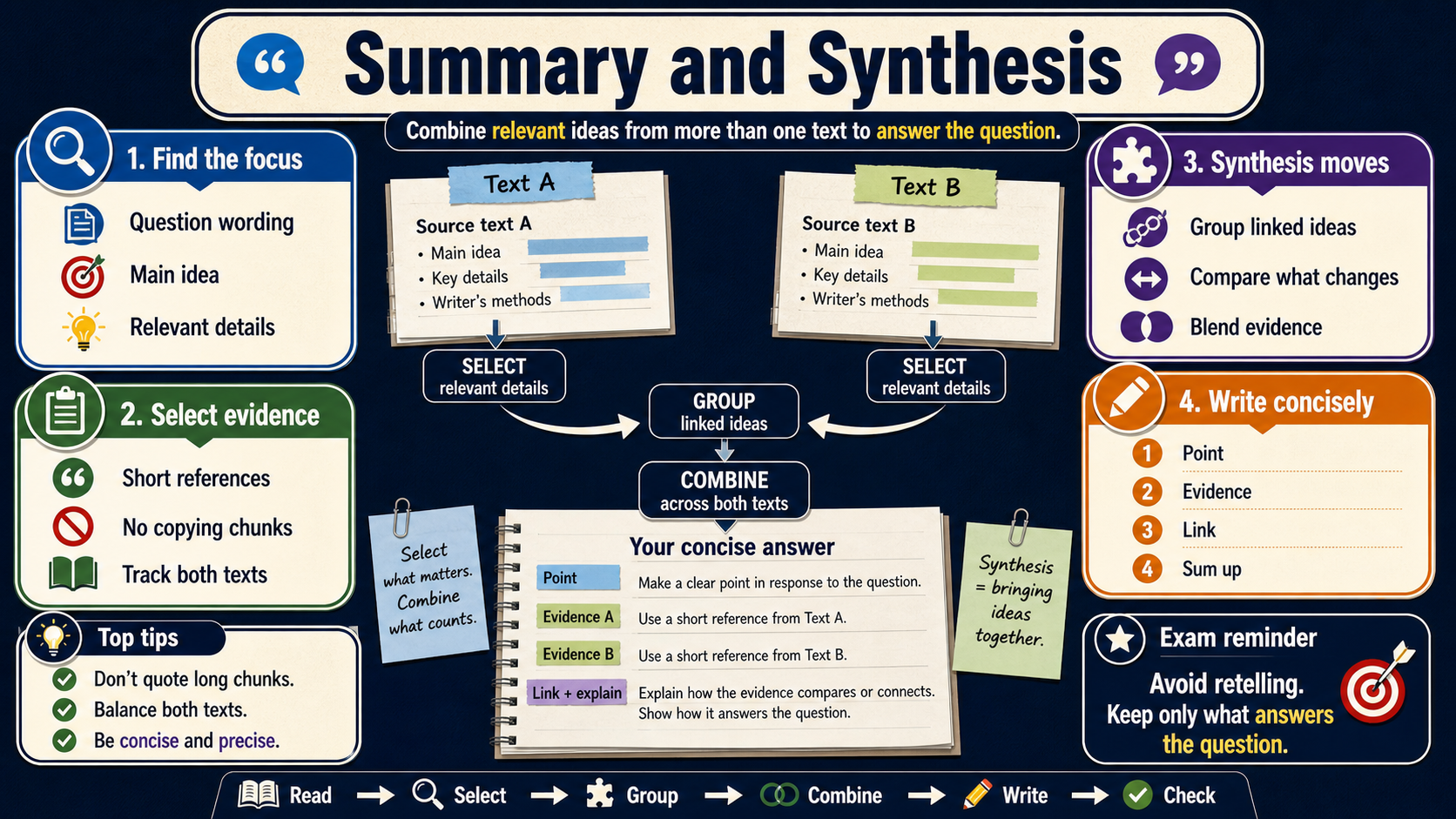
Summary and synthesis infographic
Before viewing
Before viewing, decide whether the task needs selection, comparison, evaluation or synthesis.
After viewing
After viewing, write one sentence that links two details or sources without drifting into unsupported opinion.
Clear explanation
Main idea
A summary should be shorter than the original and should focus only on what the question asks for.
How to do it
Do not copy large chunks. Use your own words where possible, with short references if needed.
Answer habit
Synthesis means combining information from different parts of a text or from two texts into one clear point.
Worked examples
Focused summary
Question: Summarise what we learn about the traveller’s difficulties.
Synthesis
Both texts show travel as uncomfortable, but one presents it as exciting while the other presents it as exhausting.
Quick checks
Choose an answer, then check your thinking.
1. Two sources describe different rescue attempts. What belongs in a synthesis answer?
2. Which phrase signals useful synthesis?
Practice questions
Question 1
Summarise Source A’s argument about the lido in one sentence.
Reveal answer and marking guidance
Answer: The lido should be protected because it holds community memories and brings people together.
Marking: Credit concise selection.
Question 2
Summarise Source B’s argument in one sentence.
Reveal answer and marking guidance
Answer: The lido should close because repairs are expensive and the money could serve more urgent needs.
Marking: Credit relevant selection.
Question 3
Synthesize both sources into one balanced point.
Reveal answer and marking guidance
Answer: Both writers discuss public value, but Source A values shared memory while Source B values practical spending.
Marking: Reward combining, not copying.
Question 4
What should be left out of a summary answer?
Reveal answer and marking guidance
Answer: Detailed language analysis, personal opinion and irrelevant background.
Marking: Credit discipline and relevance.
Answers and marking guidance
The exact practice answers are hidden under each question so you can try first. For summary and synthesis, reward selection and compression: combine linked ideas from both sources, remove examples that do not answer the focus, and use concise wording that shows the relationship between details.
Common mistakes
- Copying whole examples: summary needs selection.
- Listing two sources separately: synthesis combines linked ideas.
- Adding analysis when not asked: keep to relevant information.
- Being vague: compressed does not mean empty.
Extension challenge
Summarise the two lido sources in two sentences: one shared issue and one key difference.
Reveal answer
Example answer: A strong synthesis selects only relevant details and shows the relationship between the sources without turning into a full comparison essay.
Exam-board guidance
Summary and synthesis tasks vary by paper. Use the command word to decide whether to retrieve, summarise, synthesise or compare.
AQA GCSE English
Check the mark value and assessment focus, then keep evidence and analysis tied to the exact question.
OCR GCSE English
Use precise references and organise the response around the command word rather than a memorised answer.
Pearson Edexcel GCSE English
Match the lesson skill to the relevant paper question, source, set text or writing form.
Eduqas GCSE English
Adapt the technique to the component your school is preparing for, especially timing and question wording.
WJEC Wales
Check whether your course uses current Wales-specific routes, then apply the same evidence and accuracy habits.
CCEA GCSE English
Use the unit focus to balance evidence, explanation, comparison, context and written accuracy.
Next lesson
Next, continue with Descriptive Writing.