
Lesson overview
This lesson builds controlled atmosphere through focus, sensory detail and deliberate shifts.
Use precise detail, structure and sentence control to create a vivid description. It supports GCSE English Language, GCSE English Literature or both, depending on your course.
What you will learn
Key habits before you start
Writing control route
- Purpose: Decide whether the writing should describe, argue, persuade, inform, narrate or present.
- Audience and form: Match tone, structure and detail to the reader and task format.
- Paragraph control: Build paragraphs around a clear focus, then vary sentence shape deliberately.
- Accuracy: Check sentence boundaries, punctuation, spelling and tense before finishing.
Why this matters
Descriptive writing rewards control. The best answers are not just lists of adjectives; they guide the reader’s attention.
Prior knowledge
You should already be comfortable with:
Practice prompts supplied on this page
Use these prompts to practise controlled description: build atmosphere through viewpoint, sensory detail, zooming in and a final image.
Prompt bank
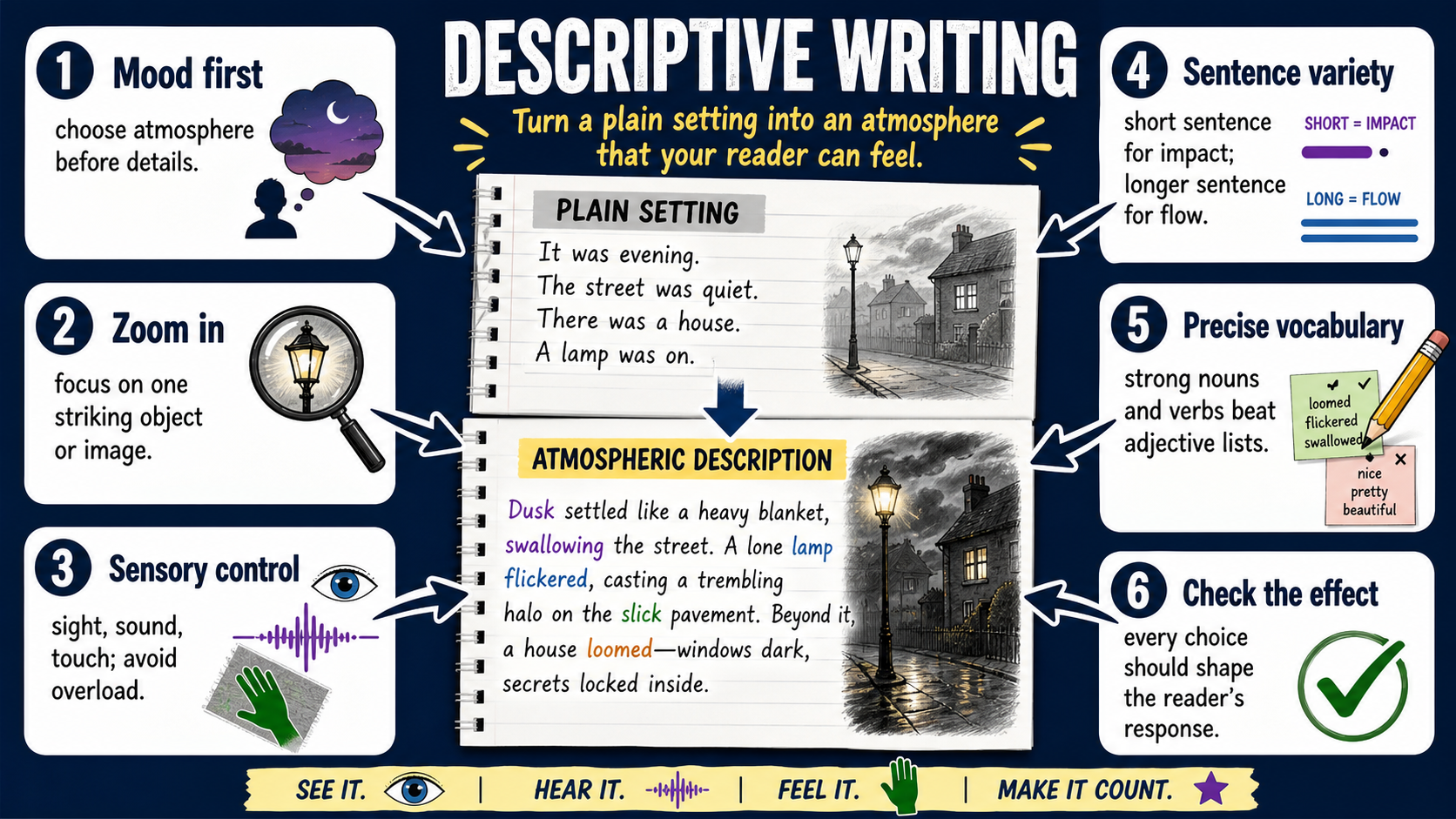
Descriptive writing control infographic
Before viewing
Before viewing, identify the purpose, audience and form of the writing task you are practising.
After viewing
After viewing, revise one sentence or paragraph so it better matches the task purpose and audience.
Clear explanation
Main idea
Choose a mood first, such as calm, threatening, lonely or celebratory. Every detail should help build that mood.
How to do it
Use a camera approach: wide shot, zoom in, shift focus, then end on a memorable detail.
Answer habit
Accuracy matters. Commas, full stops, tense control and paragraphing protect writing marks.
Worked examples
Wide to narrow
The beach stretched under a pale sky. At the water’s edge, one cracked shell rocked in the foam.
Controlled vocabulary
Instead of “very scary”, use “uneasy”, “hostile” or “claustrophobic” if they fit.
Quick checks
Choose an answer, then check your thinking.
1. A description of an ordinary shop needs to become unsettling. Which choice gives the best control?
2. Which sentence is most descriptive rather than narrative?
Practice questions
Question 1
Plan a description of an ordinary shop becoming unsettling in four stages.
Reveal answer and marking guidance
Answer: Wide view, one strange detail, sharper sensory focus, final image that leaves unease.
Marking: Credit controlled structure.
Question 2
Write one sentence that makes a normal object feel unsettling.
Reveal answer and marking guidance
Answer: The freezer light blinked behind the glass as if something inside had opened one eye.
Marking: Reward sensory detail and mood.
Question 3
Why is a description not the same as a story?
Reveal answer and marking guidance
Answer: Description can stay focused on place, mood and image rather than a chain of events.
Marking: Credit genre awareness.
Question 4
What should you check after drafting?
Reveal answer and marking guidance
Answer: Check that each paragraph develops the same atmosphere rather than adding random action.
Marking: Reward control.
Answers and marking guidance
The exact practice answers are hidden under each question so you can try first. For description, reward atmosphere built through viewpoint, sensory detail, zooming and a final image. A strong answer can use the ordinary shop prompt without turning it into a full plot; the focus should stay on crafted description.
Common mistakes
- Turning description into a long story: keep focus on atmosphere and detail.
- Listing senses mechanically: select details that build one mood.
- Using random vocabulary: ambitious words must fit the image.
- Ending abruptly: use a final image or shift to give control.
Extension challenge
Describe the same ordinary shop twice: once as welcoming and once as unsettling, changing only viewpoint, detail and sentence rhythm.
Reveal answer
Example answer: A strong response controls atmosphere through selected images, zoom, contrast and sentence rhythm rather than adding unnecessary plot.
Exam-board guidance
Descriptive-writing tasks may use images, titles or prompts. Across boards, plan viewpoint and atmosphere first, then shape paragraphs and accuracy for the available marks.
AQA GCSE English
Check the mark value and assessment focus, then keep evidence and analysis tied to the exact question.
OCR GCSE English
Use precise references and organise the response around the command word rather than a memorised answer.
Pearson Edexcel GCSE English
Match the lesson skill to the relevant paper question, source, set text or writing form.
Eduqas GCSE English
Adapt the technique to the component your school is preparing for, especially timing and question wording.
WJEC Wales
Check whether your course uses current Wales-specific routes, then apply the same evidence and accuracy habits.
CCEA GCSE English
Use the unit focus to balance evidence, explanation, comparison, context and written accuracy.
Next lesson
Next, continue with Narrative Writing.