
Lesson overview
This lesson shapes a short exam story around conflict, turning point and consequence.
Build a focused story with a clear conflict, turning point and ending. It supports GCSE English Language, GCSE English Literature or both, depending on your course.
What you will learn
Key habits before you start
Writing control route
- Purpose: Decide whether the writing should describe, argue, persuade, inform, narrate or present.
- Audience and form: Match tone, structure and detail to the reader and task format.
- Paragraph control: Build paragraphs around a clear focus, then vary sentence shape deliberately.
- Accuracy: Check sentence boundaries, punctuation, spelling and tense before finishing.
Why this matters
Narrative writing does not need a huge plot. A focused moment, clearly shaped, is usually more effective in exam time.
Prior knowledge
You should already be comfortable with:
Practice prompts supplied on this page
Use these prompts to practise short story control: establish a problem, create a turning point, and make the ending connect back to the opening.
Prompt bank
Narrative writing control infographic
Before viewing
Before viewing, identify the purpose, audience and form of the writing task you are practising.
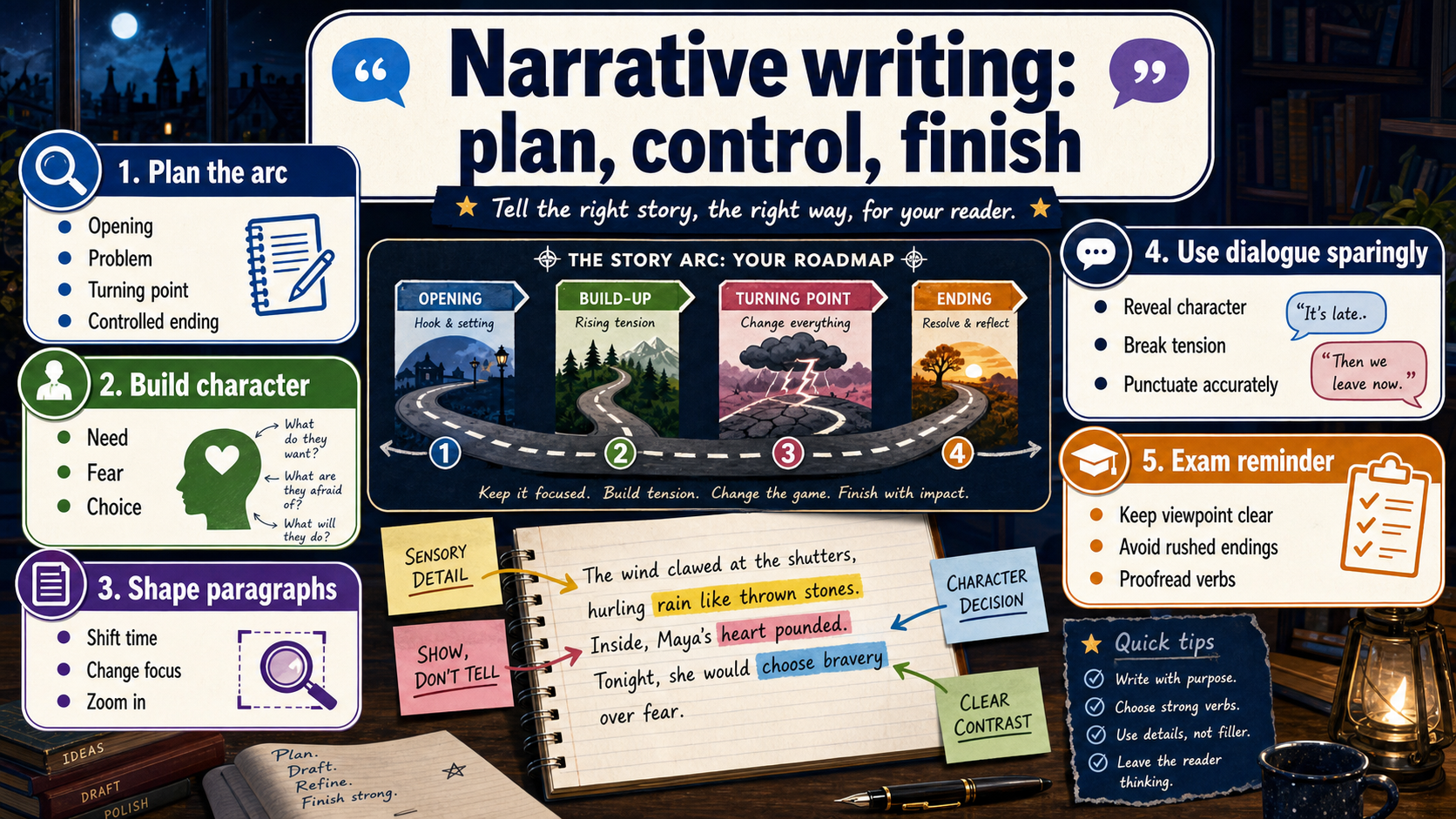
After viewing
After viewing, revise one sentence or paragraph so it better matches the task purpose and audience.
Clear explanation
Main idea
A simple arc works well: situation, problem, complication, turning point, ending. Keep the time span manageable.
How to do it
Start close to the action. You do not need a long backstory.
Answer habit
Dialogue should reveal character or move the story forward. Punctuate it carefully and avoid pages of conversation.
Worked examples
Focused plot
A pupil loses an important letter on the bus and must decide whether to tell the truth.
Ending
The ending can resolve the problem or leave a deliberate question.
Quick checks
Choose an answer, then check your thinking.
1. A story prompt shows an unopened envelope. What makes the strongest plot plan?
2. Which ending is most controlled for a short GCSE narrative?
Practice questions
Question 1
Use the unopened envelope prompt: what should the envelope force the character to do?
Reveal answer and marking guidance
Answer: It should force a decision, reveal a secret or change a relationship.
Marking: Credit consequence.
Question 2
Write a controlled opening sentence for the envelope story.
Reveal answer and marking guidance
Answer: The envelope had no stamp, no address, and my name written in handwriting I had not seen for years.
Marking: Reward hook and relevance.
Question 3
What is the turning point in a short narrative?
Reveal answer and marking guidance
Answer: The moment the character can no longer avoid the problem.
Marking: Credit story shape.
Question 4
Why should the ending connect back to the opening?
Reveal answer and marking guidance
Answer: It makes the story feel planned and shows how something has changed.
Marking: Reward structural control.
Answers and marking guidance
The exact practice answers are hidden under each question so you can try first. For narrative writing, reward a compact story shape: opening situation, problem, turning point and consequence. The unopened-envelope prompt should create pressure and choice, not a sprawling plot that cannot be controlled in exam time.
Common mistakes
- Planning too many events: a GCSE narrative needs a controlled arc.
- Starting too slowly: establish tension early.
- Forgetting consequence: the ending should connect to the opening.
- Switching viewpoint accidentally: keep control of perspective.
Extension challenge
Plan a story around the unopened envelope in five beats: opening, pressure, decision, turning point and consequence.
Reveal answer
Example answer: A strong plan is small enough to write well: one central pressure, one turning point and an ending that makes the opening matter.
Exam-board guidance
Narrative-writing prompts vary by board, but controlled structure is always valuable. Plan a manageable conflict and protect sentence accuracy.
AQA GCSE English
Check the mark value and assessment focus, then keep evidence and analysis tied to the exact question.
OCR GCSE English
Use precise references and organise the response around the command word rather than a memorised answer.
Pearson Edexcel GCSE English
Match the lesson skill to the relevant paper question, source, set text or writing form.
Eduqas GCSE English
Adapt the technique to the component your school is preparing for, especially timing and question wording.
WJEC Wales
Check whether your course uses current Wales-specific routes, then apply the same evidence and accuracy habits.
CCEA GCSE English
Use the unit focus to balance evidence, explanation, comparison, context and written accuracy.
Next lesson
Next, continue with Viewpoint and Persuasive Writing.