
Lesson overview
This lesson develops a clear viewpoint and shapes it for a reader or listener.
Write speeches, articles and letters that argue a clear viewpoint. It supports GCSE English Language, GCSE English Literature or both, depending on your course.
What you will learn
Key habits before you start
Writing control route
- Purpose: Decide whether the writing should describe, argue, persuade, inform, narrate or present.
- Audience and form: Match tone, structure and detail to the reader and task format.
- Paragraph control: Build paragraphs around a clear focus, then vary sentence shape deliberately.
- Accuracy: Check sentence boundaries, punctuation, spelling and tense before finishing.
Why this matters
Viewpoint writing appears in many GCSE Language papers. Strong answers sound purposeful, organised and accurate.
Prior knowledge
You should already be comfortable with:
Practice prompts supplied on this page
Use these prompts to practise viewpoint writing: state a clear position, support it with specific detail and shape the voice for the audience.
Prompt bank
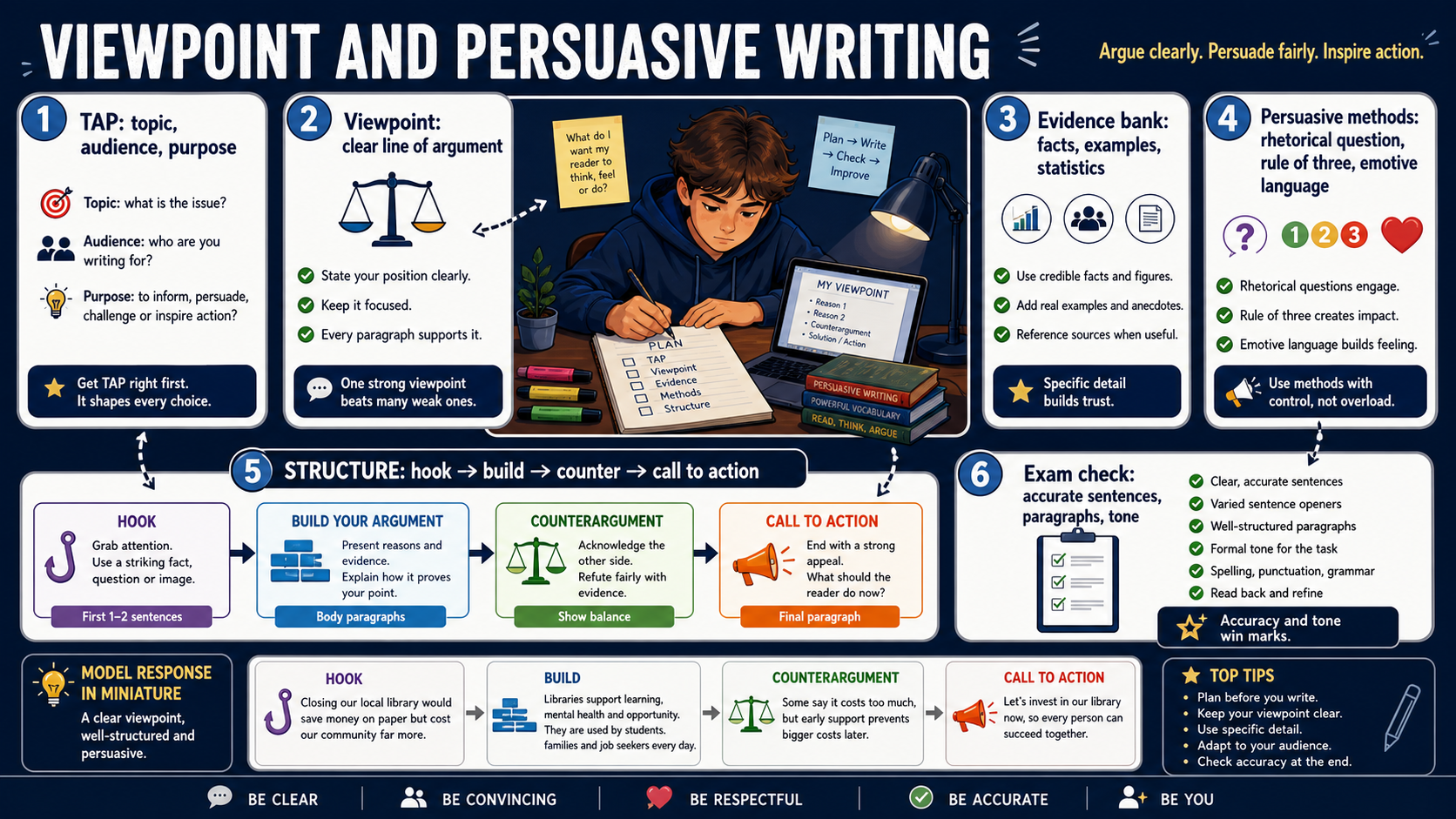
Viewpoint and persuasive writing infographic
Before viewing
Before viewing, identify the purpose, audience and form of the writing task you are practising.
After viewing
After viewing, revise one sentence or paragraph so it better matches the task purpose and audience.
Clear explanation
Main idea
Before writing, decide what you want your reader or listener to think, feel or do.
How to do it
Use methods such as direct address, rhetorical questions, contrast, repetition, anecdote and statistics, but do not force every method in.
Answer habit
Form matters. A speech, article and letter can share ideas, but their openings, tone and signposting differ.
Worked examples
Speech opening
Friends, teachers and students, we need to talk about the way our school treats quiet spaces.
Controlled rhetoric
Repeating “We need” at the start of three paragraphs can create emphasis.
Quick checks
Choose an answer, then check your thinking.
1. You are arguing that an old public lido should be protected. Which opening has the clearest viewpoint?
2. Which detail would make the argument feel specific?
Practice questions
Question 1
Write a clear viewpoint about protecting the old lido.
Reveal answer and marking guidance
Answer: The old lido should be protected because it is a living community space, not just an outdated building.
Marking: Credit position plus reason.
Question 2
Add one specific supporting detail.
Reveal answer and marking guidance
Answer: Generations of local children learned to swim there, so closing it would erase shared memory.
Marking: Reward specificity.
Question 3
Write a counterargument and response.
Reveal answer and marking guidance
Answer: Some repairs are costly, but phased restoration would protect both budgets and community value.
Marking: Credit balance without losing viewpoint.
Question 4
Which form choices would change if this became a speech?
Reveal answer and marking guidance
Answer: Direct address, spoken signposting and a stronger sense of audience in the room.
Marking: Reward form awareness.
Answers and marking guidance
The exact practice answers are hidden under each question so you can try first. For viewpoint writing, reward a clear position, specific local detail, shaped voice and paragraph movement. The lido argument should sound purposeful and audience-aware rather than a generic list of opinions. Strong responses use concrete civic details, anticipate objections about cost or convenience and make the reader feel the issue matters now.
Common mistakes
- Sounding neutral: viewpoint writing needs a clear position.
- Using generic examples: local detail makes argument convincing.
- Forgetting audience: shape address and tone for the reader.
- Listing techniques: rhetorical choices need purpose.
Extension challenge
Write a 120-word opening arguing that the old lido should be protected, including one concession about cost.
Reveal answer
Example answer: A strong viewpoint opening sounds purposeful, uses concrete civic detail and handles an objection without losing its position.
Exam-board guidance
Viewpoint and persuasive tasks may ask for articles, letters, speeches or other forms. Keep the position clear and adapt voice to audience.
AQA GCSE English
Check the mark value and assessment focus, then keep evidence and analysis tied to the exact question.
OCR GCSE English
Use precise references and organise the response around the command word rather than a memorised answer.
Pearson Edexcel GCSE English
Match the lesson skill to the relevant paper question, source, set text or writing form.
Eduqas GCSE English
Adapt the technique to the component your school is preparing for, especially timing and question wording.
WJEC Wales
Check whether your course uses current Wales-specific routes, then apply the same evidence and accuracy habits.
CCEA GCSE English
Use the unit focus to balance evidence, explanation, comparison, context and written accuracy.
Next lesson
Next, continue with Sentence Accuracy and Paragraph Control.