
Lesson overview
Use this as transferable English technique.
Use an extract as a route into the whole text without getting trapped in one small moment. the core habits of close reading, precise evidence, controlled writing and checking apply across GCSE English.
What you will learn
Key habits before you start
Reading evidence route
- Explicit meaning: Start with what the text directly says before building an interpretation.
- Inference: Make a sensible conclusion that is supported by the words on the page.
- Evidence: Use short references that can be explained precisely.
- Explanation: Link the evidence back to the question, effect or writer's purpose.
Why this matters
Many literature questions ask pupils to start from an extract and then range across the whole text. Balance is the key skill.
Prior knowledge
You should already be comfortable with:
Extract-to-whole-text material
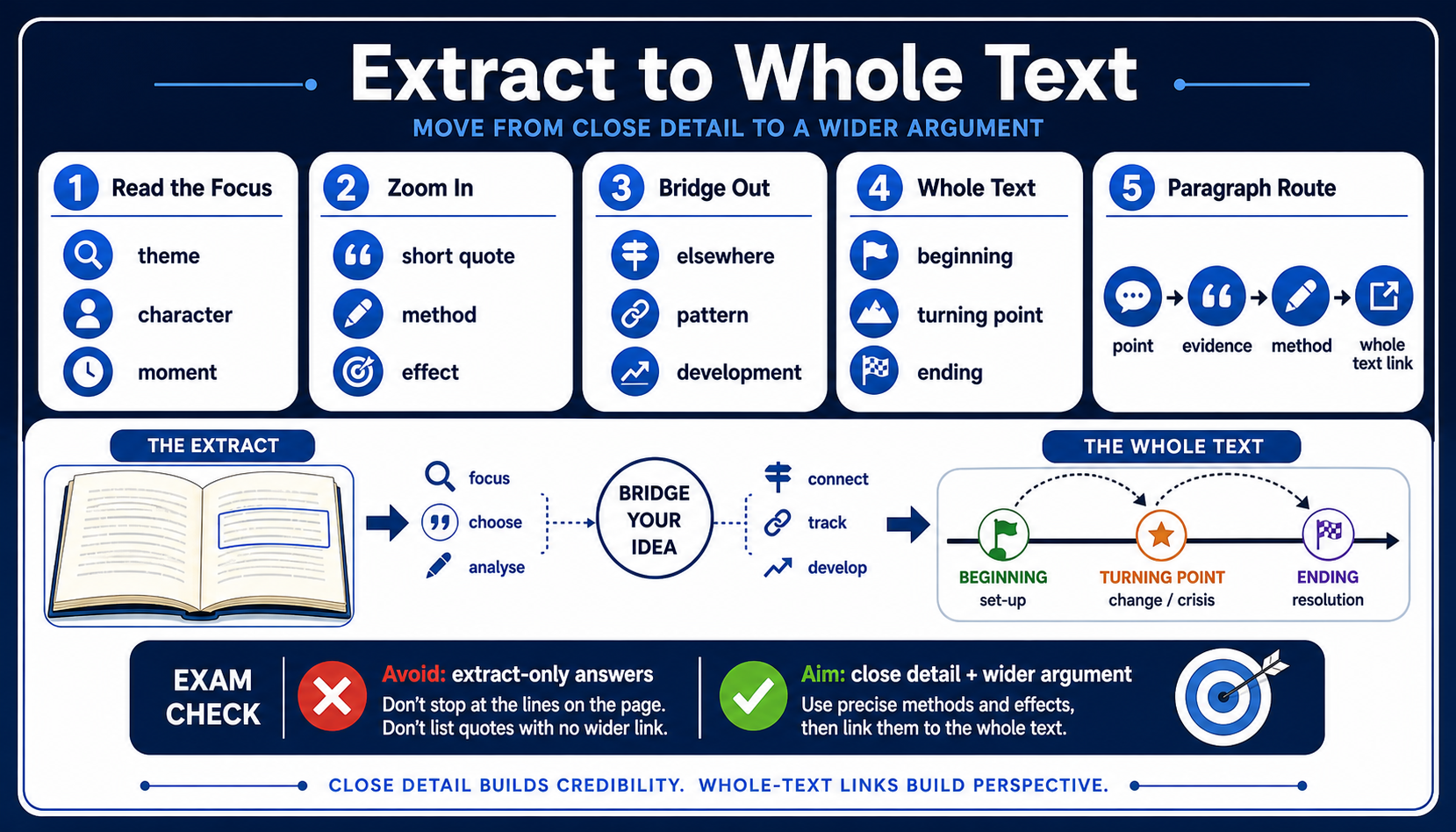
Use these prompts to practise moving from a printed extract to the wider text. The bridge should be explicit: same theme, changed character, repeated method or later consequence.
Bridge prompt bank
Extract-to-whole-text questions infographic
Before viewing
Before viewing, write the lesson title as a question: what should extract-to-whole-text questions help you do in an exam answer?
After viewing
After viewing, choose one label or route from the visual and use it to improve one sentence in your practice answer.
Clear explanation
Start with the question
Read the extract through the question focus, such as power, fear, conflict or responsibility.
Use the extract
Analyse a small number of details closely. Do not write about every line.
Move outward
Link the extract to earlier or later moments that develop the same idea.
Worked examples
Extract point
In this moment, the character appears controlled because the writer uses formal public language.
Whole-text link
Later, that control breaks down, so the extract can be seen as part of a wider change.
Quick checks
Choose an answer, then check your thinking.
1. An extract question on Macbeth starts with one scene. What must the answer also do?
2. Which sentence makes the best bridge from extract to whole text?
Practice questions
Question 1
What should an extract paragraph do first?
Reveal answer and marking guidance
Answer: Analyse the given moment closely using the question focus.
Marking: Credit extract focus.
Question 2
What should the whole-text link do?
Reveal answer and marking guidance
Answer: Show how the same idea develops elsewhere in the text.
Marking: Reward wider route.
Question 3
Write a bridge sentence for Macbeth.
Reveal answer and marking guidance
Answer: This moment begins a pattern of secrecy that becomes more violent after Duncan’s murder.
Marking: Credit precise bridge.
Question 4
What is the common mistake?
Reveal answer and marking guidance
Answer: Ignoring either the extract or the rest of the text.
Marking: Reward balanced coverage.
Answers and marking guidance
The exact practice answers are hidden under each question so you can try first. For extract-to-whole-text work, reward a secure bridge from the printed extract to named later or earlier moments. The answer should keep returning to the question focus instead of bolting on disconnected whole-text knowledge.
Common mistakes
- Line-by-line commentary: select only useful details.
- Plot summary: turn knowledge into argument.
- Dropped context: connect context to this interpretation.
- No wider range: include meaningful links across the text.
Extension challenge
Choose one extract moment from a set text and write two bridge sentences to later moments in the whole text.
Reveal answer
Example answer: A strong bridge names the shared theme or character change, then explains why the wider-text moment develops the extract rather than merely adding plot.
Exam-board guidance
Extract-to-whole-text literature tasks vary by text and board. Practise moving from the printed passage to wider moments while keeping the same character, theme or method focus.
AQA GCSE English
Check the mark value and assessment focus, then keep evidence and analysis tied to the exact question.
OCR GCSE English
Use precise references and organise the response around the command word rather than a memorised answer.
Pearson Edexcel GCSE English
Match the lesson skill to the relevant paper question, source, set text or writing form.
Eduqas GCSE English
Adapt the technique to the component your school is preparing for, especially timing and question wording.
WJEC Wales
Check whether your course uses current Wales-specific routes, then apply the same evidence and accuracy habits.
CCEA GCSE English
Use the unit focus to balance evidence, explanation, comparison, context and written accuracy.
Next lesson
Next, practise single text literature essay walkthrough.