
Lesson overview
Use this as transferable English technique.
Plan and write a focused essay on one literature text using argument, evidence, method and context. the core habits of close reading, precise evidence, controlled writing and checking apply across GCSE English.
What you will learn
Key habits before you start
Literature argument route
- Thesis: Open with a clear argument about the writer's idea or message.
- Evidence range: Use short evidence from key moments across the text.
- Method: Explain how language, structure, characterisation or contrast shapes meaning.
- Whole text: Link moments together so the answer shows development, not isolated notes.
Why this matters
Strong literature essays are not memory dumps. They are shaped arguments about how writers create meanings.
Prior knowledge
You should already be comfortable with:
Single-text essay material
Use these prompts to rehearse a full literature essay route. Keep each plan tied to one text, one question focus and a small number of high-value moments.
Essay-route prompt bank
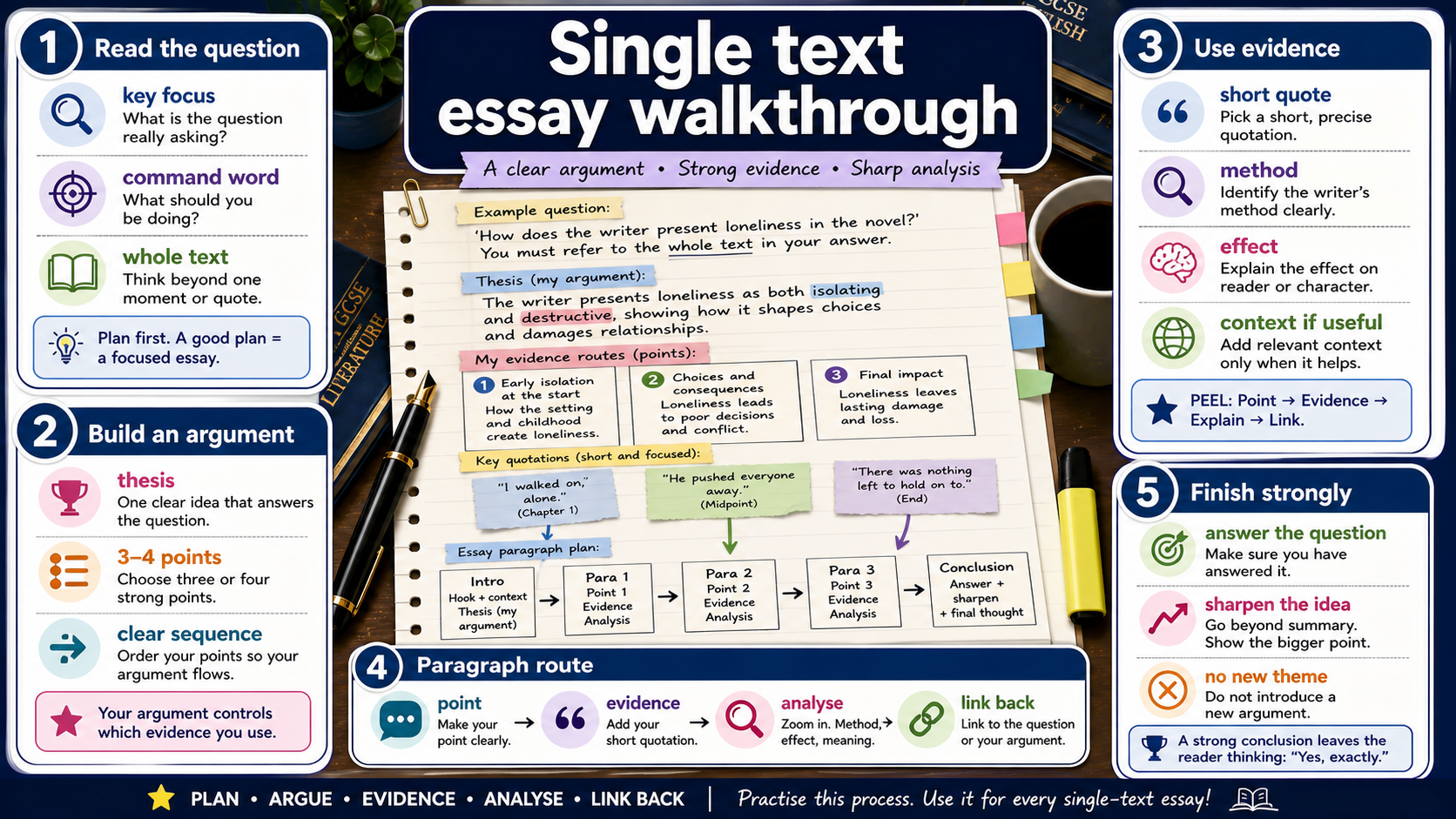
Single text literature essay walkthrough infographic
Before viewing
Before viewing, choose one theme, character or turning point that the visual should help you connect to evidence.
After viewing
After viewing, write one thesis sentence and one evidence sentence using the route shown in the visual.
Clear explanation
Thesis
A thesis is your overall answer to the question. It should be specific enough to guide every paragraph.
Paragraph movement
Each paragraph should add a new stage, reason or angle rather than repeat the same idea.
Context
Use context when it explains why an idea, conflict or method matters. Avoid detached biography.
Worked examples
Thesis
The writer presents responsibility as something characters resist before they are forced to confront its consequences.
Paragraph route
Start with public behaviour, then private reaction, then final change.
Quick checks
Choose an answer, then check your thinking.
1. What should a single-text essay walkthrough prioritise after reading the question?
2. Which conclusion is strongest?
Practice questions
Question 1
What should happen before choosing quotations?
Reveal answer and marking guidance
Answer: Decide the argument the essay will prove.
Marking: Credit argument-first planning.
Question 2
What makes a paragraph part of a line of thought?
Reveal answer and marking guidance
Answer: It develops, complicates or proves the thesis rather than sitting separately.
Marking: Reward essay coherence.
Question 3
Write a conclusion move.
Reveal answer and marking guidance
Answer: Return to the question and sharpen what the writer finally suggests about the theme.
Marking: Credit purposeful conclusion.
Question 4
What should you avoid in a single-text essay?
Reveal answer and marking guidance
Answer: Retelling the plot in order without analysing writer choices.
Marking: Reward analytical focus.
Answers and marking guidance
The exact practice answers are hidden under each question so you can try first. For a single-text essay, reward a thesis that answers the exact question, paragraphs ordered by argument rather than plot, short evidence and a conclusion that sharpens the interpretation instead of repeating the introduction.
Common mistakes
- Starting with biography: start with the question and text.
- Narrating the plot: select moments that prove the argument.
- Method labels without argument: analyse how the writer shapes meaning.
- One paragraph repeated: make each paragraph add something new.
Extension challenge
Plan three different thesis statements for the same studied text question. Decide which is the most specific and why.
Reveal answer
Example answer: A strong thesis is arguable, text-specific and narrow enough to organise the whole essay around precise moments.
Exam-board guidance
Single-text literature essays depend on your set text and extract style. Use this page to practise thesis, paragraph order and whole-text coverage for the specific novel, play or prose text you study.
AQA GCSE English
Check the mark value and assessment focus, then keep evidence and analysis tied to the exact question.
OCR GCSE English
Use precise references and organise the response around the command word rather than a memorised answer.
Pearson Edexcel GCSE English
Match the lesson skill to the relevant paper question, source, set text or writing form.
Eduqas GCSE English
Adapt the technique to the component your school is preparing for, especially timing and question wording.
WJEC Wales
Check whether your course uses current Wales-specific routes, then apply the same evidence and accuracy habits.
CCEA GCSE English
Use the unit focus to balance evidence, explanation, comparison, context and written accuracy.
Next lesson
Next, practise unseen poetry comparison.