
Lesson overview
Use this as transferable English technique.
Compare unseen poems by focusing on meaning, speaker, tone, method and structure. the core habits of close reading, precise evidence, controlled writing and checking apply across GCSE English.
What you will learn
Key habits before you start
Poetry evidence route
- Meaning first: Begin with what the poem says or suggests before naming techniques.
- Evidence: Use short quotations or precise references that reveal image, voice, tone or structure.
- Method and effect: Explain how a word, image, contrast, rhythm or ending shapes the reader's response.
- Comparison: Compare ideas and effects, not just matching technique labels.
Why this matters
Unseen poetry comparison is manageable when pupils compare clear ideas before trying to name complex techniques.
Prior knowledge
You should already be comfortable with:
Unseen poetry comparison material
Use these pairings to practise comparing unfamiliar poems quickly. Start with speaker and tone, then compare one image or structural choice from each poem.
unseen comparison bank
Unseen poetry analysis and comparison infographic
Before viewing
Before viewing, predict which details you should track first: meaning, speaker, image, tone, structure or comparison.
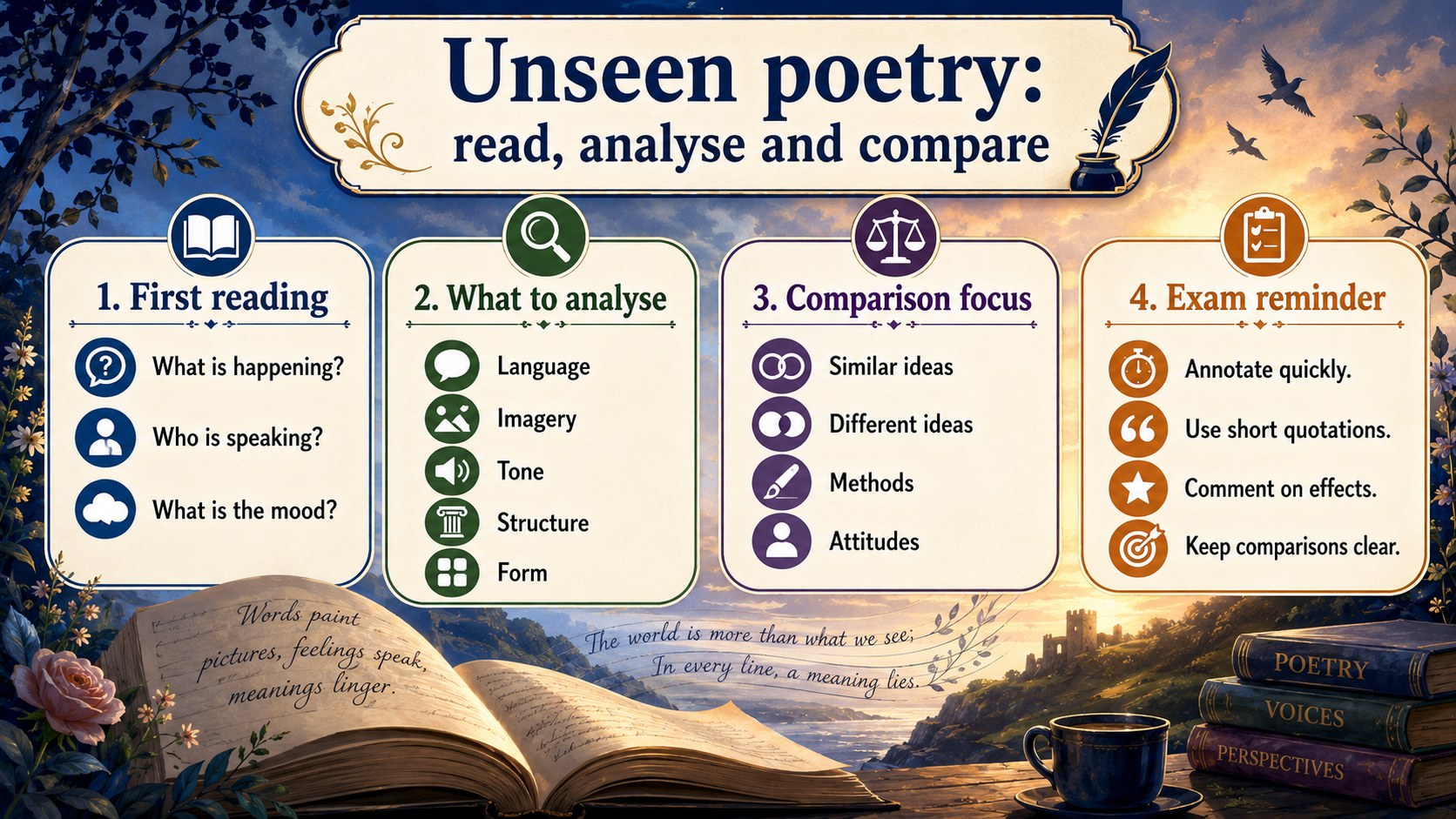
After viewing
After viewing, select one image or structural choice from a poem and write one sentence explaining its effect.
Clear explanation
First poem
Find the speaker, situation, main feeling and change. Then choose evidence that proves the reading.
Second poem
Ask what is similar or different in attitude, voice or ending.
Comparison
Compare one focus at a time: ideas, speaker, tone, imagery, structure or ending.
Worked examples
Idea comparison
Both poems present loneliness, but the first speaker accepts it while the second resists it.
Method comparison
Both poets use natural imagery, but one makes nature comforting and the other makes it threatening.
Quick checks
Choose an answer, then check your thinking.
1. Two unseen poems both mention silence. What should you compare first?
2. Which comparison sentence is strongest?
Practice questions
Question 1
What should you compare before techniques?
Reveal answer and marking guidance
Answer: The speakers’ feelings or attitudes towards the shared idea.
Marking: Credit meaning-led comparison.
Question 2
Write a comparison about silence.
Reveal answer and marking guidance
Answer: Both poems use silence to show isolation, but one makes it peaceful while the other makes it threatening.
Marking: Reward similarity and contrast.
Question 3
What if you do not understand every line?
Reveal answer and marking guidance
Answer: Build a secure comparison from the clearest repeated ideas, images and shifts.
Marking: Credit practical exam strategy.
Question 4
What should each paragraph compare?
Reveal answer and marking guidance
Answer: One shared focus, such as tone, imagery, speaker or ending.
Marking: Reward paragraph control.
Answers and marking guidance
The exact practice answers are hidden under each question so you can try first. For unseen poetry comparison, reward paired comments on speaker, tone, imagery, structure and change. Similar details such as silence only matter when the answer explains whether the poets use them in similar or contrasting ways.
Common mistakes
- Trying to decode everything: focus on secure meanings first.
- Ignoring the second poem: give both poems enough attention.
- Forced method matching: methods do not need identical names.
- No comparison language: use connectives that show similarity and difference.
Extension challenge
Read two unfamiliar poems and write a six-sentence comparison: idea, evidence A, evidence B, method A, method B, final difference.
Reveal answer
Example answer: A strong comparison explains both similarity and difference, using short evidence from both poems and one method comment for each.
Exam-board guidance
Unseen poetry comparison can appear after a single-poem response or as a paired task. Check the timing and compare speaker, tone, imagery and structure rather than memorised anthology material.
AQA GCSE English
Check the mark value and assessment focus, then keep evidence and analysis tied to the exact question.
OCR GCSE English
Use precise references and organise the response around the command word rather than a memorised answer.
Pearson Edexcel GCSE English
Match the lesson skill to the relevant paper question, source, set text or writing form.
Eduqas GCSE English
Adapt the technique to the component your school is preparing for, especially timing and question wording.
WJEC Wales
Check whether your course uses current Wales-specific routes, then apply the same evidence and accuracy habits.
CCEA GCSE English
Use the unit focus to balance evidence, explanation, comparison, context and written accuracy.
Next lesson
Next, practise comparing writers' viewpoints under time.