
Lesson overview
Use this as transferable English technique.
Compare writers quickly and clearly when a paper gives two non-fiction sources. the core habits of close reading, precise evidence, controlled writing and checking apply across GCSE English.
What you will learn
Key habits before you start
Writing control route
- Purpose: Decide whether the writing should describe, argue, persuade, inform, narrate or present.
- Audience and form: Match tone, structure and detail to the reader and task format.
- Paragraph control: Build paragraphs around a clear focus, then vary sentence shape deliberately.
- Accuracy: Check sentence boundaries, punctuation, spelling and tense before finishing.
Why this matters
Timed comparison rewards deliberate selection. Pupils do not need everything; they need the right paired details.
Prior knowledge
You should already be comfortable with:
Practice sources supplied on this page
Use the two lido sources to practise timed comparison: make fast paired notes on viewpoint, evidence and method before writing.
Source A: original article opening
Our town should protect the old lido because public spaces give people more than somewhere to swim. They hold memories, routines and chances for neighbours to meet. A new car park may be convenient, but convenience is a poor exchange for a place that has served generations.
Source B: original letter opening
I understand why some residents feel attached to the old lido, but sentiment cannot repair cracked tiles or pay rising maintenance costs. The site is unused for most of the year. A safer, modern facility would serve more people and cost less to maintain.
Writers’ viewpoints comparison infographic
Before viewing
Before viewing, identify the purpose, audience and form of the writing task you are practising.
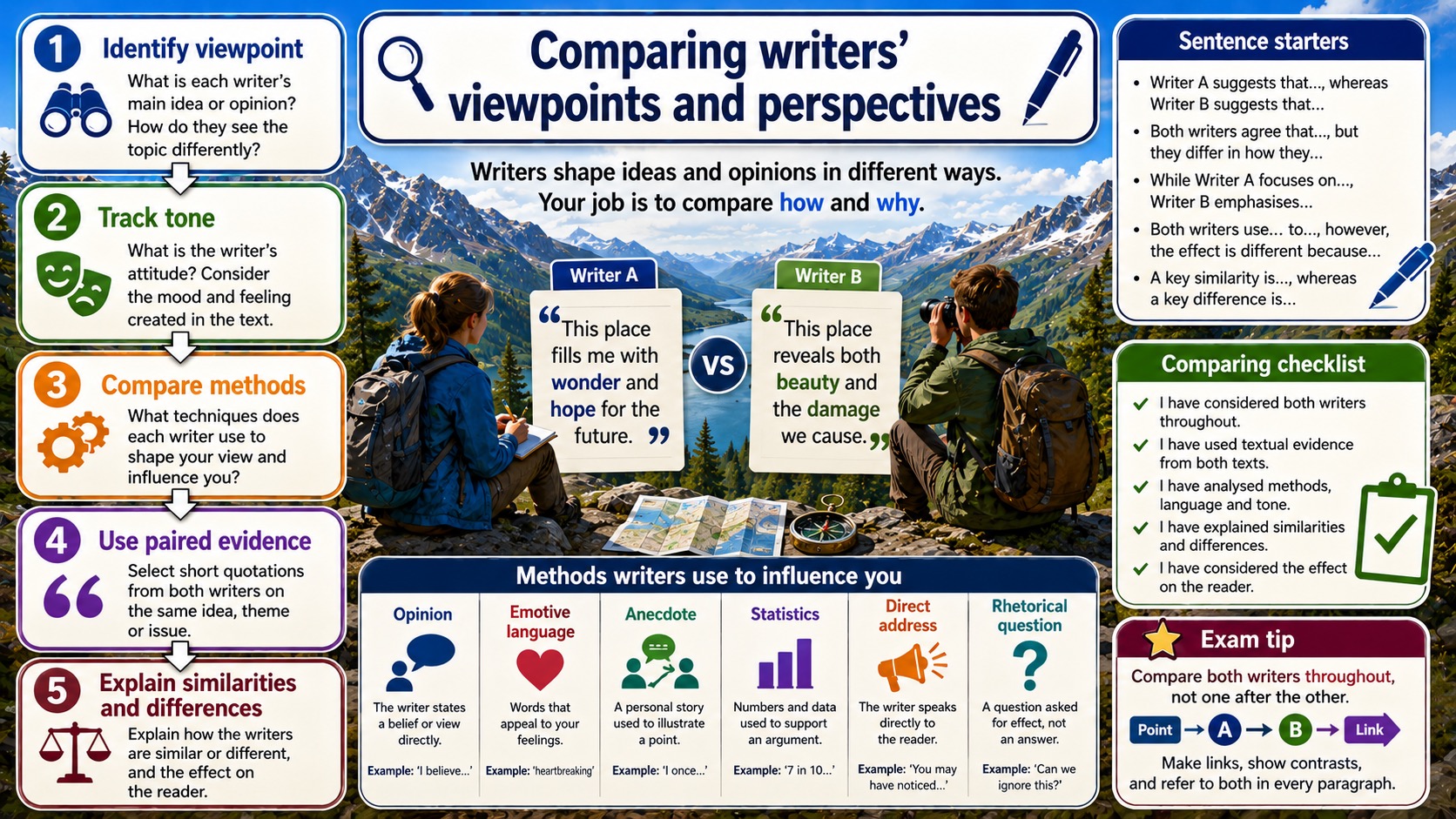
After viewing
After viewing, revise one sentence or paragraph so it better matches the task purpose and audience.
Clear explanation
Viewpoint first
Write a brief note for each writer: positive, negative, mixed, critical, hopeful, angry or uncertain.
Pair evidence
Select evidence that can be compared. If the details do not connect, choose different evidence.
Write directly
Use one paragraph for a similarity or difference, then explain how each writer creates that viewpoint.
Worked examples
Paired point
Both writers criticise the situation, but Writer A is amused while Writer B is angry.
Evidence pair
Writer A uses playful exaggeration; Writer B uses blunt statistics.
Quick checks
Choose an answer, then check your thinking.
1. With only a few minutes left, what is the quickest comparison plan?
2. Which pair of viewpoints is ready to write about?
Practice questions
Question 1
What is the fastest useful plan?
Reveal answer and marking guidance
Answer: Two paired viewpoint points, each with one short reference from both sources.
Marking: Credit timed strategy.
Question 2
Write one paired viewpoint for the lido sources.
Reveal answer and marking guidance
Answer: Source A sees the lido as community heritage, while Source B sees it as unaffordable nostalgia.
Marking: Reward direct comparison.
Question 3
How do you stop the answer becoming two summaries?
Reveal answer and marking guidance
Answer: Use comparison words and discuss both writers inside each paragraph.
Marking: Credit integration.
Question 4
What should you skip when time is short?
Reveal answer and marking guidance
Answer: Long copied quotations and background that does not compare viewpoint.
Marking: Reward prioritisation.
Answers and marking guidance
The exact practice answers are hidden under each question so you can try first. For timed viewpoint comparison, reward fast paired planning: writer A’s community-memory argument, writer B’s practical-cost objection, two short evidence choices and one method comment. Penalise long separate summaries that delay comparison.
Common mistakes
- Writing about only one source: comparison needs both.
- Choosing unconnected evidence: pair details before writing.
- Vague connectives: use precise similarity and difference language.
- No method analysis: show how tone or viewpoint is created.
Extension challenge
Set a seven-minute timer and write one paragraph comparing the lido writers’ viewpoints, using one short phrase from each source.
Reveal answer
Example answer: A strong timed paragraph moves quickly: it pairs the writers, names the disagreement and explains one method without drifting into separate summaries.
Exam-board guidance
Timed viewpoint-comparison questions need fast pairing, not long separate readings. Check your board’s source order and mark value, then plan viewpoint, evidence and method before writing.
AQA GCSE English
Check the mark value and assessment focus, then keep evidence and analysis tied to the exact question.
OCR GCSE English
Use precise references and organise the response around the command word rather than a memorised answer.
Pearson Edexcel GCSE English
Match the lesson skill to the relevant paper question, source, set text or writing form.
Eduqas GCSE English
Adapt the technique to the component your school is preparing for, especially timing and question wording.
WJEC Wales
Check whether your course uses current Wales-specific routes, then apply the same evidence and accuracy habits.
CCEA GCSE English
Use the unit focus to balance evidence, explanation, comparison, context and written accuracy.
Next lesson
Next, practise final gcse english exam routine.