
Lesson overview
Use this as transferable English technique.
Build a final revision and exam-room routine for GCSE English Language and Literature. the core habits of close reading, precise evidence, controlled writing and checking apply across GCSE English.
What you will learn
Key habits before you start
Reading evidence route
- Explicit meaning: Start with what the text directly says before building an interpretation.
- Inference: Make a sensible conclusion that is supported by the words on the page.
- Evidence: Use short references that can be explained precisely.
- Explanation: Link the evidence back to the question, effect or writer's purpose.
Why this matters
The final stage is about reliable routines: knowing what to do before, during and after each answer.
Prior knowledge
You should already be comfortable with:
Practice question material
Use this question bank to rehearse final exam habits: decode the command word, choose evidence quickly, and check timing before writing too much.
Exam-style question bank
Use these prompts with the studied text or edition set by your school. For copyrighted modern texts, this page teaches method without reproducing long extracts.
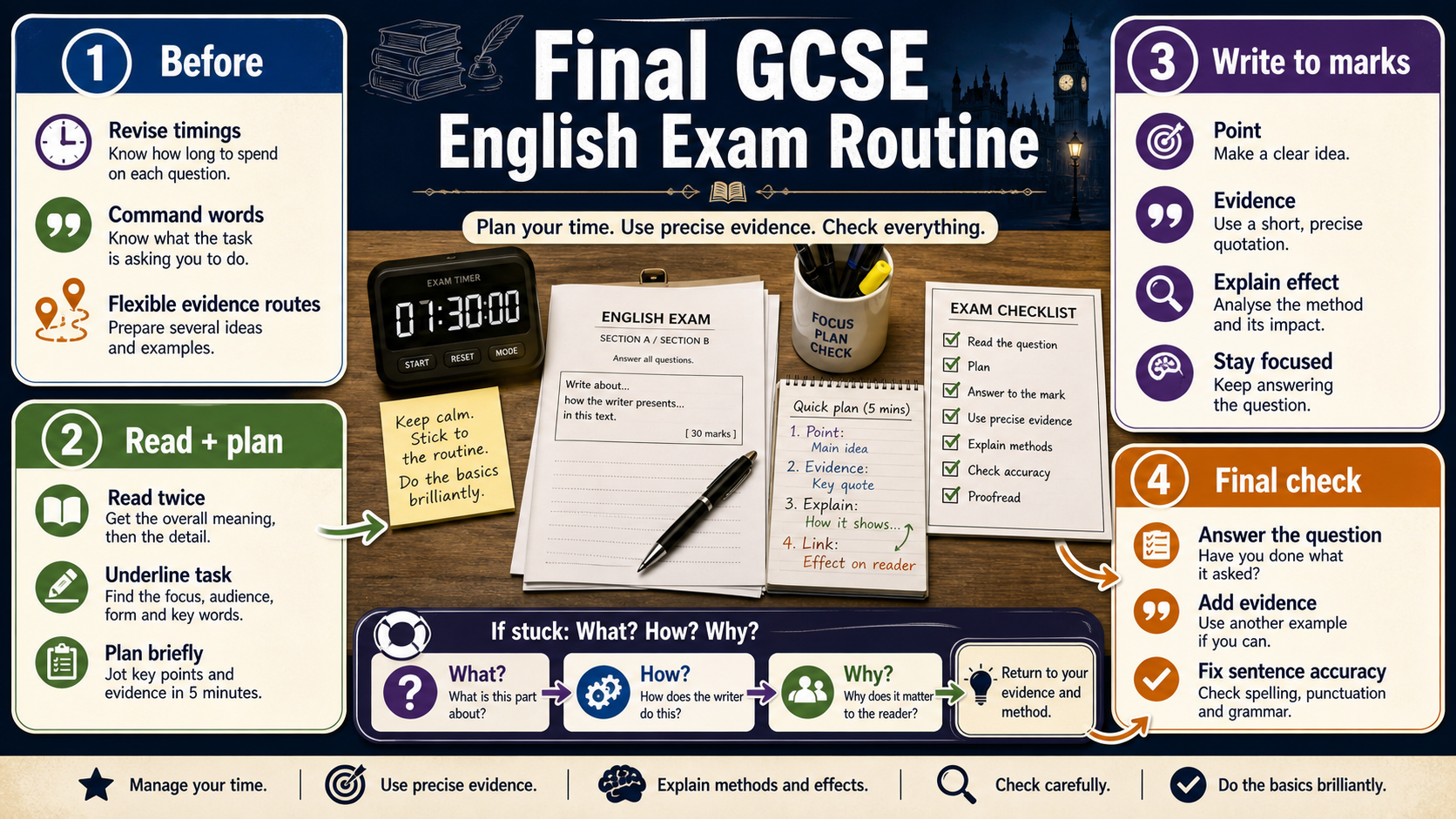
Final GCSE English exam routine infographic
Before viewing
Before viewing, write the lesson title as a question: what should final gcse english exam routine help you do in an exam answer?
After viewing
After viewing, choose one label or route from the visual and use it to improve one sentence in your practice answer.
Clear explanation
Before the exam
Revise flexible routes, not whole memorised essays. Use short quotations, question plans and timed paragraphs.
During the exam
Read the question twice, plan briefly, write to the task and check the final two minutes.
If stuck
Return to basics: what is the text saying, how is it being said, and why does that matter?
Worked examples
Final revision task
Plan three possible questions for one text, then write only the introductions.
Recovery routine
Underline the key words, write a simple point, choose evidence, explain effect.
Quick checks
Choose an answer, then check your thinking.
1. On exam morning, what is the most useful routine?
2. During the paper, what should trigger a timing decision?
Practice questions
Question 1
What should you review the night before?
Reveal answer and marking guidance
Answer: Timings, command words, flexible evidence routes and common accuracy checks.
Marking: Credit realistic revision.
Question 2
What should you not do on exam morning?
Reveal answer and marking guidance
Answer: Try to memorise whole new essays or overload yourself with every note.
Marking: Reward exam judgement.
Question 3
How should marks guide timing?
Reveal answer and marking guidance
Answer: More marks mean more development; low-mark questions need concise answers.
Marking: Credit timing control.
Question 4
What is the final two-minute check?
Reveal answer and marking guidance
Answer: Make sure the answer addresses the question, uses evidence and has readable sentence control.
Marking: Reward final routine.
Answers and marking guidance
The exact practice answers are hidden under each question so you can try first. For final routine questions, reward decisions that protect marks under pressure: decode the command word, select the right source or text, plan briefly, watch timings and reserve checking time for sentence accuracy and missed question parts.
Common mistakes
- Only rereading notes: turn notes into active tasks.
- No timed practice: timing needs rehearsal.
- Panic planning: use a simple route when stuck.
- Ignoring accuracy: proofreading can protect communication marks.
Extension challenge
Make a one-page exam routine for yourself: before reading, during planning, during writing, final check and stuck strategy.
Reveal answer
Example answer: A strong routine is practical and timed: it tells you what to do first, how to recover if stuck and what to check before the paper ends.
Exam-board guidance
Final revision should match your exact papers: timings, source order, writing tasks and set texts. Use this page to rehearse decisions before the exam rather than adding new content at the last minute.
AQA GCSE English
Check the mark value and assessment focus, then keep evidence and analysis tied to the exact question.
OCR GCSE English
Use precise references and organise the response around the command word rather than a memorised answer.
Pearson Edexcel GCSE English
Match the lesson skill to the relevant paper question, source, set text or writing form.
Eduqas GCSE English
Adapt the technique to the component your school is preparing for, especially timing and question wording.
WJEC Wales
Check whether your course uses current Wales-specific routes, then apply the same evidence and accuracy habits.
CCEA GCSE English
Use the unit focus to balance evidence, explanation, comparison, context and written accuracy.
Next lesson
This completes the current GCSE English exam-technique batch.