
Lesson overview
This lesson improves drafts by targeting clarity, evidence, paragraph order and accuracy.
Use quick editing checks to improve clarity, accuracy and impact. It supports GCSE English Language, GCSE English Literature or both, depending on your course.
What you will learn
Key habits before you start
Writing control route
- Purpose: Decide whether the writing should describe, argue, persuade, inform, narrate or present.
- Audience and form: Match tone, structure and detail to the reader and task format.
- Paragraph control: Build paragraphs around a clear focus, then vary sentence shape deliberately.
- Accuracy: Check sentence boundaries, punctuation, spelling and tense before finishing.
Why this matters
A short proofreading routine can recover marks. It also trains pupils to notice weaknesses before they become habits.
Prior knowledge
You should already be comfortable with:
Practice prompts supplied on this page
Use these prompts to practise targeted improvement: improve clarity, paragraph focus, evidence and sentence accuracy rather than rewriting everything.
Prompt bank
Improving drafts and proofreading infographic
Before viewing
Before viewing, identify the purpose, audience and form of the writing task you are practising.
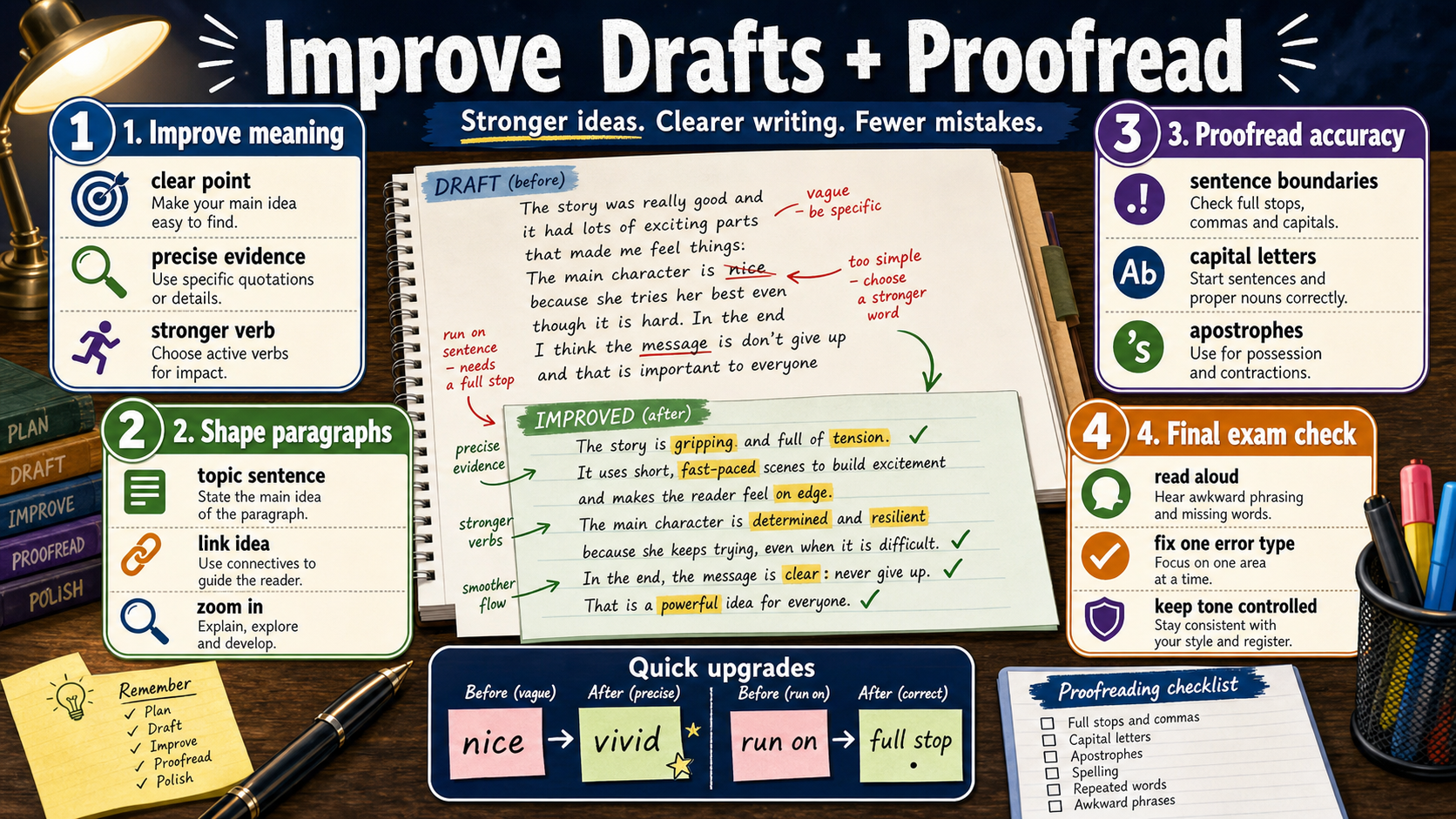
After viewing
After viewing, revise one sentence or paragraph so it better matches the task purpose and audience.
Clear explanation
Main idea
Read the final paragraph first if time is short; endings are often rushed and error-heavy.
How to do it
Check sentence boundaries: every sentence should be complete and punctuated.
Answer habit
Improve one or two key words rather than rewriting everything. Precision is more realistic than perfection in exam time.
Worked examples
Sentence fix
Fragment: “Because the storm was getting worse.”
Vocabulary upgrade
Replace “bad weather” with “relentless rain” if it fits the tone.
Quick checks
Choose an answer, then check your thinking.
1. A draft paragraph has a strong idea but vague evidence. What is the best improvement?
2. Which proofreading check is most likely to raise clarity quickly?
Practice questions
Question 1
Improve a vague sentence: “The quote is good.”
Reveal answer and marking guidance
Answer: The word “clawed” makes the wind seem violent, so the setting feels threatening.
Marking: Credit specific method and effect.
Question 2
What should proofreading check first?
Reveal answer and marking guidance
Answer: Sentence sense, full stops, commas that separate clearly, and missing words.
Marking: Reward accuracy.
Question 3
How can you improve paragraph order?
Reveal answer and marking guidance
Answer: Put the clearest argument first, then develop or contrast it in the next paragraph.
Marking: Credit structure.
Question 4
What is one high-value final check?
Reveal answer and marking guidance
Answer: Make sure every paragraph still answers the question, not a similar question.
Marking: Reward task focus.
Answers and marking guidance
The exact practice answers are hidden under each question so you can try first. For draft-improvement tasks, reward targeted edits: sharper evidence, clearer paragraph focus, corrected sentence boundaries and removed repetition. Do not credit rewriting everything if the original problem only needs a precise fix.
Common mistakes
- Rewriting everything: target the weakness that loses marks.
- Only correcting spelling: clarity, paragraph order and evidence may matter more.
- Adding techniques without purpose: improvements need a reason.
- Proofreading too late: leave time before the final minute.
Extension challenge
Improve one weak paragraph by changing only three things: evidence, sentence boundary and final explanation.
Reveal answer
Example answer: A strong edit makes the paragraph clearer and more focused without burying the original idea under unnecessary rewriting.
Exam-board guidance
Writing and accuracy marks appear in different places across boards. Use this lesson to protect clarity wherever extended writing is assessed.
AQA GCSE English
Check the mark value and assessment focus, then keep evidence and analysis tied to the exact question.
OCR GCSE English
Use precise references and organise the response around the command word rather than a memorised answer.
Pearson Edexcel GCSE English
Match the lesson skill to the relevant paper question, source, set text or writing form.
Eduqas GCSE English
Adapt the technique to the component your school is preparing for, especially timing and question wording.
WJEC Wales
Check whether your course uses current Wales-specific routes, then apply the same evidence and accuracy habits.
CCEA GCSE English
Use the unit focus to balance evidence, explanation, comparison, context and written accuracy.
Next lesson
Next, move into set-text revision with Macbeth: Ambition, Guilt and Power.