
Lesson overview
This lesson creates fast plans that protect relevance, timing and evidence choices.
Plan fast, focused answers for reading, writing and literature questions. It supports GCSE English Language, GCSE English Literature or both, depending on your course.
What you will learn
Key habits before you start
Writing control route
- Purpose: Decide whether the writing should describe, argue, persuade, inform, narrate or present.
- Audience and form: Match tone, structure and detail to the reader and task format.
- Paragraph control: Build paragraphs around a clear focus, then vary sentence shape deliberately.
- Accuracy: Check sentence boundaries, punctuation, spelling and tense before finishing.
Why this matters
Timed English answers fail when pupils start writing without direction. A short plan can save time by preventing drift.
Prior knowledge
You should already be comfortable with:
Practice prompts supplied on this page
Use these prompts to practise fast planning: turn the task into a route of topic points, evidence choices and timing decisions.
Prompt bank
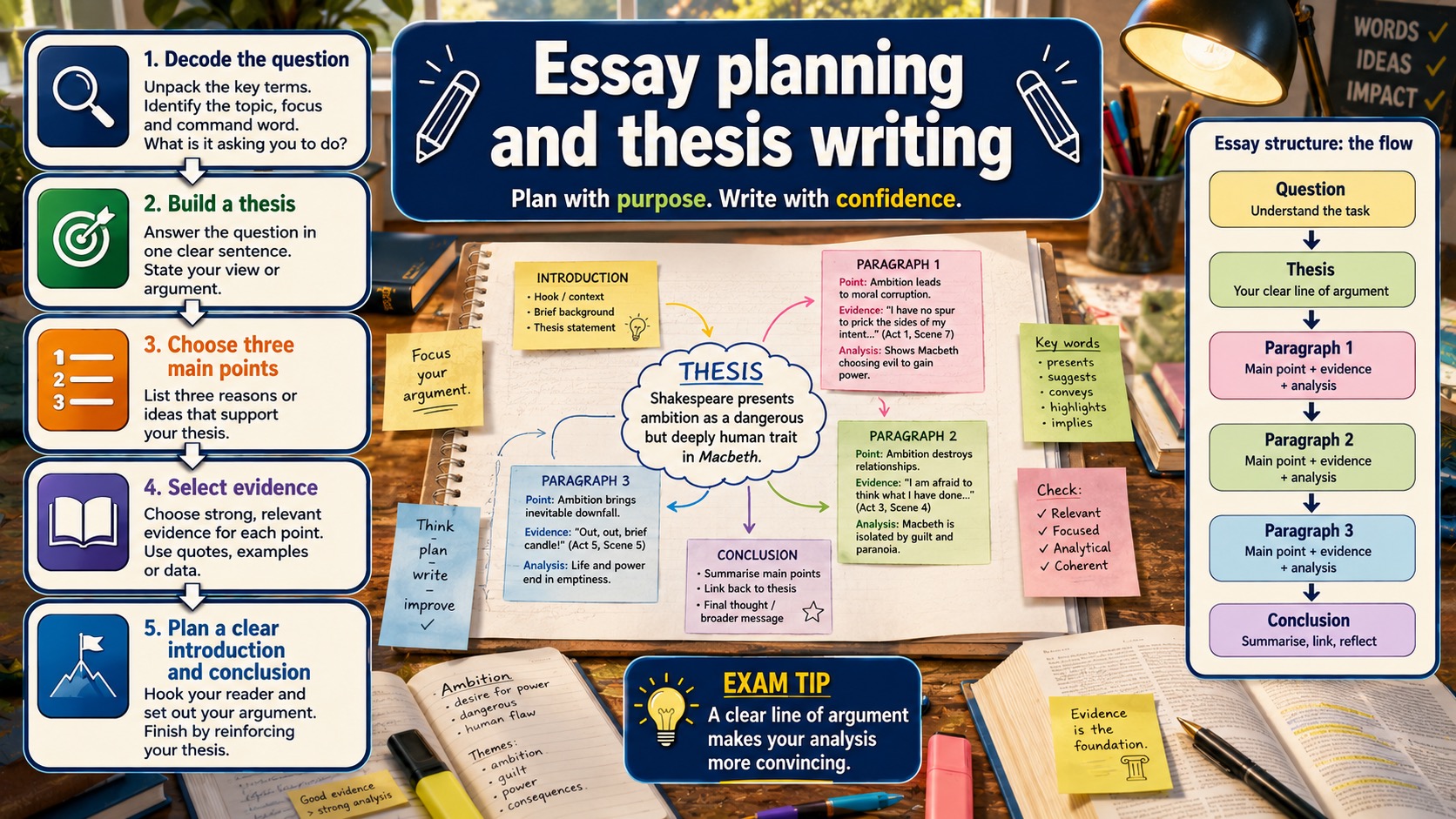
Essay planning and thesis writing infographic
Before viewing
Before viewing, identify the purpose, audience and form of the writing task you are practising.
After viewing
After viewing, revise one sentence or paragraph so it better matches the task purpose and audience.
Clear explanation
Main idea
For reading, plan evidence and the order of points. For writing, plan purpose, audience, structure and key ideas. For literature, plan your thesis and paragraph route.
How to do it
A plan should be brief: bullet points, arrows or numbered points are enough.
Answer habit
Use the marks and time available to decide how developed the answer needs to be.
Worked examples
Literature plan
Thesis, paragraph 1 character at start, paragraph 2 turning point, paragraph 3 final presentation.
Writing plan
Opening image, shift to problem, personal anecdote, wider argument, call to action.
Quick checks
Choose an answer, then check your thinking.
1. You have a literature essay and five minutes to plan. What belongs in the plan?
2. What is the best reason to reject a point during planning?
Practice questions
Question 1
Make a five-minute literature plan shape.
Reveal answer and marking guidance
Answer: Thesis, three topic points, evidence route for each, final judgement.
Marking: Credit realistic timing.
Question 2
What should you reject while planning?
Reveal answer and marking guidance
Answer: Any point that is interesting but does not answer the exact wording.
Marking: Reward relevance.
Question 3
How should marks affect timing?
Reveal answer and marking guidance
Answer: Questions with more marks need more developed paragraphs and more time.
Marking: Credit exam strategy.
Question 4
Write a plan for a responsibility essay in three words or phrases.
Reveal answer and marking guidance
Answer: Selfishness, consequence, change.
Marking: Reward focused route.
Answers and marking guidance
The exact practice answers are hidden under each question so you can try first. For planning under time, reward brief routes that contain thesis, two or three points, evidence choices and timing decisions. A plan is successful if it prevents drift and protects the highest-value parts of the answer.
Common mistakes
- Writing a full plan instead of the answer: keep planning brief.
- Planning points with no evidence: each point needs a support route.
- Keeping weak points: reject ideas that do not answer the task.
- Ignoring marks: spend time where the paper rewards it.
Extension challenge
Make a five-minute plan for a literature question: thesis, three points, evidence and one context/method note.
Reveal answer
Example answer: A strong timed plan is short, selective and usable; it prevents drift rather than becoming a second task.
Exam-board guidance
Timing expectations differ by paper, but planning should always serve the answer. Use the mark value and command word to decide plan depth.
AQA GCSE English
Check the mark value and assessment focus, then keep evidence and analysis tied to the exact question.
OCR GCSE English
Use precise references and organise the response around the command word rather than a memorised answer.
Pearson Edexcel GCSE English
Match the lesson skill to the relevant paper question, source, set text or writing form.
Eduqas GCSE English
Adapt the technique to the component your school is preparing for, especially timing and question wording.
WJEC Wales
Check whether your course uses current Wales-specific routes, then apply the same evidence and accuracy habits.
CCEA GCSE English
Use the unit focus to balance evidence, explanation, comparison, context and written accuracy.
Next lesson
Next, continue with Improving Drafts and Proofreading.