
Lesson overview
This lesson turns quotations into flexible argument tools instead of memorised decoration.
Learn short, flexible quotation revision instead of memorising huge chunks. It supports GCSE English Language, GCSE English Literature or both, depending on your course.
What you will learn
Key habits before you start
Reading evidence route
- Explicit meaning: Start with what the text directly says before building an interpretation.
- Inference: Make a sensible conclusion that is supported by the words on the page.
- Evidence: Use short references that can be explained precisely.
- Explanation: Link the evidence back to the question, effect or writer's purpose.
Why this matters
Memorising dozens of long quotations is inefficient. Short, flexible references are easier to remember and easier to analyse.
Prior knowledge
You should already be comfortable with:
Quotation revision material
Use these card prompts with your set texts. The aim is to revise short, flexible evidence that can answer several questions, not to memorise long passages.
Quotation card prompt bank
Quotation revision infographic
Before viewing
Before viewing, write the lesson title as a question: what should quotation revision that actually works help you do in an exam answer?
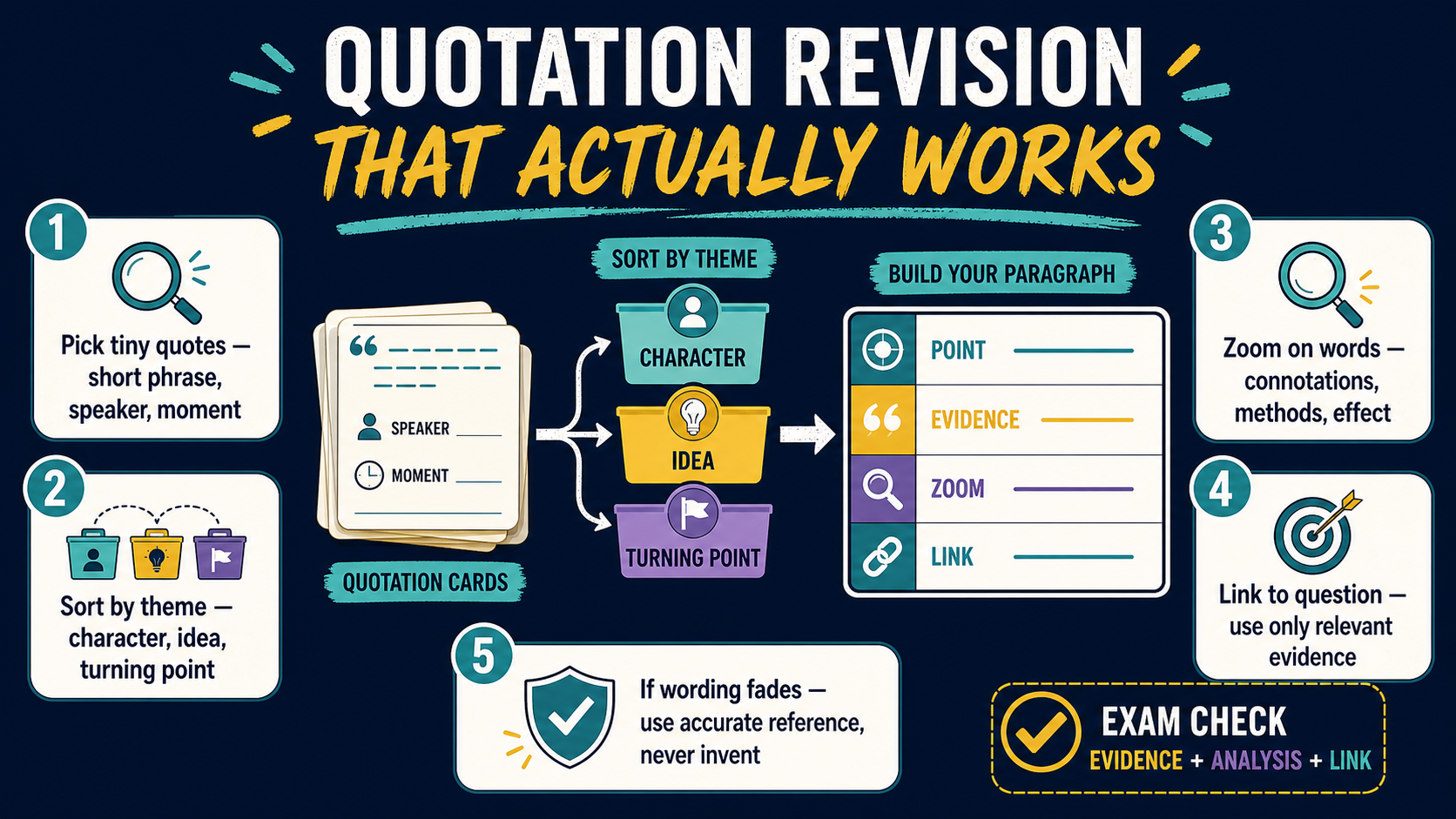
After viewing
After viewing, choose one label or route from the visual and use it to improve one sentence in your practice answer.
Clear explanation
Main idea
Choose quotations that connect to more than one theme or character. These give you more options in the exam.
How to do it
Revise tiny fragments accurately. A two-word quotation can be enough if you can analyse it closely.
Answer habit
Create cards with quotation, speaker or moment, themes and one method comment.
Worked examples
Flexible quotation
A phrase linked to power might also connect to gender, fear or conflict.
Word-level analysis
One violent verb can support a whole point about threat or control.
Quick checks
Choose an answer, then check your thinking.
1. Which quotation card is most useful for revision?
2. What should you do if you forget the exact wording in the exam?
Practice questions
Question 1
Build a card for “vaulting ambition”.
Reveal answer and marking guidance
Answer: Text: Macbeth. Theme: ambition. Use: Macbeth knows desire can overleap moral control.
Marking: Credit text, theme and use.
Question 2
What should you do if exact wording fails?
Reveal answer and marking guidance
Answer: Use an accurate reference to the moment rather than inventing a quotation.
Marking: Reward honesty and precision.
Question 3
Why are short quotations often stronger?
Reveal answer and marking guidance
Answer: They are easier to embed and analyse closely.
Marking: Credit concise evidence.
Question 4
Create a comparison-ready quote note for “mind-forg’d manacles”.
Reveal answer and marking guidance
Answer: London: oppression is psychological as well as social, useful for power and control.
Marking: Reward interpretation.
Answers and marking guidance
The exact practice answers are hidden under each question so you can try first. For quotation revision, reward short, flexible evidence with multiple uses: who says it, where it appears, what theme it supports and how a method works. Approximate references are better than invented quotations when exact wording is forgotten.
Common mistakes
- Learning quotations with no use: attach theme and method to each one.
- Inventing exact wording: use approximate reference if memory fails.
- Choosing very long quotations: short phrases are more flexible.
- Revising in a fixed order only: shuffle by theme and question type.
Extension challenge
Create three quotation cards for one set text: one character, one theme and one method card. Add two possible questions for each.
Reveal answer
Example answer: A strong quotation card gives exact or approximate evidence, location, speaker and several possible analytical uses.
Exam-board guidance
Quotation expectations vary, especially for closed-book literature. Use this lesson to revise flexible evidence and avoid invented wording.
AQA GCSE English
Check the mark value and assessment focus, then keep evidence and analysis tied to the exact question.
OCR GCSE English
Use precise references and organise the response around the command word rather than a memorised answer.
Pearson Edexcel GCSE English
Match the lesson skill to the relevant paper question, source, set text or writing form.
Eduqas GCSE English
Adapt the technique to the component your school is preparing for, especially timing and question wording.
WJEC Wales
Check whether your course uses current Wales-specific routes, then apply the same evidence and accuracy habits.
CCEA GCSE English
Use the unit focus to balance evidence, explanation, comparison, context and written accuracy.
Next lesson
Next, continue with Planning Under Timed Conditions.