
Lesson overview
This lesson uses context only when it sharpens interpretation of a precise textual moment.
Use context to deepen analysis without writing detached history. It supports GCSE English Language, GCSE English Literature or both, depending on your course.
What you will learn
Key habits before you start
Literature argument route
- Thesis: Open with a clear argument about the writer's idea or message.
- Evidence range: Use short evidence from key moments across the text.
- Method: Explain how language, structure, characterisation or contrast shapes meaning.
- Whole text: Link moments together so the answer shows development, not isolated notes.
Why this matters
Context can improve an essay, but only when it explains something about the writer’s choices or the text’s meanings.
Prior knowledge
You should already be comfortable with:
Context practice material
Use these prompts to practise adding context only when it sharpens close analysis. Each answer should begin with a textual detail, then add the relevant social, historical or genre idea.
Context-to-text prompt bank
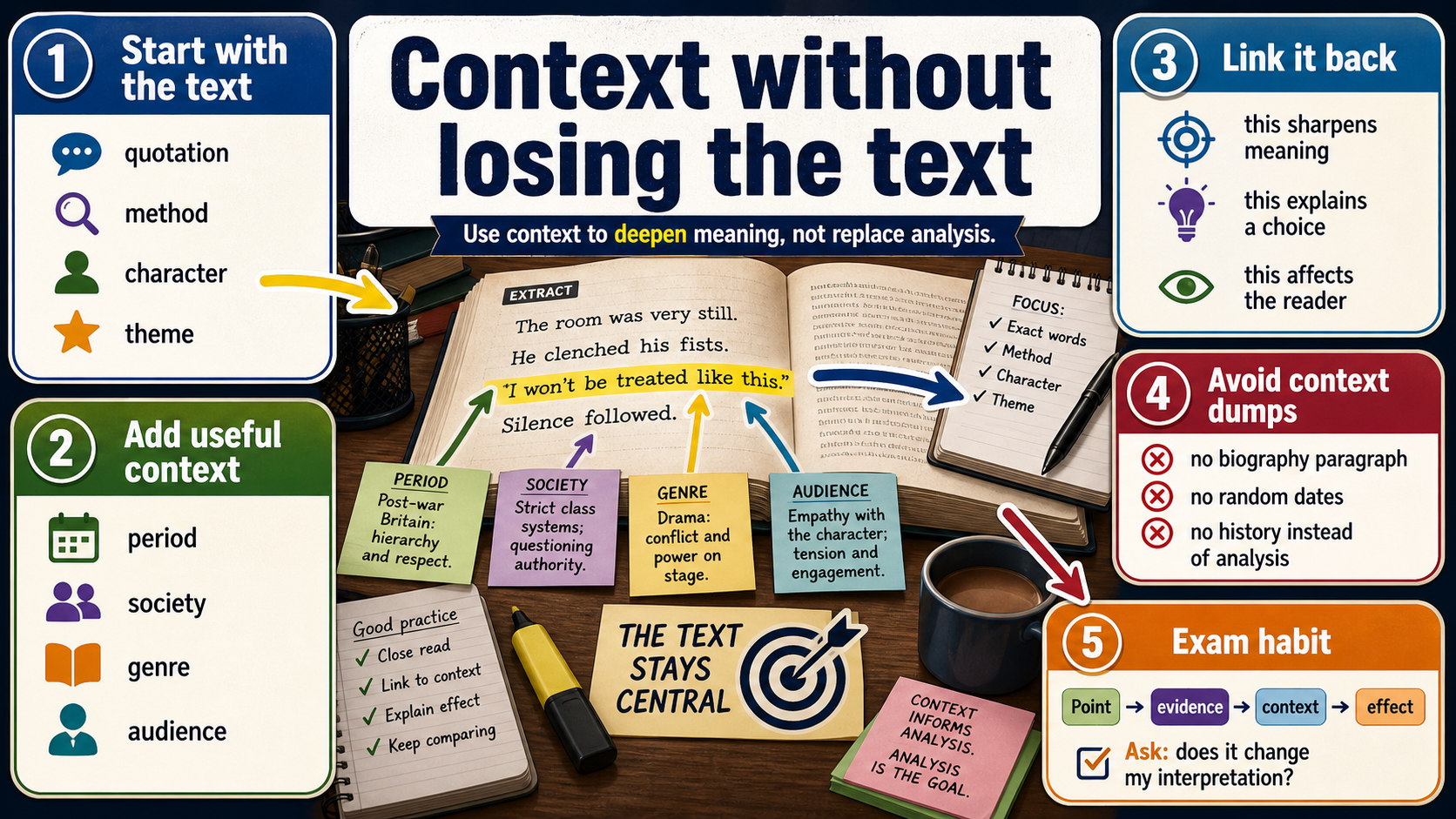
Context without losing the text infographic
Before viewing
Before viewing, choose one theme, character or turning point that the visual should help you connect to evidence.
After viewing
After viewing, write one thesis sentence and one evidence sentence using the route shown in the visual.
Clear explanation
Main idea
Relevant context might include historical period, social attitudes, genre, writer’s ideas or audience expectations.
How to do it
The text must stay central. A sentence about context should help explain a quotation, method, character or theme.
Answer habit
Avoid dumping memorised facts. If the fact does not change your interpretation, leave it out.
Worked examples
Useful context
In a play about social responsibility, class inequality context can help explain why a wealthy character’s attitude matters.
Detached context
Writing a full paragraph about the writer’s birth date is rarely useful.
Quick checks
Choose an answer, then check your thinking.
1. A paragraph on Jekyll and Hyde mentions Victorian respectability. What must it do next?
2. Which context use is weakest?
Practice questions
Question 1
Use context well for Jekyll and Hyde reputation.
Reveal answer and marking guidance
Answer: Victorian respectability helps explain why Jekyll hides desires that would damage his public name.
Marking: Credit context tied to character.
Question 2
Use context badly in one sentence.
Reveal answer and marking guidance
Answer: Stevenson was born in 1850, so the quote is effective.
Marking: Reward recognition of detached context.
Question 3
Where should context sit in a paragraph?
Reveal answer and marking guidance
Answer: Near the evidence it explains, after the textual point is clear.
Marking: Credit paragraph control.
Question 4
What question should you ask before adding context?
Reveal answer and marking guidance
Answer: Does this fact change or deepen my interpretation of this moment?
Marking: Reward relevance.
Answers and marking guidance
The exact practice answers are hidden under each question so you can try first. For context paragraphs, credit only context that sharpens close reading: Victorian respectability, poverty, gender, class or political background must explain a precise moment, character choice or method rather than replacing textual analysis.
Common mistakes
- Starting with history instead of the text: begin with a precise detail.
- Dropping in context: explain how it changes interpretation.
- Writing a biography paragraph: author life rarely replaces analysis.
- Using context for every sentence: one relevant link is often enough.
Extension challenge
Take one Jekyll and Hyde or Christmas Carol point and add context in one sentence without losing the quotation or moment.
Reveal answer
Example answer: A strong response keeps the textual detail central, then uses context such as reputation, poverty or social responsibility to sharpen interpretation.
Exam-board guidance
Context weighting differs across literature components. Use it where the assessment rewards social, historical or genre understanding, but keep the set text as the main evidence.
AQA GCSE English
Check the mark value and assessment focus, then keep evidence and analysis tied to the exact question.
OCR GCSE English
Use precise references and organise the response around the command word rather than a memorised answer.
Pearson Edexcel GCSE English
Match the lesson skill to the relevant paper question, source, set text or writing form.
Eduqas GCSE English
Adapt the technique to the component your school is preparing for, especially timing and question wording.
WJEC Wales
Check whether your course uses current Wales-specific routes, then apply the same evidence and accuracy habits.
CCEA GCSE English
Use the unit focus to balance evidence, explanation, comparison, context and written accuracy.
Next lesson
Next, continue with Quotation Revision That Actually Works.