
Lesson overview
This lesson approaches an unfamiliar poem through speaker, situation, tone and shift.
Approach unfamiliar poems through first impressions, evidence and method. It supports GCSE English Language, GCSE English Literature or both, depending on your course.
What you will learn
Key habits before you start
Poetry evidence route
- Meaning first: Begin with what the poem says or suggests before naming techniques.
- Evidence: Use short quotations or precise references that reveal image, voice, tone or structure.
- Method and effect: Explain how a word, image, contrast, rhythm or ending shapes the reader's response.
- Comparison: Compare ideas and effects, not just matching technique labels.
Why this matters
Unseen poetry is less frightening when you use a steady routine rather than hunting for hidden meanings.
Prior knowledge
You should already be comfortable with:
Unseen poetry practice material
Use these poem openings as unfamiliar material. Practise establishing speaker, situation, tone and shift before you analyse individual words or methods.
unseen practice bank
Unseen poetry infographic
Before viewing
Before viewing, predict which details you should track first: meaning, speaker, image, tone, structure or comparison.
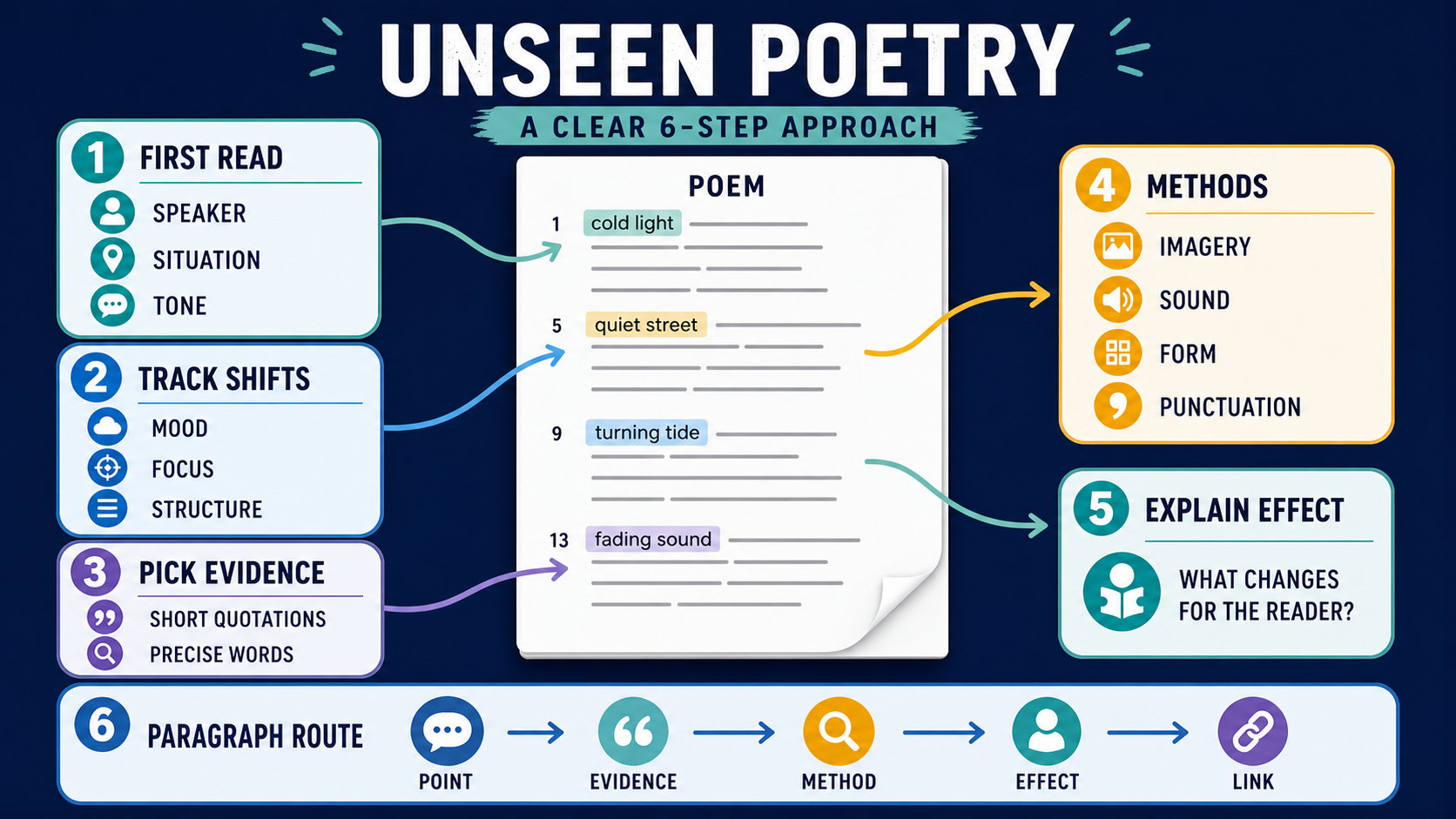
After viewing
After viewing, select one image or structural choice from a poem and write one sentence explaining its effect.
Clear explanation
Main idea
First, identify who seems to be speaking, what they describe or experience, and how the mood changes.
How to do it
Then choose a few strong details. You do not need to explain every line.
Answer habit
Write about possible meanings carefully. It is fine to say a word could suggest something if your evidence supports it.
Worked examples
First impression
A poem about an empty playground may seem nostalgic, lonely or unsettling depending on the details.
Method
Repeated sounds can create softness, harshness or rhythm.
Quick checks
Choose an answer, then check your thinking.
1. For an unseen poem, what is the safest first reading task?
2. Which comment is strongest for tone?
Practice questions
Question 1
What should you decide before naming techniques?
Reveal answer and marking guidance
Answer: Who seems to be speaking, what is happening and how the mood changes.
Marking: Credit meaning first.
Question 2
Write a cautious interpretation sentence.
Reveal answer and marking guidance
Answer: The repeated questions could suggest uncertainty because the speaker seems unable to settle on an answer.
Marking: Reward tentative but evidenced interpretation.
Question 3
What should you avoid in unseen poetry?
Reveal answer and marking guidance
Answer: Inventing context or forcing rare terminology before understanding the poem.
Marking: Credit exam discipline.
Question 4
How many details should a focused paragraph usually analyse?
Reveal answer and marking guidance
Answer: One or two precise details, explained well.
Marking: Reward quality over coverage.
Answers and marking guidance
The exact practice answers are hidden under each question so you can try first. For unseen poetry, reward a first reading that establishes speaker, situation, tone and shift before analysing methods. The strongest answers make cautious interpretations and support them with short evidence from the poem.
Common mistakes
- Looking for hidden meanings immediately: start with speaker and situation.
- Ignoring tone shifts: poems often change direction.
- Writing certainty without evidence: unseen analysis should be cautious.
- Only naming techniques: explain how methods shape feeling.
Extension challenge
Read one unfamiliar classic poem and write four notes: speaker, situation, tone and shift.
Reveal answer
Example answer: A strong unseen-poetry response makes a careful interpretation, then supports it with short evidence about voice, imagery or structure.
Exam-board guidance
Unseen poetry tasks differ by board, but first-reading discipline matters everywhere. Establish speaker, situation and tone before method analysis.
AQA GCSE English
Check the mark value and assessment focus, then keep evidence and analysis tied to the exact question.
OCR GCSE English
Use precise references and organise the response around the command word rather than a memorised answer.
Pearson Edexcel GCSE English
Match the lesson skill to the relevant paper question, source, set text or writing form.
Eduqas GCSE English
Adapt the technique to the component your school is preparing for, especially timing and question wording.
WJEC Wales
Check whether your course uses current Wales-specific routes, then apply the same evidence and accuracy habits.
CCEA GCSE English
Use the unit focus to balance evidence, explanation, comparison, context and written accuracy.
Next lesson
Next, continue with Context Without Losing the Text.