
Lesson overview
This lesson builds comparison paragraphs that link poems by attitude and method.
Write comparison paragraphs that connect poems by ideas and methods. It supports GCSE English Language, GCSE English Literature or both, depending on your course.
What you will learn
Key habits before you start
Poetry evidence route
- Meaning first: Begin with what the poem says or suggests before naming techniques.
- Evidence: Use short quotations or precise references that reveal image, voice, tone or structure.
- Method and effect: Explain how a word, image, contrast, rhythm or ending shapes the reader's response.
- Comparison: Compare ideas and effects, not just matching technique labels.
Why this matters
Poetry comparison rewards connection. You need to explain both what is similar or different and why that matters.
Prior knowledge
You should already be comfortable with:
Comparison poetry material
Use these pairings to practise integrated comparison before applying the method to your anthology or unseen poems. Each pair gives a shared theme and a genuine difference in attitude.
comparison bank
Poetry comparison infographic
Before viewing
Before viewing, predict which details you should track first: meaning, speaker, image, tone, structure or comparison.
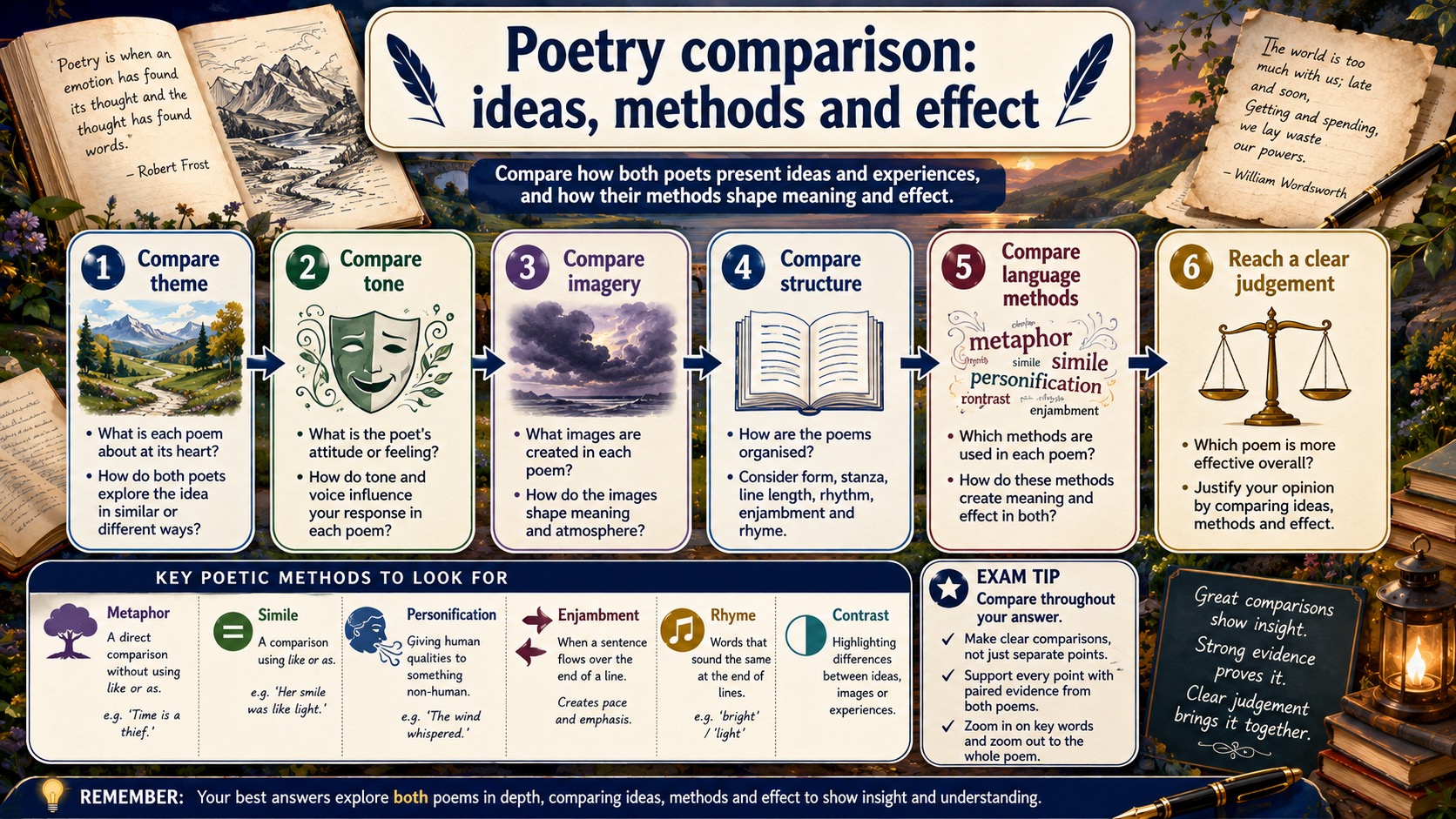
After viewing
After viewing, select one image or structural choice from a poem and write one sentence explaining its effect.
Clear explanation
Main idea
Start with the question’s theme. Decide what each poem suggests about that theme.
How to do it
Compare within paragraphs: make a point about poem A, connect poem B, then explain the significance of the similarity or difference.
Answer habit
Do not compare random features. Compare methods that shape meaning.
Worked examples
Integrated comparison
Both speakers feel trapped, but poem A uses physical imagery while poem B uses a controlled rhyme scheme to suggest restriction.
Weak comparison
Both poems use metaphors.
Quick checks
Choose an answer, then check your thinking.
1. If one poem presents love as persuasive and another as painful memory, what should the topic sentence do?
2. Which evidence pair is most comparison-ready?
Practice questions
Question 1
Compare Ozymandias and London in one sentence.
Reveal answer and marking guidance
Answer: Both criticise power, but Shelley shows pride ruined by time while Blake shows oppression continuing in the city.
Marking: Credit similarity and difference.
Question 2
Compare Love’s Philosophy and When We Two Parted in one sentence.
Reveal answer and marking guidance
Answer: Shelley presents love as natural union, while Byron presents love as secrecy, separation and pain.
Marking: Reward clear contrast.
Question 3
What should the second poem do in a paragraph?
Reveal answer and marking guidance
Answer: It should deepen, challenge or contrast the first poem’s idea.
Marking: Credit integrated comparison.
Question 4
Why are two short quotations better than two long stanzas?
Reveal answer and marking guidance
Answer: They let you compare precise methods without losing the argument.
Marking: Reward concise evidence.
Answers and marking guidance
The exact practice answers are hidden under each question so you can try first. For poetry comparison, credit a shared theme plus a meaningful difference: for example, ruined power in Ozymandias against social control in London, or Shelley’s persuasive union against Byron’s secrecy and loss. Method comments should serve that comparison.
Common mistakes
- Comparing features instead of ideas: methods must link to attitude or theme.
- Writing two mini-essays: keep both poems in the same paragraph.
- Forcing any pair: choose poems with a genuine shared theme.
- Over-quoting: two short references usually compare better than long extracts.
Extension challenge
Create two comparison routes: Ozymandias with London for power, and Love’s Philosophy with When We Two Parted for relationships.
Reveal answer
Example answer: A strong route names both similarity and difference, such as power being criticised through ruined pride in one poem and daily oppression in another.
Exam-board guidance
Poetry comparison may involve anthology or unseen poems. Check your board’s cluster, but use this lesson to build comparative topic sentences and paired method comments.
AQA GCSE English
Check the mark value and assessment focus, then keep evidence and analysis tied to the exact question.
OCR GCSE English
Use precise references and organise the response around the command word rather than a memorised answer.
Pearson Edexcel GCSE English
Match the lesson skill to the relevant paper question, source, set text or writing form.
Eduqas GCSE English
Adapt the technique to the component your school is preparing for, especially timing and question wording.
WJEC Wales
Check whether your course uses current Wales-specific routes, then apply the same evidence and accuracy habits.
CCEA GCSE English
Use the unit focus to balance evidence, explanation, comparison, context and written accuracy.
Next lesson
Next, continue with Unseen Poetry.