
Lesson overview
This lesson builds an anthology toolkit: speaker, theme, form, structure and comparison routes.
Revise anthology poems by tracking speaker, theme, language, form and structure. It supports GCSE English Language, GCSE English Literature or both, depending on your course.
What you will learn
Key habits before you start
Poetry evidence route
- Meaning first: Begin with what the poem says or suggests before naming techniques.
- Evidence: Use short quotations or precise references that reveal image, voice, tone or structure.
- Method and effect: Explain how a word, image, contrast, rhythm or ending shapes the reader's response.
- Comparison: Compare ideas and effects, not just matching technique labels.
Why this matters
Anthology poetry becomes easier when each poem is organised around a few secure ideas rather than dozens of disconnected annotations.
Prior knowledge
You should already be comfortable with:
Poetry anthology revision material
Use these out-of-copyright poems to practise poem profile notes: speaker, situation, tone, theme, method and useful comparison partners. Then build equivalent cards for your school anthology. If your anthology uses a modern copyrighted poem, use your school copy or a legitimate publisher link rather than copying the whole poem into your notes.
poem profile bank
full text for practice: Ozymandias
I met a traveller from an antique land,
Who said: Two vast and trunkless legs of stone
Stand in the desert... Near them, on the sand,
Half sunk, a shattered visage lies, whose frown,
And wrinkled lip, and sneer of cold command,
Tell that its sculptor well those passions read
Which yet survive, stamped on these lifeless things,
The hand that mocked them, and the heart that fed:
And on the pedestal these words appear:
My name is Ozymandias, King of Kings;
Look on my Works, ye Mighty, and despair!
Nothing beside remains. Round the decay
Of that colossal Wreck, boundless and bare
The lone and level sands stretch far away.
full text for practice: London
I wander thro' each charter'd street,
Near where the charter'd Thames does flow,
And mark in every face I meet,
Marks of weakness, marks of woe.
In every cry of every Man,
In every Infant's cry of fear,
In every voice, in every ban,
The mind-forg'd manacles I hear.
How the Chimney-sweeper's cry
Every black'ning Church appalls;
And the hapless Soldier's sigh
Runs in blood down Palace walls.
But most, thro' midnight streets I hear
How the youthful Harlot's curse
Blasts the new born Infant's tear,
And blights with plagues the Marriage hearse.
full text for practice: Love's Philosophy
The fountains mingle with the river
And the rivers with the ocean,
The winds of heaven mix for ever
With a sweet emotion;
Nothing in the world is single;
All things by a law divine
In one spirit meet and mingle.
Why not I with thine?
See the mountains kiss high heaven
And the waves clasp one another;
No sister-flower would be forgiven
If it disdained its brother;
And the sunlight clasps the earth
And the moonbeams kiss the sea:
What is all this sweet work worth
If thou kiss not me?
full text for practice: When We Two Parted
When we two parted
In silence and tears,
Half broken-hearted
To sever for years,
Pale grew thy cheek and cold,
Colder thy kiss;
Truly that hour foretold
Sorrow to this.
The dew of the morning
Sunk chill on my brow;
It felt like the warning
Of what I feel now.
Thy vows are all broken,
And light is thy fame;
I hear thy name spoken,
And share in its shame.
They name thee before me,
A knell to mine ear;
A shudder comes o'er me--
Why wert thou so dear?
They know not I knew thee,
Who knew thee too well:
Long, long shall I rue thee,
Too deeply to tell.
In secret we met--
In silence I grieve,
That thy heart could forget,
Thy spirit deceive.
If I should meet thee
After long years,
How should I greet thee?--
With silence and tears.
Poetry anthology skills infographic
Before viewing
Before viewing, predict which details you should track first: meaning, speaker, image, tone, structure or comparison.
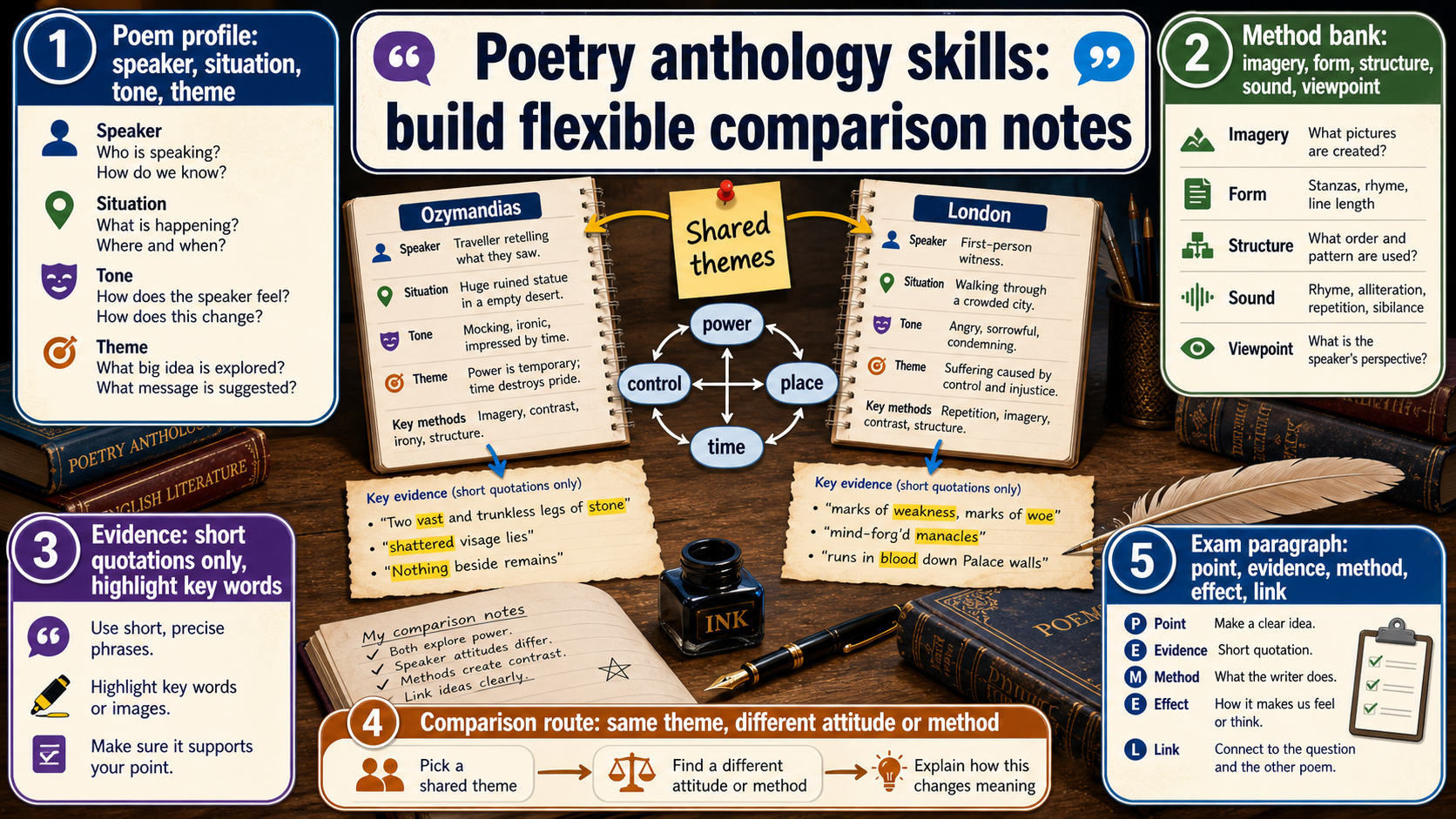
After viewing
After viewing, select one image or structural choice from a poem and write one sentence explaining its effect.
Clear explanation
Main idea
For each poem, know who is speaking, what situation is presented, what changes and which themes are strongest.
How to do it
Poetic methods include imagery, sound, rhythm, rhyme, stanza shape, line breaks, voice and contrast.
Answer habit
Revision notes should include comparison links: which poems share themes, and how do they treat those themes differently?
Worked examples
Tone shift
A poem may begin calmly and end bitterly.
Comparison note
Both poems present memory, but one treats it as comfort while the other treats it as painful.
Quick checks
Choose an answer, then check your thinking.
1. Before comparing anthology poems, what should you pin down for each poem?
2. Which pairing creates a clear route into power and place?
Practice questions
Question 1
Make a revision note for Ozymandias.
Reveal answer and marking guidance
Answer: Ruined statue, arrogant ruler, power decays over time.
Marking: Credit concise poem knowledge.
Question 2
Make a revision note for Love’s Philosophy.
Reveal answer and marking guidance
Answer: Persuasive speaker uses natural union to argue for romantic closeness.
Marking: Reward speaker and method.
Question 3
What should you record for every anthology poem?
Reveal answer and marking guidance
Answer: Speaker, attitude, theme, short evidence, methods and useful comparison partners.
Marking: Credit flexible comparison preparation.
Question 4
How do you avoid random comparison?
Reveal answer and marking guidance
Answer: Choose poems because they share a theme but differ in attitude or method.
Marking: Reward purposeful pairing.
Answers and marking guidance
The exact practice answers are hidden under each question so you can try first. For anthology revision, reward poem profile cards that capture speaker, situation, tone, form, structure, short evidence and comparison partners. Strong cards should also include one secure contrast route, such as power against place or persuasion against loss, so pupils can adapt quickly to the exact exam question instead of memorising one fixed essay.
Common mistakes
- Revising poems in isolation: learn useful comparison partners.
- Memorising biography: prioritise speaker, tone, theme and method.
- Recording long quotations only: short flexible evidence works better.
- Ignoring form and structure: poem shape can carry meaning.
Extension challenge
Make an anthology card for Ozymandias or London with speaker, theme, method, structure and two comparison partners.
Reveal answer
Example answer: A strong card helps answer several questions because it links theme, evidence and comparison routes rather than storing disconnected facts.
Exam-board guidance
Anthology requirements differ by board and school. Use this lesson to build transferable poem profiles, then match them to your confirmed cluster.
AQA GCSE English
Check the mark value and assessment focus, then keep evidence and analysis tied to the exact question.
OCR GCSE English
Use precise references and organise the response around the command word rather than a memorised answer.
Pearson Edexcel GCSE English
Match the lesson skill to the relevant paper question, source, set text or writing form.
Eduqas GCSE English
Adapt the technique to the component your school is preparing for, especially timing and question wording.
WJEC Wales
Check whether your course uses current Wales-specific routes, then apply the same evidence and accuracy habits.
CCEA GCSE English
Use the unit focus to balance evidence, explanation, comparison, context and written accuracy.
Next lesson
Next, continue with Comparing Poems.