
Lesson overview
This lesson studies modern texts through conflict, voice, scene and social pressure.
Study modern texts through character, conflict, theme and social ideas. It supports GCSE English Language, GCSE English Literature or both, depending on your course.
What you will learn
Key habits before you start
Literature argument route
- Thesis: Open with a clear argument about the writer's idea or message.
- Evidence range: Use short evidence from key moments across the text.
- Method: Explain how language, structure, characterisation or contrast shapes meaning.
- Whole text: Link moments together so the answer shows development, not isolated notes.
Why this matters
Modern texts often explore identity, family, responsibility, class, conflict, power or belonging. The best essays connect personal moments to bigger ideas.
Prior knowledge
You should already be comfortable with:
Modern prose and drama material
Use your set text and school edition to practise modern text analysis. Select scenes or chapters that show character change, social conflict and the writer's control of voice, structure or staging.
Modern text prompt bank
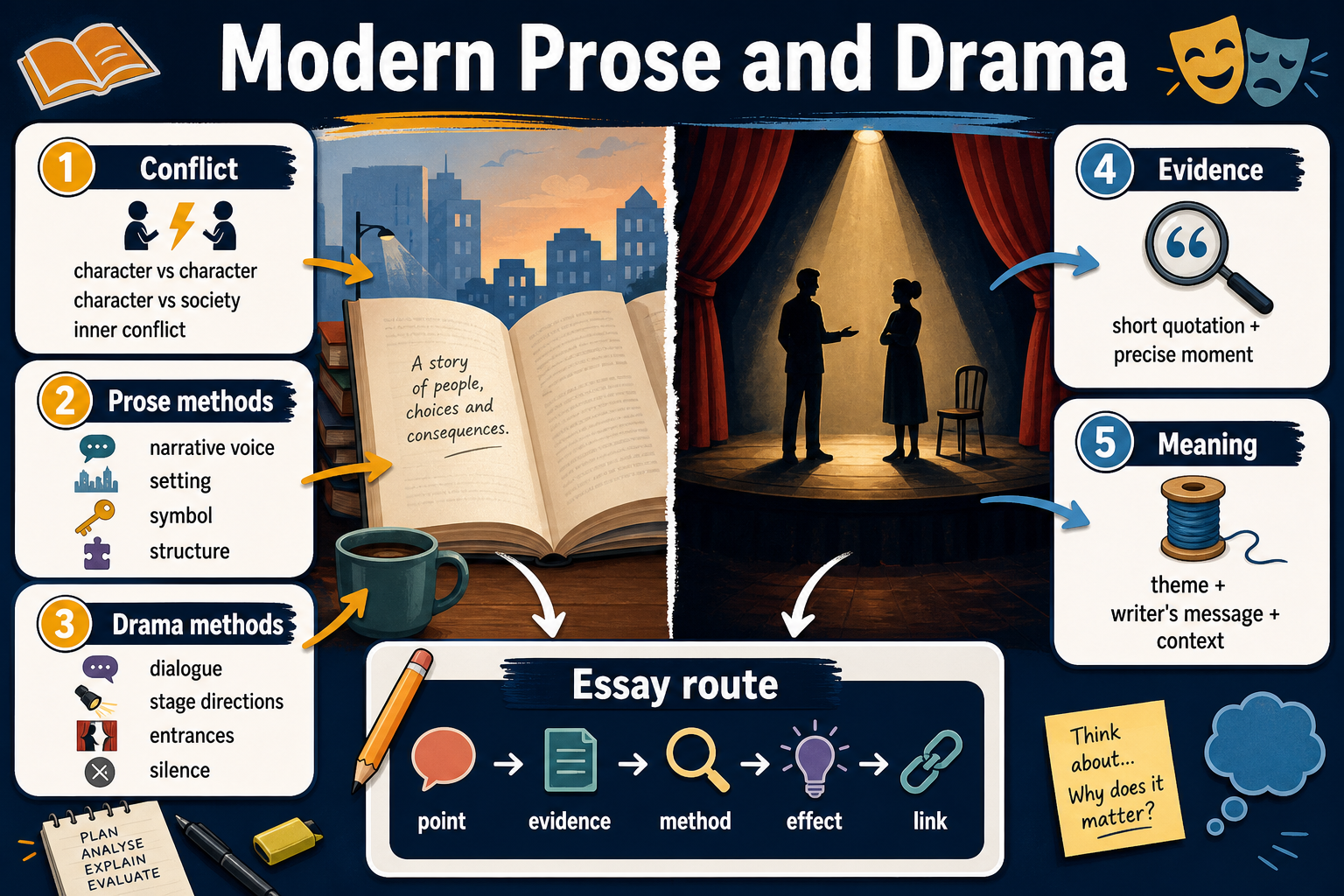
Modern prose and drama infographic
Before viewing
Before viewing, choose one theme, character or turning point that the visual should help you connect to evidence.
After viewing
After viewing, write one thesis sentence and one evidence sentence using the route shown in the visual.
Clear explanation
Main idea
For prose, consider narrative voice, setting, symbolism and structure. For drama, consider dialogue, stage directions, entrances and dramatic tension.
How to do it
Track conflict: between people, within a character, or between a character and society.
Answer habit
Context may include social attitudes, historical events or the writer’s concerns, but it should always connect to the text.
Worked examples
Drama method
A pause in stage directions can show tension or withheld emotion.
Prose method
A repeated object can become symbolic.
Quick checks
Choose an answer, then check your thinking.
1. In a modern drama question, what should you track across scenes?
2. Which evidence choice suits a drama answer?
Practice questions
Question 1
What should you track across a modern drama?
Reveal answer and marking guidance
Answer: How relationships and conflicts shift from scene to scene.
Marking: Credit development.
Question 2
How can stage directions become evidence?
Reveal answer and marking guidance
Answer: They can show silence, tension, movement, status or emotional control.
Marking: Reward dramatic method.
Question 3
What is a safe way to handle copyrighted modern texts?
Reveal answer and marking guidance
Answer: Use named moments and short references from your school edition rather than reproducing long extracts.
Marking: Credit copyright-safe study.
Question 4
Write a thesis about responsibility in a modern play.
Reveal answer and marking guidance
Answer: The play presents responsibility as something characters resist until pressure exposes their choices.
Marking: Reward theme and conflict.
Answers and marking guidance
The exact practice answers are hidden under each question so you can try first. For modern prose or drama, reward references to narrative voice, scene structure, stage directions, character change and social ideas. Protected set texts should be handled through school-edition quotations and precise moment references.
Common mistakes
- Treating drama like prose: stage directions, entrances and silence matter.
- Ignoring narrative voice: prose often guides judgement through perspective.
- Using protected text loosely: check exact wording in your school edition.
- Writing about issues generally: link social ideas to scenes and methods.
Extension challenge
Choose one scene or chapter from your modern text and list how voice, staging or structure changes the audience’s judgement.
Reveal answer
Example answer: A strong response connects a precise moment from the set text to writer method and social meaning, using school-edition evidence.
Exam-board guidance
Modern prose and drama set texts vary heavily by school and board. Use this page to practise method and argument with the confirmed text on your course.
AQA GCSE English
Check the mark value and assessment focus, then keep evidence and analysis tied to the exact question.
OCR GCSE English
Use precise references and organise the response around the command word rather than a memorised answer.
Pearson Edexcel GCSE English
Match the lesson skill to the relevant paper question, source, set text or writing form.
Eduqas GCSE English
Adapt the technique to the component your school is preparing for, especially timing and question wording.
WJEC Wales
Check whether your course uses current Wales-specific routes, then apply the same evidence and accuracy habits.
CCEA GCSE English
Use the unit focus to balance evidence, explanation, comparison, context and written accuracy.
Next lesson
Next, continue with Poetry Anthology Skills.