
Lesson overview
This lesson focuses on 19th-century fiction through narrator, setting, society and change.
Analyse character, setting, narration and social context in a 19th-century novel. It supports GCSE English Language, GCSE English Literature or both, depending on your course.
What you will learn
Key habits before you start
Literature argument route
- Thesis: Open with a clear argument about the writer's idea or message.
- Evidence range: Use short evidence from key moments across the text.
- Method: Explain how language, structure, characterisation or contrast shapes meaning.
- Whole text: Link moments together so the answer shows development, not isolated notes.
Why this matters
19th-century novel questions often combine extract analysis with whole-text knowledge, so pupils need both close reading and big-picture understanding.
Prior knowledge
You should already be comfortable with:
19th-century novel practice material
Use 19th-century novels to practise setting, context, narrative voice and social criticism. Then transfer the method to the exact 19th-century text your class studies.
prose reference bank
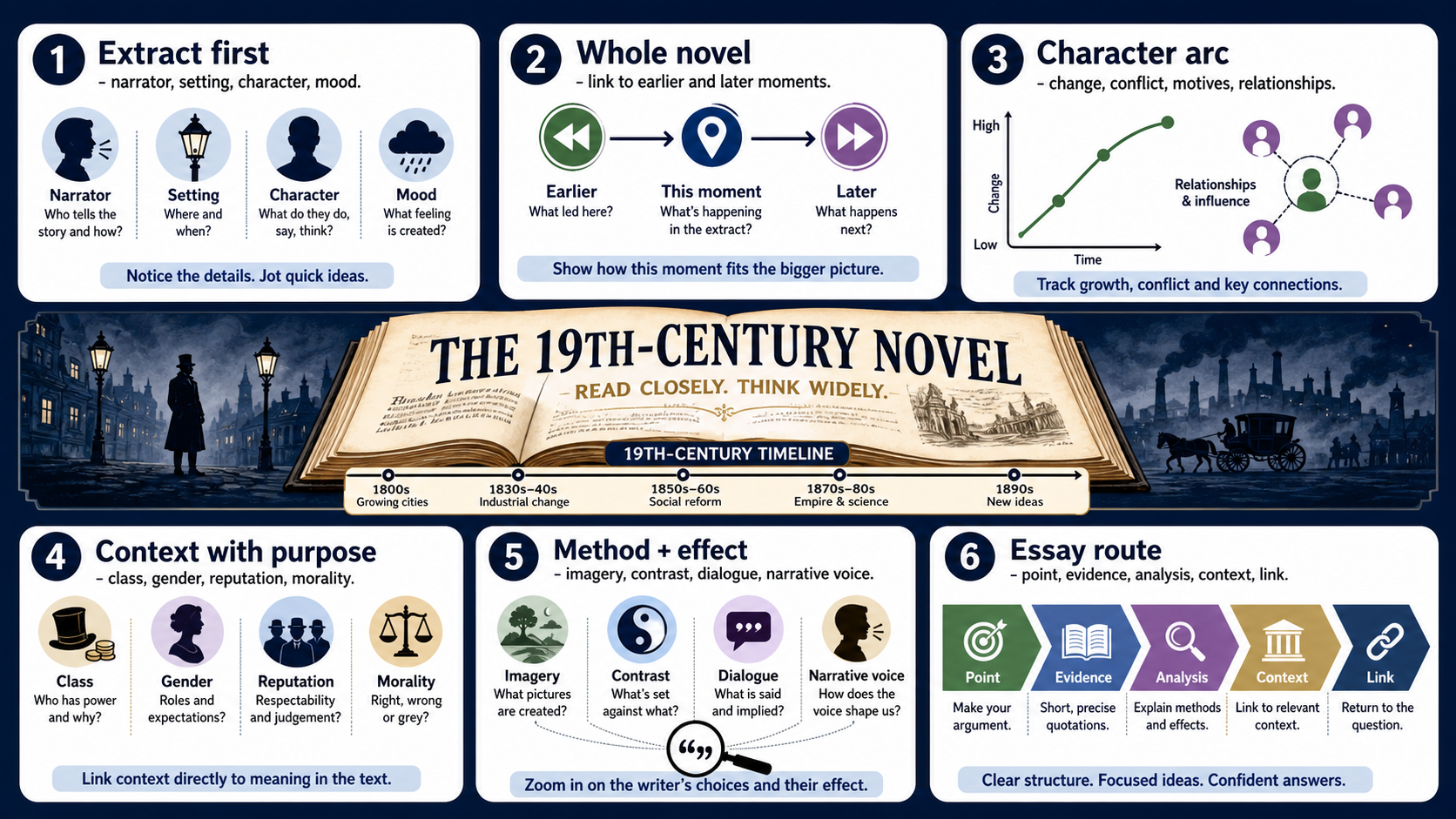
19th-century novel revision route infographic
Before viewing
Before viewing, choose one theme, character or turning point that the visual should help you connect to evidence.
After viewing
After viewing, write one thesis sentence and one evidence sentence using the route shown in the visual.
Clear explanation
Main idea
Start with the extract, but connect it to the wider novel when the task asks you to.
How to do it
Narrators can guide sympathy, reveal judgement or create distance. Setting often reflects social class, danger, isolation or moral atmosphere.
Answer habit
Context might include poverty, gender, education, industrialisation, empire or social reform, depending on the novel.
Worked examples
Setting
A dark, cramped room can suggest poverty, secrecy or emotional pressure.
Whole-text link
If a character seems generous in the extract, connect this to whether they change or stay the same later.
Quick checks
Choose an answer, then check your thinking.
1. Why should a 19th-century novel answer mention setting carefully?
2. Which context sentence is most useful?
Practice questions
Question 1
How can setting matter in a 19th-century novel?
Reveal answer and marking guidance
Answer: It can reveal class, isolation, danger, respectability or moral contrast.
Marking: Credit social meaning.
Question 2
Give a 19th-century example of social pressure.
Reveal answer and marking guidance
Answer: Jekyll hides his double life because reputation and respectability matter.
Marking: Reward text-specific context.
Question 3
Why should context stay close to the text?
Reveal answer and marking guidance
Answer: It should explain a character, setting or method rather than becoming a history essay.
Marking: Credit relevant context.
Question 4
Write a thesis about change in a 19th-century novel.
Reveal answer and marking guidance
Answer: Dickens often presents change as morally necessary when private selfishness harms public life.
Marking: Reward arguable, text-linked thesis.
Answers and marking guidance
The exact practice answers are hidden under each question so you can try first. For the 19th-century novel, reward setting, social context, narrative voice and character development tied to textual evidence. Answers should show how Dickens, Stevenson or another set novelist shapes moral pressure, secrecy or social criticism.
Common mistakes
- Context dumping: Victorian context must illuminate a moment.
- Ignoring narrative voice: who tells the story shapes meaning.
- Only writing about plot: analyse setting, character and method.
- Forgetting textual evidence: short references can still be precise.
Extension challenge
Compare how a 19th-century novel uses setting to reveal social pressure or moral change.
Reveal answer
Example answer: A strong response links setting to theme, such as London streets, homes or workplaces revealing class, reputation, poverty or fear.
Exam-board guidance
19th-century novel questions usually reward context, method and whole-text knowledge. Use practice material here, then apply it to your board’s set novel.
AQA GCSE English
Check the mark value and assessment focus, then keep evidence and analysis tied to the exact question.
OCR GCSE English
Use precise references and organise the response around the command word rather than a memorised answer.
Pearson Edexcel GCSE English
Match the lesson skill to the relevant paper question, source, set text or writing form.
Eduqas GCSE English
Adapt the technique to the component your school is preparing for, especially timing and question wording.
WJEC Wales
Check whether your course uses current Wales-specific routes, then apply the same evidence and accuracy habits.
CCEA GCSE English
Use the unit focus to balance evidence, explanation, comparison, context and written accuracy.
Next lesson
Next, continue with Modern Prose and Drama.