
Lesson overview
This lesson treats Shakespeare as drama: character, theme and stagecraft working together.
Approach Shakespeare questions through character, theme, language and performance choices. It supports GCSE English Language, GCSE English Literature or both, depending on your course.
What you will learn
Key habits before you start
Shakespeare response route
- Question focus: Track the named character, theme or idea before choosing evidence.
- Evidence: Use concise quotations and stage moments rather than retelling the plot.
- Dramatic method: Comment on language, stagecraft, contrast, audience response or structure.
- Context: Use context to sharpen interpretation, not as a separate history paragraph.
Why this matters
Shakespeare is drama. The words matter, but so do entrances, exits, soliloquies, conflict and audience knowledge.
Prior knowledge
You should already be comfortable with:
Shakespeare stagecraft material
Use Shakespeare scenes to practise drama as performance. Track how language, entrances, exits, soliloquies and audience knowledge shape character and theme.
stagecraft bank
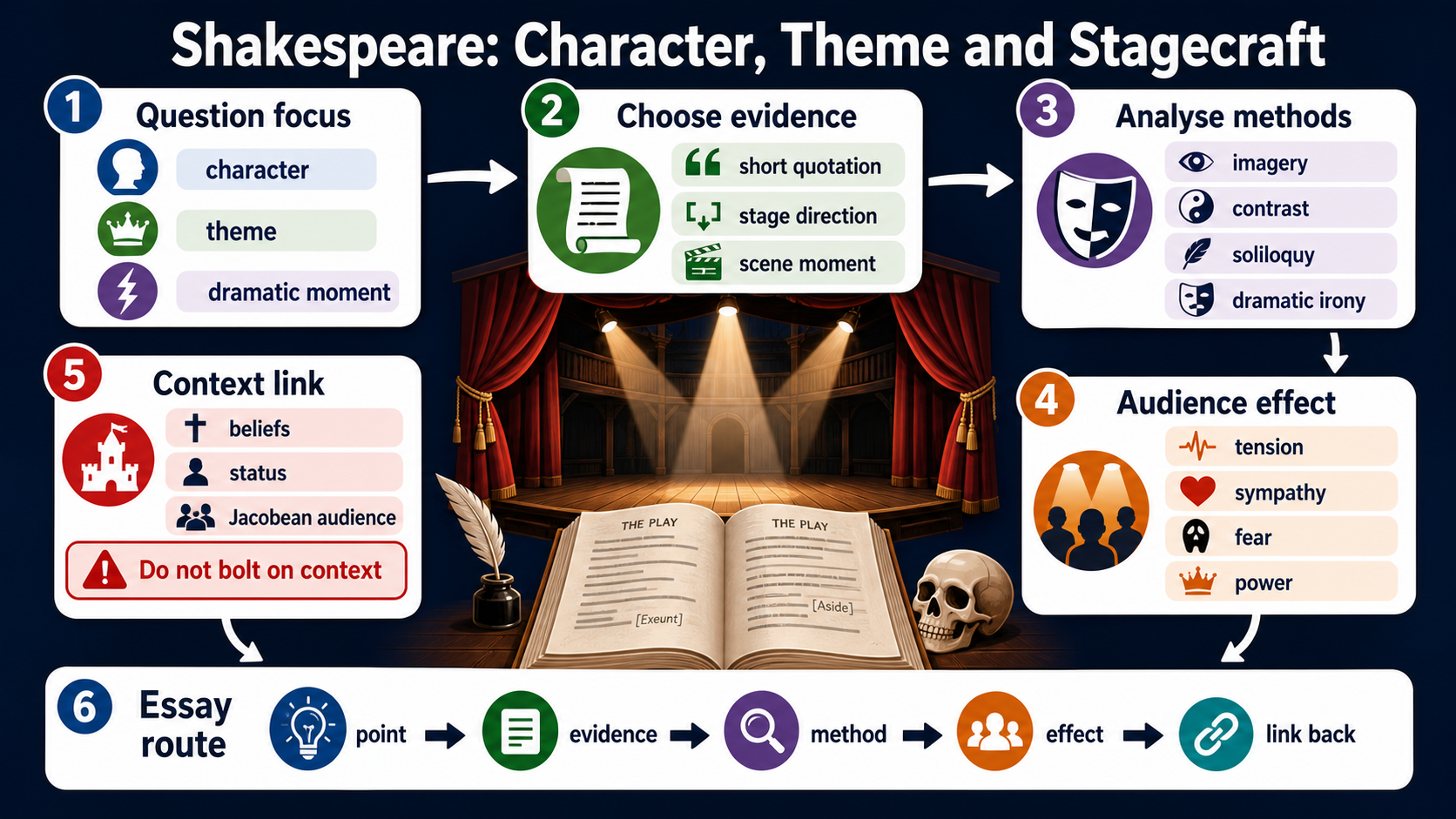
Shakespeare character, theme and stagecraft infographic
Before viewing
Before viewing, choose one theme, character or turning point that the visual should help you connect to evidence.
After viewing
After viewing, write one thesis sentence and one evidence sentence using the route shown in the visual.
Clear explanation
Main idea
Treat the text as a play for performance. Ask what the audience sees, hears and knows at each moment.
How to do it
Stagecraft includes soliloquy, aside, dramatic irony, entrances, exits, conflict and props.
Answer habit
Context can include Jacobean society, kingship, gender, religion or hierarchy, depending on the play and question.
Worked examples
Soliloquy
A soliloquy lets the audience hear private thoughts.
Dramatic irony
The audience may know more than a character.
Quick checks
Choose an answer, then check your thinking.
1. In Shakespeare, why might an entrance or exit matter as much as a metaphor?
2. Which comment shows stage awareness?
Practice questions
Question 1
Why is a soliloquy useful evidence in Shakespeare?
Reveal answer and marking guidance
Answer: It lets the audience hear private conflict that other characters cannot hear.
Marking: Credit dramatic awareness.
Question 2
Name one stagecraft feature other than language.
Reveal answer and marking guidance
Answer: Entrances, exits, asides, soliloquies, dramatic irony or stage directions.
Marking: Reward form knowledge.
Question 3
Write a point about dramatic irony.
Reveal answer and marking guidance
Answer: Dramatic irony can make the audience judge a character because they know more than someone on stage.
Marking: Credit audience effect.
Question 4
Why should a Shakespeare answer mention performance?
Reveal answer and marking guidance
Answer: Because the text was written for the stage, so meaning is shaped by what the audience sees and hears.
Marking: Reward stage-centred interpretation.
Answers and marking guidance
The exact practice answers are hidden under each question so you can try first. For Shakespeare stagecraft, reward comments on entrances, exits, soliloquies, dramatic irony, conflict and staging as well as language. A strong answer explains how the audience experiences character and theme in performance.
Common mistakes
- Reading Shakespeare only as page text: remember it is performance.
- Ignoring stage movement: entrances, exits and public scenes create power.
- Only translating language: analyse dramatic effect.
- Forgetting audience knowledge: dramatic irony changes response.
Extension challenge
Choose a Shakespeare scene and explain how one entrance, exit or soliloquy changes the audience’s understanding.
Reveal answer
Example answer: A strong answer treats language and stagecraft together, showing how performance choices reveal character and theme.
Exam-board guidance
Shakespeare set plays vary, but dramatic method matters across routes. Use this lesson alongside your confirmed play and exact extract practice.
AQA GCSE English
Check the mark value and assessment focus, then keep evidence and analysis tied to the exact question.
OCR GCSE English
Use precise references and organise the response around the command word rather than a memorised answer.
Pearson Edexcel GCSE English
Match the lesson skill to the relevant paper question, source, set text or writing form.
Eduqas GCSE English
Adapt the technique to the component your school is preparing for, especially timing and question wording.
WJEC Wales
Check whether your course uses current Wales-specific routes, then apply the same evidence and accuracy habits.
CCEA GCSE English
Use the unit focus to balance evidence, explanation, comparison, context and written accuracy.
Next lesson
Next, continue with The 19th-Century Novel.