
Lesson overview
This lesson builds literature essays around a line of argument, not plot retelling.
Build clear analytical essays with a focused argument and embedded evidence. It supports GCSE English Language, GCSE English Literature or both, depending on your course.
What you will learn
Key habits before you start
Literature argument route
- Thesis: Open with a clear argument about the writer's idea or message.
- Evidence range: Use short evidence from key moments across the text.
- Method: Explain how language, structure, characterisation or contrast shapes meaning.
- Whole text: Link moments together so the answer shows development, not isolated notes.
Why this matters
A literature essay is not a memory dump. It is a focused argument about how the writer presents an idea, character or theme.
Prior knowledge
You should already be comfortable with:
Literature essay writing material
Use these prompts to practise turning text knowledge into an argument. Each paragraph should make a claim, use brief evidence and explain how the writer shapes meaning.
Literature paragraph prompt bank
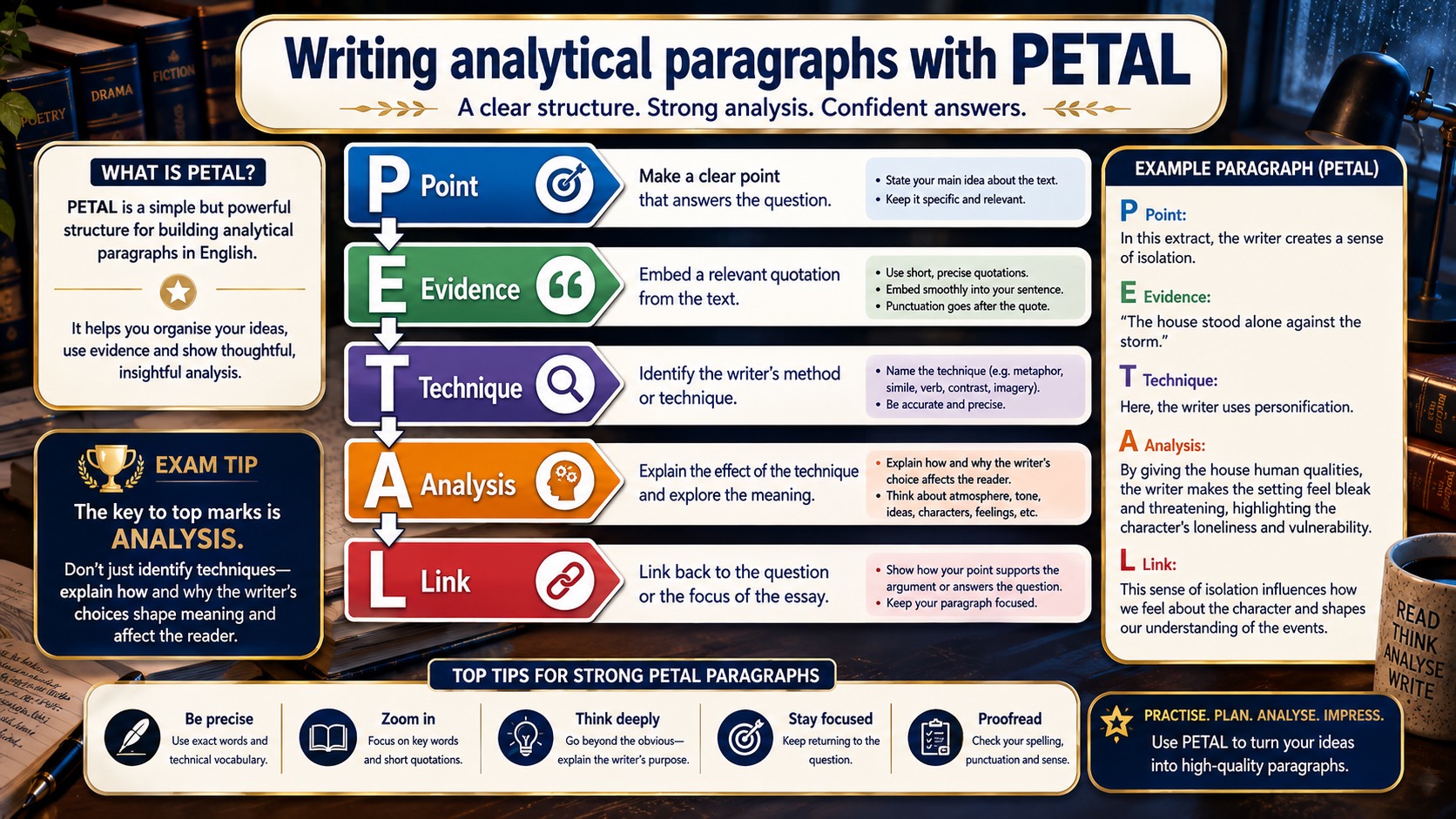
PETAL analytical paragraphs infographic
Before viewing
Before viewing, identify the purpose, audience and form of the writing task you are practising.
After viewing
After viewing, revise one sentence or paragraph so it better matches the task purpose and audience.
Clear explanation
Main idea
Begin by turning the question into an argument. If the question asks how ambition is presented, decide what the writer suggests about ambition.
How to do it
Each paragraph should make one main point, support it with evidence and explain method, meaning and effect.
Answer habit
End paragraphs by linking back to the question so the essay stays focused.
Worked examples
Thesis
Shakespeare presents ambition as attractive at first but destructive once it controls Macbeth’s choices.
Embedded evidence
Macbeth’s “vaulting ambition” suggests an urge that overleaps moral control.
Quick checks
Choose an answer, then check your thinking.
1. A literature question asks how far you agree. What should your thesis do?
2. Which paragraph route is strongest?
Practice questions
Question 1
Write a thesis for a Macbeth ambition essay.
Reveal answer and marking guidance
Answer: Shakespeare presents ambition as tempting but destructive once Macbeth lets it overrule moral judgement.
Marking: Credit arguable whole-text claim.
Question 2
What should each paragraph do after the topic sentence?
Reveal answer and marking guidance
Answer: Use evidence, analyse method or meaning, and link back to the question.
Marking: Reward paragraph discipline.
Question 3
Improve: “Macbeth is ambitious.”
Reveal answer and marking guidance
Answer: Macbeth’s ambition becomes dangerous because it shifts from private desire to violent action.
Marking: Credit development and interpretation.
Question 4
Where should context appear?
Reveal answer and marking guidance
Answer: Where it helps explain a precise moment, not as a detached history paragraph.
Marking: Reward relevant context.
Answers and marking guidance
The exact practice answers are hidden under each question so you can try first. For literature essays, reward a thesis that answers how far or in what way, paragraphs that build an argument, short evidence and method/context comments that support interpretation rather than distract from it.
Common mistakes
- Starting with plot summary: begin with an argument.
- Using context as decoration: make it support interpretation.
- Repeating the same point: each paragraph should develop the thesis.
- Ending with a bland summary: sharpen the final judgement.
Extension challenge
Write two thesis statements for the same literature question: one basic and one more arguable. Explain which is stronger.
Reveal answer
Example answer: A strong thesis answers the exact wording and creates a route for the essay, rather than announcing the text is interesting or important.
Exam-board guidance
Literature essay formats vary by text and board, but argument, evidence and method remain central. Use this lesson to turn revision knowledge into a focused response.
AQA GCSE English
Check the mark value and assessment focus, then keep evidence and analysis tied to the exact question.
OCR GCSE English
Use precise references and organise the response around the command word rather than a memorised answer.
Pearson Edexcel GCSE English
Match the lesson skill to the relevant paper question, source, set text or writing form.
Eduqas GCSE English
Adapt the technique to the component your school is preparing for, especially timing and question wording.
WJEC Wales
Check whether your course uses current Wales-specific routes, then apply the same evidence and accuracy habits.
CCEA GCSE English
Use the unit focus to balance evidence, explanation, comparison, context and written accuracy.
Next lesson
Next, continue with Shakespeare: Character, Theme and Stagecraft.