
Lesson overview
This lesson turns a studied text into usable notes about character, theme and change.
Learn how to study plot, character, theme, method and context together. It supports GCSE English Language, GCSE English Literature or both, depending on your course.
What you will learn
Key habits before you start
Literature argument route
- Thesis: Open with a clear argument about the writer's idea or message.
- Evidence range: Use short evidence from key moments across the text.
- Method: Explain how language, structure, characterisation or contrast shapes meaning.
- Whole text: Link moments together so the answer shows development, not isolated notes.
Why this matters
Literature essays reward interpretation. You need to know what happens, but marks come from explaining how and why the writer presents ideas.
Prior knowledge
You should already be comfortable with:
Studying a literature text material
Use this revision structure with the text your class is studying. Build notes that connect characters, themes, methods and the order of the whole text.
Whole-text study prompt bank
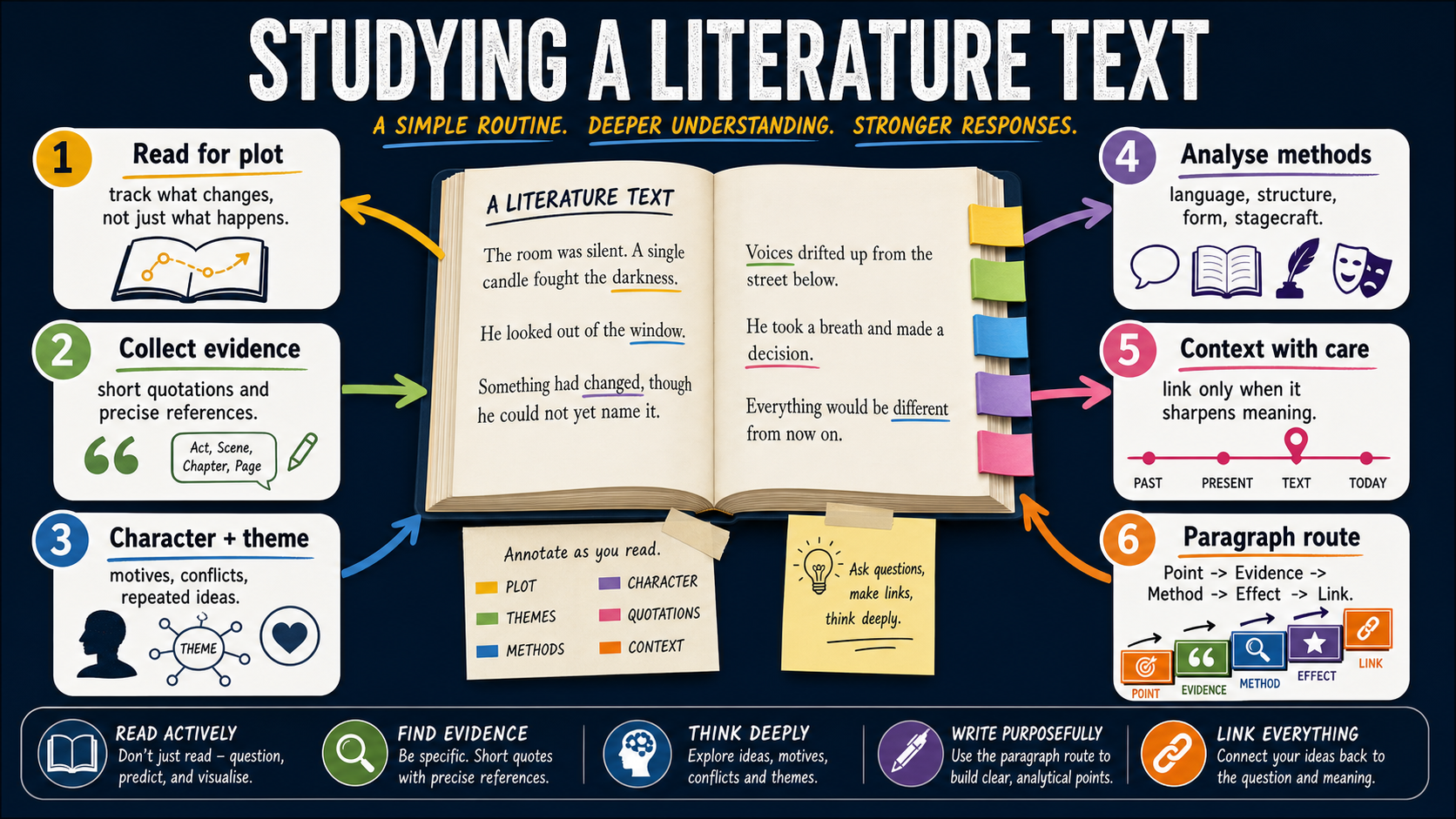
Studying a literature text infographic
Before viewing
Before viewing, choose one theme, character or turning point that the visual should help you connect to evidence.
After viewing
After viewing, write one thesis sentence and one evidence sentence using the route shown in the visual.
Clear explanation
Main idea
Start with the text itself: what happens, who changes, what conflicts repeat and what themes develop.
How to do it
Methods include language, structure, form, stagecraft, narrative voice and contrast.
Answer habit
Context should support interpretation, not replace it. Link context to a specific moment in the text.
Worked examples
Theme note
Theme: power. Evidence could include commands, social status, money, violence or silence.
Context use
A Victorian setting may shape gender expectations.
Quick checks
Choose an answer, then check your thinking.
1. When revising a set text, which note is most useful?
2. What should a theme revision card include?
Practice questions
Question 1
Make a useful revision note about Scrooge.
Reveal answer and marking guidance
Answer: Scrooge changes from isolated miser to socially responsible figure after confronting past, present and future.
Marking: Credit whole-text change.
Question 2
What should a character card include?
Reveal answer and marking guidance
Answer: Starting point, turning points, key evidence and final position.
Marking: Reward flexible revision.
Question 3
Why is plot summary not enough?
Reveal answer and marking guidance
Answer: The exam asks how writers present ideas, so notes must connect events to methods and meanings.
Marking: Credit analytical focus.
Question 4
Choose one theme and one moment that would support it.
Reveal answer and marking guidance
Answer: Responsibility: Scrooge seeing the Cratchits shows poverty becoming personal and urgent.
Marking: Reward theme linked to moment.
Answers and marking guidance
The exact practice answers are hidden under each question so you can try first. For studying a literature text, reward notes that track character, theme, method and change across the whole work. A useful revision note should be usable in several questions, not tied to one memorised paragraph.
Common mistakes
- Making notes by chapter only: also organise by theme and character.
- Keeping isolated quotations: connect evidence to method and change.
- Ignoring endings: final moments often reshape the whole text.
- Revising one essay: prepare flexible routes.
Extension challenge
Build a whole-text map with five turning points and one theme that changes across them.
Reveal answer
Example answer: A strong study map helps you move between character, theme, structure and method without relying on a memorised essay.
Exam-board guidance
Set texts differ by board and school. Use this lesson to organise whichever novel, play or poetry cluster your teacher has confirmed.
AQA GCSE English
Check the mark value and assessment focus, then keep evidence and analysis tied to the exact question.
OCR GCSE English
Use precise references and organise the response around the command word rather than a memorised answer.
Pearson Edexcel GCSE English
Match the lesson skill to the relevant paper question, source, set text or writing form.
Eduqas GCSE English
Adapt the technique to the component your school is preparing for, especially timing and question wording.
WJEC Wales
Check whether your course uses current Wales-specific routes, then apply the same evidence and accuracy habits.
CCEA GCSE English
Use the unit focus to balance evidence, explanation, comparison, context and written accuracy.
Next lesson
Next, continue with Writing Literature Essays.