
Lesson overview
Use this as transferable English technique.
Plan a whole non-fiction reading paper by tracking viewpoint, purpose and comparison. the core habits of close reading, precise evidence, controlled writing and checking apply across GCSE English.
What you will learn
Key habits before you start
Reading comparison route
- Task focus: Identify whether the question asks you to retrieve, infer, compare, evaluate or summarise.
- Selection: Choose details that answer the question instead of copying long passages.
- Comparison: Link similarities and differences through ideas, attitudes and methods.
- Judgement: Support every evaluation with evidence from the text or source.
Why this matters
Non-fiction questions often reward pupils who can see why each writer is communicating, not just what each writer says.
Prior knowledge
You should already be comfortable with:
Practice sources supplied on this page
Use the two lido sources to practise a non-fiction paper routine: source selection, viewpoint, method, comparison and timing.
Source A: original article opening
Our town should protect the old lido because public spaces give people more than somewhere to swim. They hold memories, routines and chances for neighbours to meet. A new car park may be convenient, but convenience is a poor exchange for a place that has served generations.
Source B: original letter opening
I understand why some residents feel attached to the old lido, but sentiment cannot repair cracked tiles or pay rising maintenance costs. The site is unused for most of the year. A safer, modern facility would serve more people and cost less to maintain.
Non-fiction reading paper walkthrough infographic
Before viewing
Before viewing, decide whether the task needs selection, comparison, evaluation or synthesis.
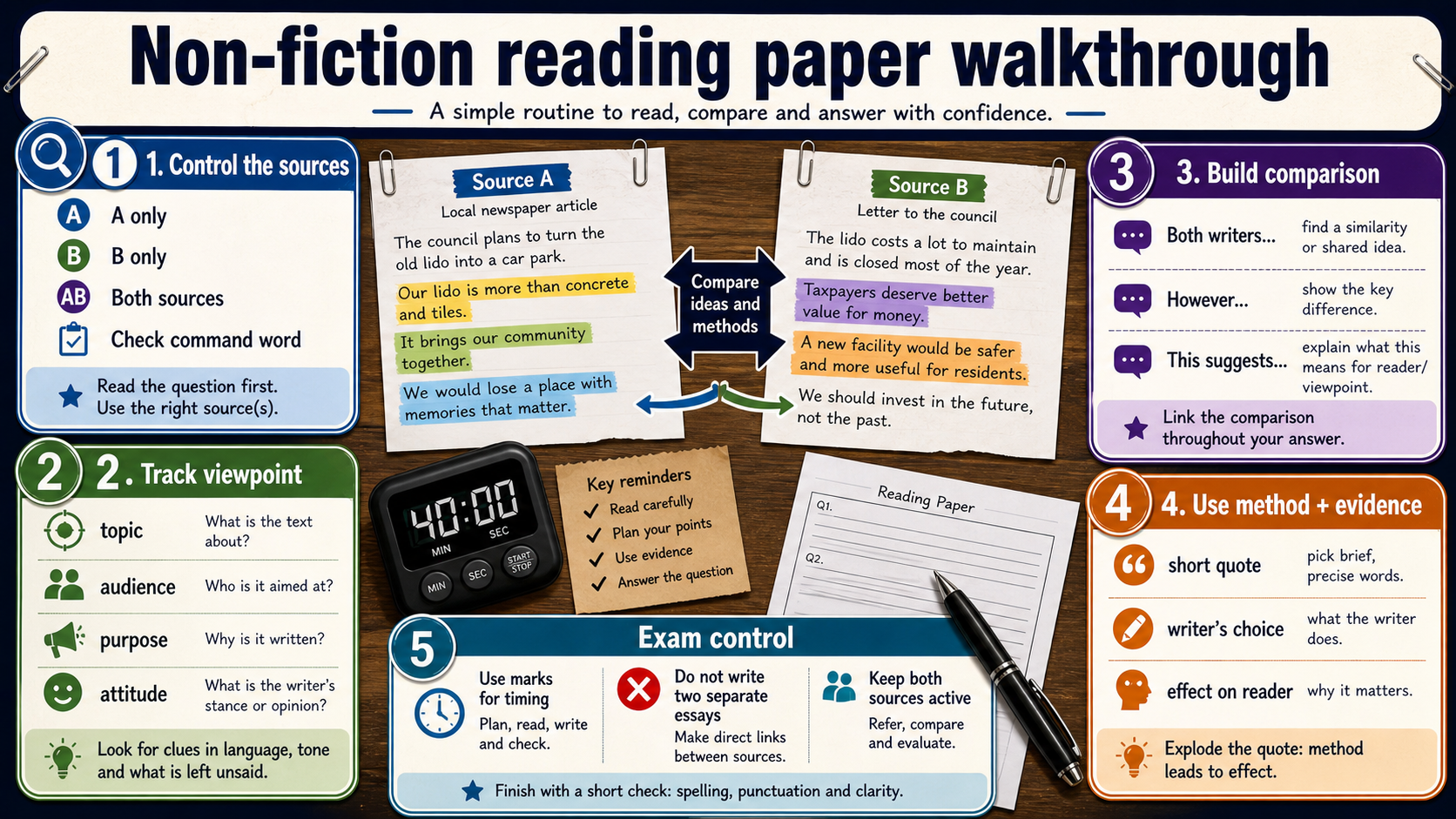
After viewing
After viewing, write one sentence that links two details or sources without drifting into unsupported opinion.
Clear explanation
Text one and text two
Read each text for topic, viewpoint, audience and purpose. Then ask what is similar or different before writing.
Comparison
Compare ideas first, then methods. A strong comparison explains both writers in one connected paragraph.
Exam control
Use the marks to decide how many points to make. Do not let a short retrieval task eat time needed for comparison.
Worked examples
Viewpoint note
Writer A presents travel as freeing, while Writer B presents it as stressful.
Method note
Writer A uses enthusiastic adjectives; Writer B uses listing to build pressure.
Quick checks
Choose an answer, then check your thinking.
1. A non-fiction paper includes two sources. What should you check before answering?
2. Which mistake costs time on comparison questions?
Practice questions
Question 1
What should you mark before answering?
Reveal answer and marking guidance
Answer: Which questions use Source A, Source B or both.
Marking: Credit source control.
Question 2
How do the lido sources differ?
Reveal answer and marking guidance
Answer: One defends community memory; the other prioritises cost and practical services.
Marking: Reward viewpoint comparison.
Question 3
What belongs in a method paragraph?
Reveal answer and marking guidance
Answer: A writer’s choice, short evidence and how it supports viewpoint or purpose.
Marking: Credit non-fiction analysis.
Question 4
What should you avoid in the comparison question?
Reveal answer and marking guidance
Answer: Separate summaries with no direct link between the writers.
Marking: Reward integrated comparison.
Answers and marking guidance
The exact practice answers are hidden under each question so you can try first. For a non-fiction paper routine, reward source control, command-word control and timing. The lido sources should be used differently depending on whether the task asks for retrieval, viewpoint, method, comparison or evaluation.
Common mistakes
- Writing two separate essays: make direct links between texts.
- Ignoring form: letters, articles and speeches shape voice differently.
- Over-quoting: select short evidence that proves the comparison.
- Missing purpose: ask what each writer wants the reader to think or feel.
Extension challenge
Choose two articles on the same issue and write three comparison sentences: one about viewpoint, one about tone and one about method.
Reveal answer
Example answer: A strong response keeps both sources active and makes the comparison task clear before adding evidence or method detail.
Exam-board guidance
Non-fiction reading papers vary in source pairing, retrieval marks and comparison marks. Use this page to decide when to use Source A, Source B or both before writing.
AQA GCSE English
Check the mark value and assessment focus, then keep evidence and analysis tied to the exact question.
OCR GCSE English
Use precise references and organise the response around the command word rather than a memorised answer.
Pearson Edexcel GCSE English
Match the lesson skill to the relevant paper question, source, set text or writing form.
Eduqas GCSE English
Adapt the technique to the component your school is preparing for, especially timing and question wording.
WJEC Wales
Check whether your course uses current Wales-specific routes, then apply the same evidence and accuracy habits.
CCEA GCSE English
Use the unit focus to balance evidence, explanation, comparison, context and written accuracy.
Next lesson
Next, practise creative writing exam walkthrough.