
Lesson overview
Use this as transferable English technique.
Build a controlled creative response with planning, structure, sentence variety and proofreading. the core habits of close reading, precise evidence, controlled writing and checking apply across GCSE English.
What you will learn
Key habits before you start
Writing control route
- Purpose: Decide whether the writing should describe, argue, persuade, inform, narrate or present.
- Audience and form: Match tone, structure and detail to the reader and task format.
- Paragraph control: Build paragraphs around a clear focus, then vary sentence shape deliberately.
- Accuracy: Check sentence boundaries, punctuation, spelling and tense before finishing.
Why this matters
Creative writing marks come from control. A simple idea written precisely is often stronger than an overloaded plot.
Prior knowledge
You should already be comfortable with:
Practice prompts supplied on this page
Use these prompts to practise exam control: choose one idea, plan a clear shape, and leave time to check sentence accuracy.
Prompt bank
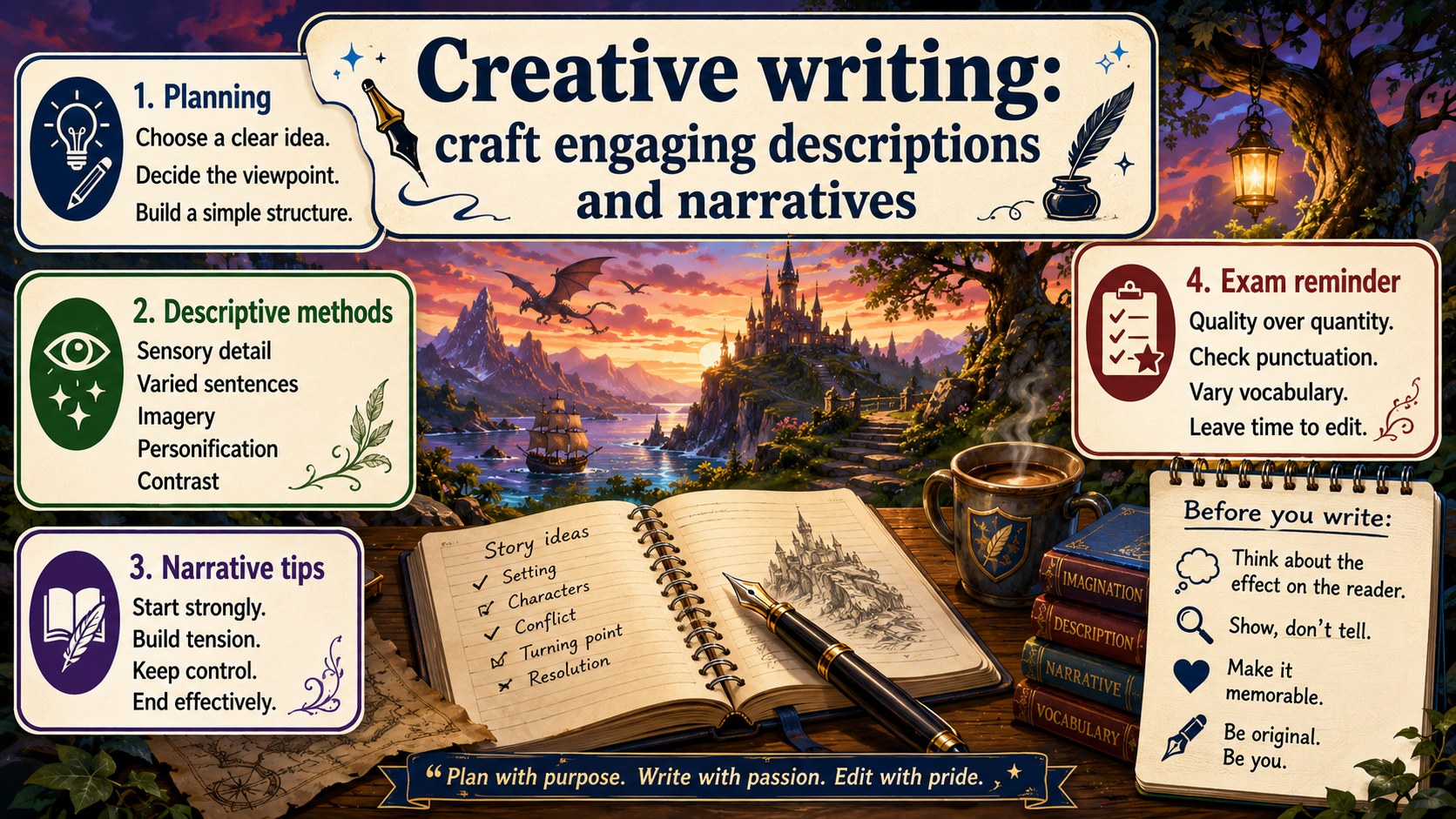
Creative writing craft infographic
Before viewing
Before viewing, identify the purpose, audience and form of the writing task you are practising.
After viewing
After viewing, revise one sentence or paragraph so it better matches the task purpose and audience.
Clear explanation
Plan small
Choose one place, moment, object or conflict. A narrow focus gives more room for detail and control.
Shape the response
Use a clear opening, development, shift and ending. Structure should guide the reader through the piece.
Proofread
Reserve time to check sentence boundaries, tense, spelling of common words and paragraph breaks.
Worked examples
Description plan
Opening wide view, zoom to one object, shift to sound, final image.
Narrative plan
Character wants something, obstacle appears, decision is made, consequence ends the piece.
Quick checks
Choose an answer, then check your thinking.
1. A creative writing exam gives a picture and a title. What should you decide first?
2. Which plan best fits a short descriptive response?
Practice questions
Question 1
Choose the better exam plan for an unsettling place.
Reveal answer and marking guidance
Answer: Wide view, one odd detail, sensory zoom, final unsettling image.
Marking: Credit controlled description.
Question 2
Choose the better exam plan for the envelope story.
Reveal answer and marking guidance
Answer: Character finds envelope, avoids it, opens it, faces a consequence.
Marking: Reward narrative shape.
Question 3
What should you decide before drafting?
Reveal answer and marking guidance
Answer: Viewpoint, mood, structure and ending direction.
Marking: Credit planning.
Question 4
What is the last five-minute check?
Reveal answer and marking guidance
Answer: Sentence accuracy, paragraph breaks and whether the ending fits the opening.
Marking: Reward exam control.
Answers and marking guidance
The exact practice answers are hidden under each question so you can try first. For creative-writing walkthrough tasks, reward a controlled idea, planned viewpoint, clear structural movement and accurate sentences. The best responses use the picture or title as a launch point, then keep the piece manageable under timed conditions.
Common mistakes
- Starting without a plan: use two minutes to choose the focus and ending.
- Too much plot: keep events manageable.
- Random ambitious vocabulary: choose precise words that fit the mood.
- No proofreading: accuracy marks need active checking.
Extension challenge
Write two openings for the same image: one calm and one tense. Keep the setting the same, but change sentence rhythm and vocabulary.
Reveal answer
Example answer: A strong pair shows deliberate control: the same image feels different because viewpoint, sentence rhythm and word choice have changed.
Exam-board guidance
Creative-writing tasks may use an image, title or written prompt. Check whether your paper rewards content, organisation and technical accuracy separately, then plan a controlled shape before drafting.
AQA GCSE English
Check the mark value and assessment focus, then keep evidence and analysis tied to the exact question.
OCR GCSE English
Use precise references and organise the response around the command word rather than a memorised answer.
Pearson Edexcel GCSE English
Match the lesson skill to the relevant paper question, source, set text or writing form.
Eduqas GCSE English
Adapt the technique to the component your school is preparing for, especially timing and question wording.
WJEC Wales
Check whether your course uses current Wales-specific routes, then apply the same evidence and accuracy habits.
CCEA GCSE English
Use the unit focus to balance evidence, explanation, comparison, context and written accuracy.
Next lesson
Next, practise transactional writing forms: article, letter and speech.