
Lesson overview
Use this as transferable English technique.
Adapt argument writing for articles, letters, speeches and other real-world forms. the core habits of close reading, precise evidence, controlled writing and checking apply across GCSE English.
What you will learn
Key habits before you start
Writing control route
- Purpose: Decide whether the writing should describe, argue, persuade, inform, narrate or present.
- Audience and form: Match tone, structure and detail to the reader and task format.
- Paragraph control: Build paragraphs around a clear focus, then vary sentence shape deliberately.
- Accuracy: Check sentence boundaries, punctuation, spelling and tense before finishing.
Why this matters
Transactional writing rewards pupils who adapt voice and structure to the form instead of writing the same essay every time.
Prior knowledge
You should already be comfortable with:
Practice prompts supplied on this page
Use these prompts to practise form choices: adapt the same broad idea into an article, letter or speech with the right audience relationship.
Prompt bank
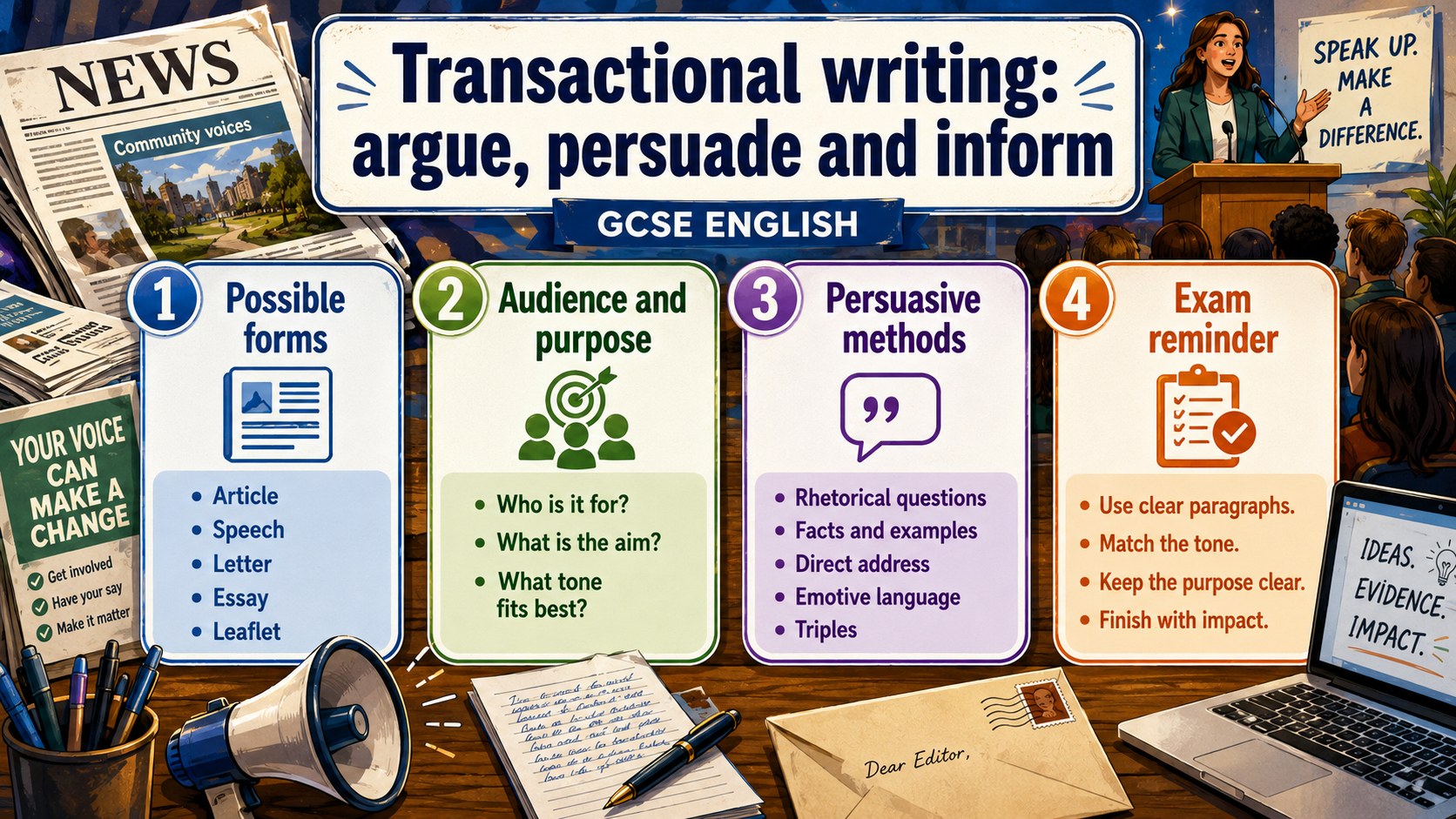
Transactional writing infographic
Before viewing
Before viewing, identify the purpose, audience and form of the writing task you are practising.
After viewing
After viewing, revise one sentence or paragraph so it better matches the task purpose and audience.
Clear explanation
Audience and purpose
Before writing, decide who you are addressing and what you want them to think, feel or do.
Form conventions
Use just enough convention: a letter opening, article headline or speech address. Then focus on argument quality.
Argument shape
Move from position, to reasons, to counterargument, to a clear final call or judgement.
Worked examples
Article opening
A headline plus a direct opening claim can establish topic and viewpoint quickly.
Speech opening
A direct address and rhetorical question can create an audience relationship.
Quick checks
Choose an answer, then check your thinking.
1. What changes most between an article, a letter and a speech?
2. Which opening best fits a speech to pupils about pressure?
Practice questions
Question 1
How would an article on the lido start?
Reveal answer and marking guidance
Answer: With a headline or opening claim that frames the public issue clearly.
Marking: Credit article convention.
Question 2
How would a speech on pressure start?
Reveal answer and marking guidance
Answer: With direct address to the listeners and a relatable opening example or question.
Marking: Reward audience awareness.
Question 3
How would a formal letter differ?
Reveal answer and marking guidance
Answer: It would use a clear recipient, controlled tone and specific request or argument.
Marking: Credit form convention.
Question 4
What should stay consistent across all forms?
Reveal answer and marking guidance
Answer: Clear viewpoint, paragraph control, evidence or examples, and accurate expression.
Marking: Reward transferable skill.
Answers and marking guidance
The exact practice answers are hidden under each question so you can try first. For transactional writing, reward form control: articles need shaped argument for readers, letters need a clear relationship with the recipient, and speeches need direct address, signposting and audience awareness.
Common mistakes
- Forgetting the form: signal the form early.
- Overdoing layout: marks come mainly from communication and accuracy.
- Flat viewpoint: make your position clear.
- Uncontrolled tone: match formality to audience.
Extension challenge
Write the same viewpoint as a speech opening, article opening and formal letter opening. Keep the idea the same but change the voice.
Reveal answer
Example answer: A strong set keeps the argument consistent while changing address, layout signals and tone to match each form.
Exam-board guidance
Transactional-writing questions may ask for an article, letter, speech, review or guide. Check the form, audience and purpose first, then adapt tone and structure before drafting.
AQA GCSE English
Check the mark value and assessment focus, then keep evidence and analysis tied to the exact question.
OCR GCSE English
Use precise references and organise the response around the command word rather than a memorised answer.
Pearson Edexcel GCSE English
Match the lesson skill to the relevant paper question, source, set text or writing form.
Eduqas GCSE English
Adapt the technique to the component your school is preparing for, especially timing and question wording.
WJEC Wales
Check whether your course uses current Wales-specific routes, then apply the same evidence and accuracy habits.
CCEA GCSE English
Use the unit focus to balance evidence, explanation, comparison, context and written accuracy.
Next lesson
Next, practise spoken language presentation.