
Lesson overview
A starting point for every later algebra topic.
Algebra notation lets you write general rules clearly. Substitution lets you use those rules with actual numbers, including formulae from real contexts.
What you will learn
Key facts before you start
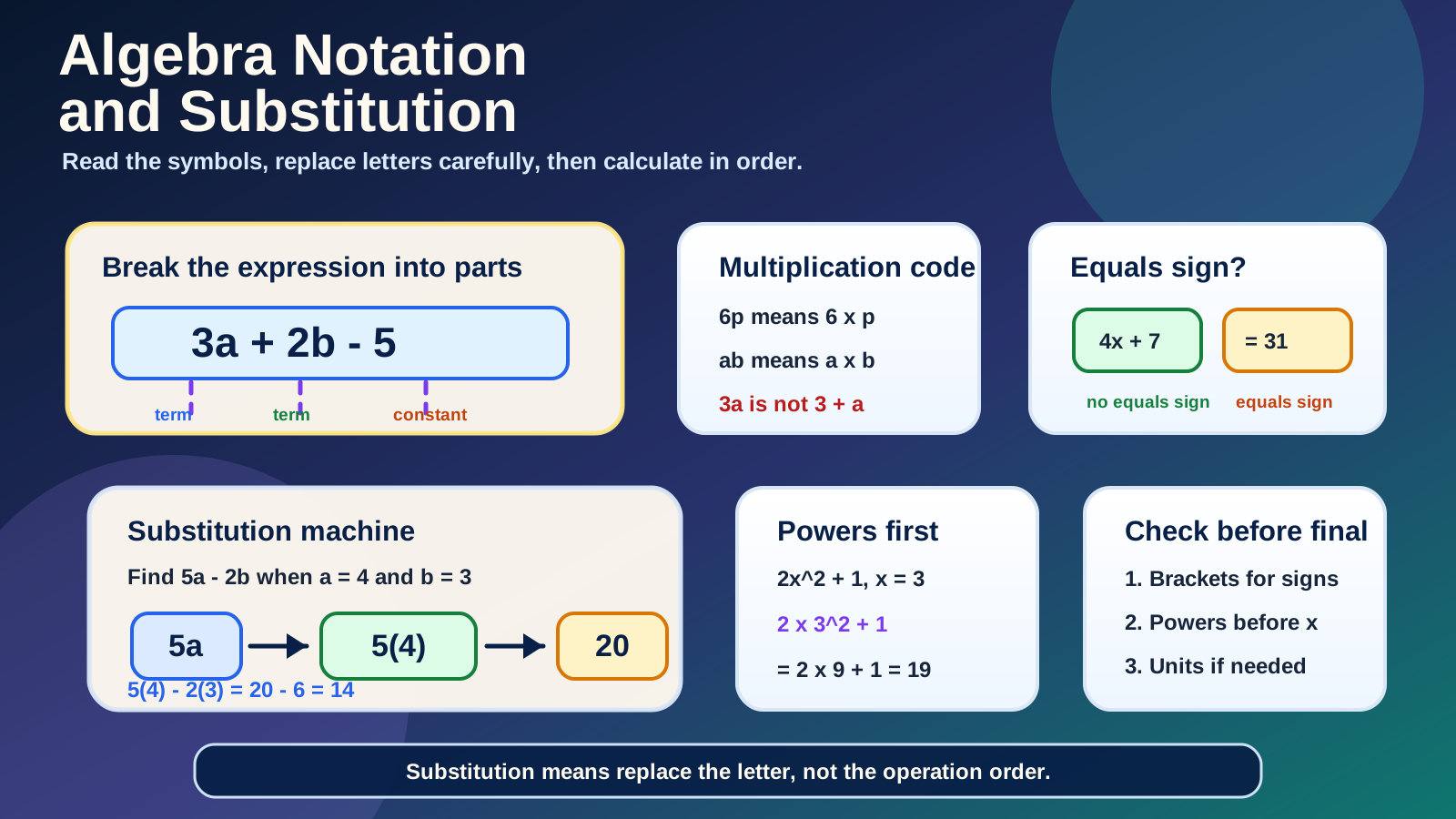
Algebra notation and substitution infographic
Before viewing
Before viewing, identify a variable, a coefficient and one substitution step in the visual.
After viewing
After viewing, substitute x = 4 into a simple expression and show the arithmetic step.
Why this matters
Algebra is a compact way of describing patterns and relationships. It appears in sequences, graphs, formulae, geometry, proportion and problem solving.
Most mistakes at this stage come from notation rather than difficult maths. If you can read the notation accurately, later algebra becomes much more manageable.
Prior knowledge
You should already be comfortable with:
Clear explanation
Variables, coefficients and terms
A variable is a letter that stands for a number. In GCSE Maths, letters such as a, b, n, x and y are often used as variables.
A coefficient is the number multiplying a variable. A term is one part of an expression, separated by + or − signs.
Expressions and equations
An expression is a mathematical phrase. It does not have an equals sign.
4x + 7 is an expressionAn equation says two things are equal. It has an equals sign and can often be solved.
4x + 7 = 31 is an equationMultiplication conventions
In algebra, multiplication is usually written without the × sign. This avoids confusion when x is being used as a variable.
Write numbers before letters, and write letters in alphabetical order where it is sensible: 5ab is clearer than b × 5 × a.
Powers in algebra
A power applies to the thing directly before it. In a², the letter a is multiplied by itself.
a² = a × a 3a² means 3 × a², not (3a)² (3a)² means 3a × 3aSubstitution
To substitute means to replace a letter with a number. A good habit is to rewrite the expression with brackets first, then simplify.
Order of operations after substitution
After substitution, use the normal order of operations: brackets, powers, multiplication and division, then addition and subtraction.
Brackets are especially useful with negative numbers.
If x = −3, then x² = (−3)² = 9 but −3² means −(3²) = −9Checking with units and contexts
If a formula comes from a real context, keep the units in mind. For example, if C = 2n + 5 gives a cost in pounds and n is the number of items, the final answer should be money.
n = 6 gives C = 2 × 6 + 5 = 17, so the cost is £17Worked examples
Example 1: Identify parts of an expression
In the expression 7x − 4, name the coefficient of x and the constant term.
7x means 7 × x, so the coefficient of x is 7 −4 is the constant termReveal answer
Answer: coefficient 7, constant term −4.
Example 2: Substitute into an expression
Find 5a − 2b when a = 4 and b = 3.
5a − 2b = 5 × 4 − 2 × 3 = 20 − 6Reveal answer
Answer: 14.
Example 3: Use powers after substitution
Find 3x² + 2 when x = 5.
3x² + 2 = 3 × 5² + 2 = 3 × 25 + 2 = 75 + 2Reveal answer
Answer: 77.
Example 4: Substitute into a formula with units
A taxi fare is modelled by F = 3d + 4, where F is the fare in pounds and d is the distance in miles. Find the fare for 8 miles.
F = 3 × 8 + 4 = 24 + 4Reveal answer
Answer: £28.
Quick checks
Choose an answer, then check your thinking.
1. What does 6p mean?
2. Which one is an equation?
3. Find 2x² + 1 when x = 3.
Practice questions
Question 1
In the expression 8m + 3, state the coefficient of m.
Reveal answer and marking guidance
Answer: 8.
Marking: 8m means 8 × m, so the coefficient of m is 8.
Question 2
Is 5y − 2 an expression or an equation?
Reveal answer and marking guidance
Answer: expression.
Marking: It has no equals sign, so it is an expression.
Question 3
Find 4a + 7 when a = 6.
Reveal answer and marking guidance
Answer: 31.
Marking: 4a + 7 = 4 × 6 + 7 = 24 + 7 = 31.
Question 4
Find 2p − 3q when p = 9 and q = 4.
Reveal answer and marking guidance
Answer: 6.
Marking: 2 × 9 − 3 × 4 = 18 − 12 = 6.
Question 5
Find x² + 5x when x = −2.
Reveal answer and marking guidance
Answer: −6.
Marking: (−2)² + 5 × (−2) = 4 − 10 = −6.
Question 6
A phone plan costs C = 12 + 4g pounds, where g is the number of extra gigabytes used. Find the cost when g = 3.
Reveal answer and marking guidance
Answer: £24.
Marking: C = 12 + 4 × 3 = 24. The answer is a cost, so use pounds.
Question 7
Find 6 − 2x² when x = −3.
Reveal answer and marking guidance
Answer: −12.
Marking: Use brackets for the negative value: 6 − 2 × (−3)² = 6 − 2 × 9 = 6 − 18 = −12.
Question 8
The formula A = bh gives the area of a rectangle in cm². Find A when b = 7.5 cm and h = 4 cm.
Reveal answer and marking guidance
Answer: 30 cm².
Marking: A = 7.5 × 4 = 30. The formula gives area, so the unit is cm².
Question 9
Find 5t² − 3t + 8 when t = −2.
Reveal answer and marking guidance
Answer: 34.
Marking: Use brackets for the negative value: 5 × (−2)² − 3 × (−2) + 8 = 20 + 6 + 8 = 34.
Question 10
The formula P = 2l + 2w gives the perimeter of a rectangle in cm. Find P when l = 8.5 and w = 3.
Reveal answer and marking guidance
Answer: 23 cm.
Marking: Substitute both values: P = 2 × 8.5 + 2 × 3 = 17 + 6 = 23. The formula gives a length, so the unit is cm.
Answers and marking guidance
The exact practice answers are hidden under each question so you can try first. For algebra notation and substitution, marks usually come from reading terms and coefficients correctly, replacing each letter with the given value, using brackets around negative substitutions, and simplifying in the correct order before adding units if the formula represents a context.
Common mistakes
- Reading 3a as 3 + a: 3a means 3 × a.
- Confusing expressions and equations: an equation has an equals sign; an expression does not.
- Squaring too late or too early: in 2x², square x first, then multiply by 2.
- Dropping brackets with negatives: if x = −4, write (−4) when substituting.
- Ignoring the context: if the formula gives a length, cost or time, include the correct unit in the answer.
Extension challenge
Find 3a² − 2ab when a = −4 and b = 5.
Reveal answer
Answer: 88.
Use brackets: 3 × (−4)² − 2 × (−4) × 5 = 3 × 16 − (−40) = 48 + 40 = 88.
Exam-board guidance
Algebra notation and substitution questions can test vocabulary, formulae, negative values, powers and units. The safest routine is to identify each letter, substitute with brackets where needed, then simplify in the correct order.
AQA GCSE Maths
Focus on the shared method, notation and checking habit; wording and context can vary by route.
OCR GCSE Maths
Show clear method steps and use precise notation; question wording may vary by route.
Pearson Edexcel GCSE Maths
Keep working visible and check units or notation; contexts may vary by route.
Eduqas GCSE Maths
Use the same core skill in practical contexts, with clear reasoning and final checks.
WJEC Wales
Connect the method to the context and state what the result means.
CCEA GCSE Maths
Make each method step visible and keep notation, units and final checks clear.
Next lesson
Next, move into Simplifying Expressions.