
Lesson overview
A practical skill for repeated percentage change and repeated numerical rules.
Growth, decay and iteration questions all involve doing a process more than once. The key is to identify the rule, apply it accurately, and round only when the context asks you to.
What you will learn
Key facts before you start
Why this matters
Many GCSE contexts change by a percentage each year, month or step. A savings account may grow, a car may lose value, and a population may increase or decrease.
Iteration uses the same repeated-step idea. Instead of a percentage multiplier, you are given a rule such as “multiply by 0.8, then add 6” and asked to keep applying it.
Prior knowledge
You should already be comfortable with:
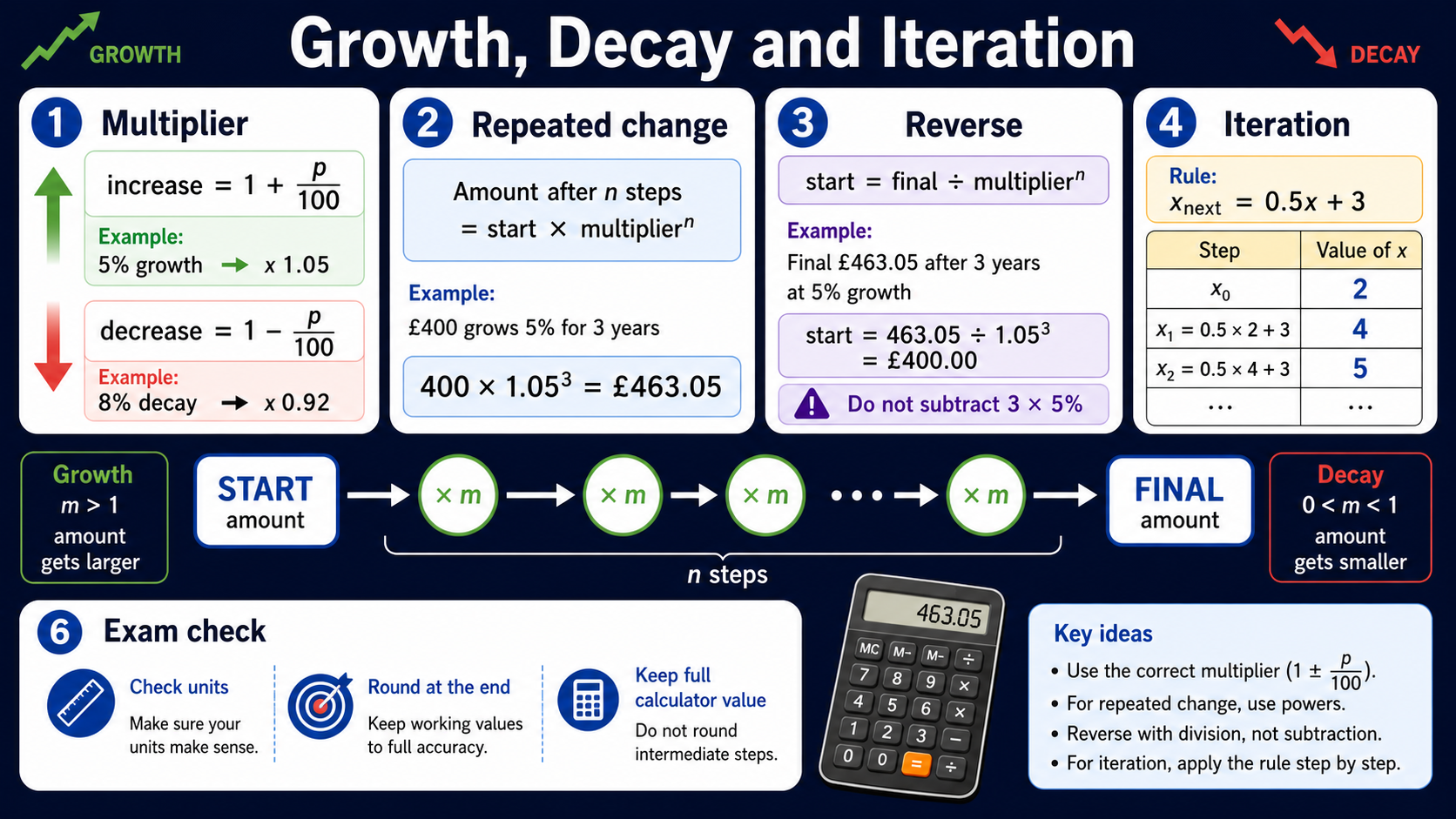
Growth, decay and iteration problems infographic
Before viewing
Before viewing, identify whether the multiplier represents growth or decay.
After viewing
After viewing, calculate two iterations and describe the direction of change.
Clear explanation
Growth and decay multipliers
Growth means the amount increases. Decay means the amount decreases. For percentage change, use a multiplier.
Repeated percentage change
If the same change happens again and again, apply the same multiplier again and again. Powers are a compact way to show this.
£600 growing by 5% for 3 years: £600 × 1.05³ £600 decreasing by 5% for 3 years: £600 × 0.95³The percentage is taken from the new amount each time, not from the original amount each time.
If a question has different percentage changes, use the multipliers in the order given. A decrease of 10% followed by a decrease of 8% is not the same as one decrease of 18%.
Reverse repeated-change questions work backwards from the final amount. Divide by the multiplier power instead of multiplying by it.
Appreciation and depreciation
Appreciation means something gains value. Depreciation means something loses value.
A bike worth £480 depreciates by 12% each year. After 2 years: £480 × 0.88² = £371.71 to the nearest pennyPopulation and context examples
In population questions, round in a way that makes sense. You cannot have part of a person, so a final population answer is usually rounded to a whole number.
A population of 12,500 grows by 3% each year. After 4 years: 12,500 × 1.03⁴ = 14,069.44... Estimated population = 14,069 peopleIteration as repeated steps
Iteration means repeating a rule. The output from one step becomes the input for the next step.
GCSE iteration questions usually reward careful substitution and clear organisation. A small table can stop you losing track.
Worked examples
Example 1: Repeated growth
A savings account has £900 in it. It grows by 4% each year for 3 years. Find the amount to the nearest penny.
growth multiplier = 1.04 amount = £900 × 1.04³ = £1012.3776Reveal answer
Answer: £1012.38.
Example 2: Depreciation
A laptop costs £750. It depreciates by 18% each year. Find its value after 2 years.
depreciation multiplier = 0.82 value = £750 × 0.82² = £504.30Reveal answer
Answer: £504.30.
Example 3: Population growth
A town has population 38,000. The population grows by 2.5% each year for 5 years. Estimate the population after 5 years.
growth multiplier = 1.025 population = 38,000 × 1.025⁵ = 42,995.02...Reveal answer
Answer: about 42,995 people.
Example 4: Iterating a rule
Start with u₀ = 5. Use the rule uₙ₊₁ = 2uₙ + 3. Find u₁, u₂ and u₃.
u₁ = 2 × 5 + 3 = 13 u₂ = 2 × 13 + 3 = 29 u₃ = 2 × 29 + 3 = 61Reveal answer
Answer: u₁ = 13, u₂ = 29, u₃ = 61.
Example 5: Reverse repeated decay
A tablet is worth £648 after depreciating by 10% each year for 2 years. Find its original value.
decay multiplier = 0.90 final value = original value × 0.90² original value = £648 ÷ 0.90² = £800Reveal answer
Answer: £800.
Quick checks
Choose an answer, then check your thinking.
1. Which multiplier represents a decrease of 15%?
2. Which expression gives 700 increasing by 6% each year for 4 years?
3. Start with u₀ = 4 and use uₙ₊₁ = 3uₙ − 1. What is u₂?
Practice questions
Question 1
A value of £240 grows by 7% for one year. Find the new value.
Reveal answer and marking guidance
Answer: £256.80.
Marking: growth multiplier = 1.07. Then £240 × 1.07 = £256.80.
Question 2
A car worth £12,000 depreciates by 20% each year. Find its value after 3 years.
Reveal answer and marking guidance
Answer: £6144.
Marking: depreciation multiplier = 0.8. Value = 12,000 × 0.8³ = 6144. The 20% is taken from the new value each year.
Question 3
A population of 18,600 decreases by 4% each year for 2 years. Estimate the population after 2 years.
Reveal answer and marking guidance
Answer: about 17,142 people.
Marking: decay multiplier = 0.96. Population = 18,600 × 0.96² = 17,141.76, so about 17,142 people.
Question 4
Start with a₀ = 10. Use the rule aₙ₊₁ = 0.5aₙ + 8. Find a₁, a₂ and a₃.
Reveal answer and marking guidance
Answer: a₁ = 13, a₂ = 14.5, a₃ = 15.25.
Marking: a₁ = 0.5 × 10 + 8 = 13; a₂ = 0.5 × 13 + 8 = 14.5; a₃ = 0.5 × 14.5 + 8 = 15.25.
Question 5
A collectible appreciates by 9% each year. It is worth £350 now. Estimate its value after 4 years to the nearest pound.
Reveal answer and marking guidance
Answer: £494.
Marking: appreciation multiplier = 1.09. Value = 350 × 1.09⁴ = 493.6..., so £494 to the nearest pound.
Question 6
Start with x₀ = 2. Use the rule xₙ₊₁ = xₙ² − 1. Find x₁ and x₂.
Reveal answer and marking guidance
Answer: x₁ = 3, x₂ = 8.
Marking: x₁ = 2² − 1 = 3. Then x₂ = 3² − 1 = 8.
Question 7
A machine is worth £2200. It depreciates by 10% in the first year and then by 8% in the second year. Find its value after 2 years.
Reveal answer and marking guidance
Answer: £1821.60.
Marking: use multipliers in order: 2200 × 0.90 × 0.92 = 1821.60. Do not combine the changes as one 18% decrease.
Question 8
Start with x₀ = 12. Use the rule xₙ₊₁ = 0.75xₙ + 5. Find x₁, x₂ and x₃.
Reveal answer and marking guidance
Answer: x₁ = 14, x₂ = 15.5, x₃ = 16.625.
Marking: x₁ = 0.75 × 12 + 5 = 14; x₂ = 0.75 × 14 + 5 = 15.5; x₃ = 0.75 × 15.5 + 5 = 16.625.
Question 9
A savings account grows by 3% each year. After 2 years it is worth £2652.25. How much was in the account at the start?
Reveal answer and marking guidance
Answer: £2500.
Marking: Two years of 3% growth uses multiplier 1.03². Starting amount = 2652.25 ÷ 1.03² = 2500.
Question 10
A phone is worth £640. It depreciates by 12% each year for 2 years, then appreciates by 5% in the third year. Find its value after 3 years to the nearest penny.
Reveal answer and marking guidance
Answer: £520.40.
Marking: Use the multipliers in order: 640 × 0.88² × 1.05 = 520.3968, so the value is £520.40 to the nearest penny.
Answers and marking guidance
The exact practice answers are hidden under each question so you can try first. For growth, decay and iteration, marks usually come from choosing the correct repeated multiplier, using powers for several equal time periods, following iteration steps in order, and rounding only when the question asks or at the final stage. For mixed changes, show each multiplier separately so the order of the changes is clear.
Common mistakes
- Using the percentage itself as the multiplier: 6% growth uses 1.06, not 0.06.
- Adding the same amount each time: repeated percentage change applies the multiplier to the latest amount.
- Using a growth multiplier for decay: a 12% decrease leaves 88%, so use 0.88.
- Rounding too early: keep full calculator values until the final answer unless the question says otherwise.
- Skipping the first iteration: find the next value, then use that new value in the rule again.
Extension challenge
A camera depreciates by 15% in the first year and then appreciates by 15% in the second year. Is its final value the same as its original value?
Reveal answer
Answer: No. Its final value is 97.75% of the original value.
Use multipliers: 0.85 × 1.15 = 0.9775. So the final value is slightly lower than the original value.
Exam-board guidance
Growth, decay and simple iteration questions are common GCSE problem-solving skills. Expect practical contexts, repeated multipliers, calculator powers, recurrence-style steps, sensible rounding and clear step-by-step reasoning.
AQA GCSE Maths
Focus on the shared method, notation and checking habit; wording and context can vary by route.
OCR GCSE Maths
Show clear method steps and use precise notation; question wording may vary by route.
Pearson Edexcel GCSE Maths
Keep working visible and check units or notation; contexts may vary by route.
Eduqas GCSE Maths
Use the same core skill in practical contexts, with clear reasoning and final checks.
WJEC Wales
Connect the method to the context and state what the result means.
CCEA GCSE Maths
Make each method step visible and keep notation, units and final checks clear.
Next lesson
Next, move into Algebra Notation and Substitution.