
Lesson overview
An extension algebra topic where fraction rules and factorising meet.
Algebraic fractions are fractions with letters in the numerator, denominator, or both. GCSE questions may ask you to simplify them, multiply or divide them, add or subtract them, state excluded values, or solve equations that contain them.
What you will learn
Key facts before you start
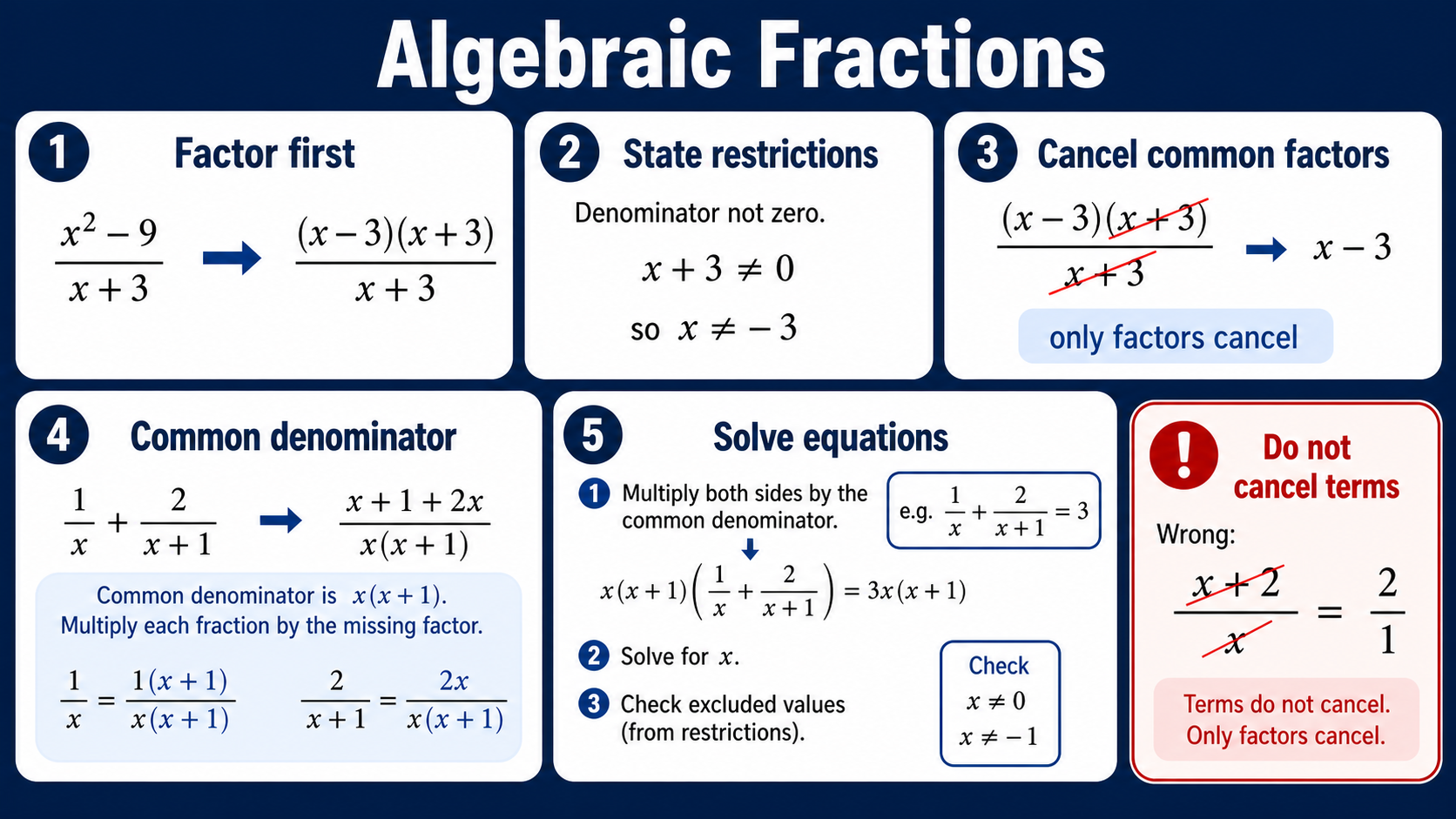
Algebraic fractions infographic
Before viewing
Before viewing, find the denominator and say which value would make it zero.
After viewing
After viewing, simplify one algebraic fraction and state any excluded value.
Why this matters
Algebraic fractions appear in advanced GCSE algebra because they combine several important skills: factorising, equivalent fractions, expanding brackets and solving equations.
The key idea is calm and familiar: do not cancel terms just because they look similar. Cancel common factors only after the numerator and denominator have been factorised.
Prior knowledge
You should already be comfortable with:
Clear explanation
Denominators cannot be zero
A fraction is undefined if its denominator is zero. For 5x − 3, the denominator cannot be 0, so x cannot be 3. If a factor cancels later, the original excluded value still matters.
Simplifying algebraic fractions
Factorise first, then cancel common factors. A factor is something multiplied by the rest of the expression.
Factorising before cancelling
If the numerator or denominator has more than one term, factorise it before cancelling.
Adding algebraic fractions
To add or subtract, make a common denominator first, then combine the numerators.
Dividing algebraic fractions
To divide by a fraction, multiply by its reciprocal, then factorise and cancel common factors.
Solving equations with algebraic fractions
Multiply every term by the common denominator to clear the fractions, then solve the equation.
Always check the original denominators after solving. If your answer would make any original denominator equal zero, that answer must be rejected.
Worked examples
Example 1: Simplify by cancelling a common factor
Simplify 8a12.
8a12 = 2a3Reveal answer
Answer: 2a3.
Example 2: Factorise before cancelling
Simplify x² + 5xx.
x² + 5xx = x(x + 5)x Cancel the common factor x.Reveal answer
Answer: x + 5, where x ≠ 0.
Example 3: Multiply algebraic fractions
Simplify 3x4 × 89.
3x × 84 × 9 = 24x36Reveal answer
Answer: 2x3.
Example 4: Add algebraic fractions
Simplify 1x + 23.
1x = 33x and 23 = 2x3xReveal answer
Answer: 3 + 2x3x, where x ≠ 0.
Example 5: Subtract with bracketed numerators
Simplify x + 43 − 2x.
x(x + 4)3x − 63x x² + 4x − 63xReveal answer
Answer: x² + 4x − 63x, where x ≠ 0.
Example 6: Solve and check restrictions
Solve 4x − 2 = 1.
x cannot be 2 because the original denominator would be zero. 4 = x − 2 x = 6Reveal answer
Answer: x = 6. This is allowed because 6 − 2 ≠ 0.
Quick checks
Choose an answer, then check your thinking.
1. What must be true for 4x?
2. Which step should usually come before cancelling in x² − 4x − 2?
3. To add 1x and 12, what do you need first?
Practice questions
Question 1
Simplify 15x20.
Reveal answer and marking guidance
Answer: 3x4.
Marking: Divide numerator and denominator by the common factor 5.
Question 2
Simplify 12a²18a.
Reveal answer and marking guidance
Answer: 2a3, where a ≠ 0.
Marking: Cancel the common factor 6a from top and bottom.
Question 3
Simplify x² − 16x + 4.
Reveal answer and marking guidance
Answer: x − 4, where x ≠ −4.
Marking: Factorise x² − 16 as (x − 4)(x + 4), then cancel the common factor x + 4.
Question 4
Simplify 5x6 × 1225.
Reveal answer and marking guidance
Answer: 2x5.
Marking: Multiply to get 60x over 150, then simplify by dividing by 30.
Question 5
Simplify 3x + 25.
Reveal answer and marking guidance
Answer: 15 + 2x5x, where x ≠ 0.
Marking: Use common denominator 5x: 3/x becomes 15/(5x), and 2/5 becomes 2x/(5x).
Question 6
Solve 6x + 1 = 2.
Reveal answer and marking guidance
Answer: x = 2, with x ≠ −1.
Marking: Multiply both sides by x + 1 to get 6 = 2(x + 1), then solve 6 = 2x + 2.
Question 7
Simplify x + 24 + 3x.
Reveal answer and marking guidance
Answer: x² + 2x + 124x, where x ≠ 0.
Marking: Use common denominator 4x. The first numerator becomes x(x + 2), so keep brackets until it expands to x² + 2x.
Question 8
Solve x + 35 = 2x − 13.
Reveal answer and marking guidance
Answer: x = 147 = 2.
Marking: Multiply by 15 to get 3(x + 3) = 5(2x − 1). Expand to 3x + 9 = 10x − 5, then solve 14 = 7x.
Question 9
Simplify x² + 3xx² − 9.
Reveal answer and marking guidance
Answer: xx − 3, where x ≠ 3 and x ≠ −3.
Marking: Factorise to x(x + 3)(x − 3)(x + 3), then cancel the common factor x + 3. Keep both original restrictions because x² − 9 cannot be zero.
Question 10
Simplify x² − x − 12x² − 16, stating any values that x cannot take.
Reveal answer and marking guidance
Answer: x + 3x + 4, where x ≠ 4 and x ≠ −4.
Marking: Factorise to (x − 4)(x + 3)(x − 4)(x + 4), then cancel the common factor x − 4. Keep both original restrictions because x² − 16 cannot be zero.
Answers and marking guidance
The exact practice answers are hidden under each question so you can try first. For algebraic fractions, marks usually come from factorising before cancelling, keeping original denominator restrictions in mind, building a valid common denominator, and using brackets around multi-term numerators. If you solve an equation with fractions, show the line where every term has been multiplied by the common denominator and check the answer against the original denominators.
Common mistakes
- Cancelling terms instead of factors: in x + 3x, the x in the denominator is not a factor of the whole numerator.
- Forgetting restrictions: if a denominator contains x, say when x cannot make the original denominator zero.
- Combining fractions without a common denominator: add or subtract only after the denominators match.
- Losing brackets: when multiplying a whole numerator, keep expressions like 2(x + 5) in brackets until expanded.
- Only multiplying one side of an equation: clearing fractions means multiplying every term on both sides.
Extension challenge
Simplify x² + 7x + 12x² − 9, stating any values that x cannot take.
Reveal answer
Answer: x + 4x − 3, where x ≠ 3 and x ≠ −3.
Factorise the numerator to (x + 3)(x + 4) and the denominator to (x − 3)(x + 3). Cancel the common factor x + 3, but keep both original denominator restrictions.
Exam-board guidance
Algebraic fractions are assessed across GCSE Maths boards as more demanding algebra. The same method marks matter everywhere: factorise, use common denominators, bracket whole numerators, keep denominator restrictions visible, reject impossible values and write each algebra step clearly.
AQA GCSE Maths
Focus on the shared method, notation and checking habit; wording and context can vary by route.
OCR GCSE Maths
Show clear method steps and use precise notation; question wording may vary by route.
Pearson Edexcel GCSE Maths
Keep working visible and check units or notation; contexts may vary by route.
Eduqas GCSE Maths
Use the same core skill in practical contexts, with clear reasoning and final checks.
WJEC Wales
Connect the method to the context and state what the result means.
CCEA GCSE Maths
Make each method step visible and keep notation, units and final checks clear.
Next lesson
Next, move into Geometry and Measures with Angles, Lines and Parallel Lines.